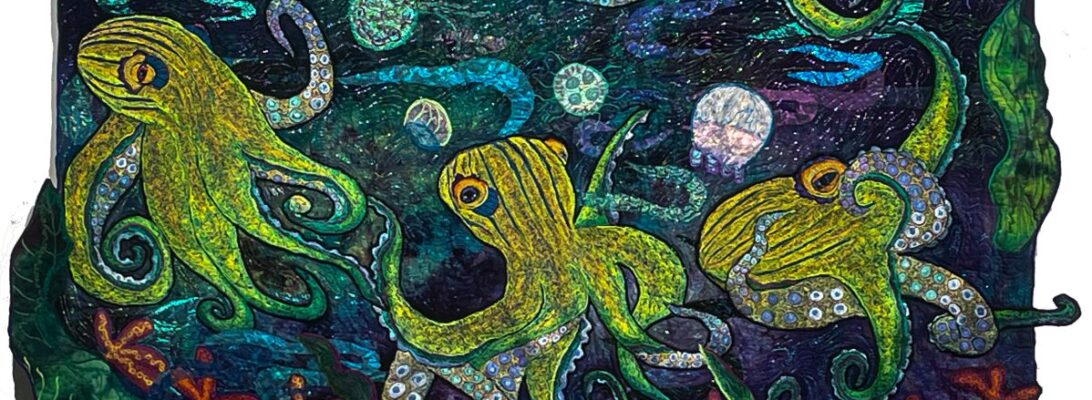
I’ve been waiting for a while to finish this quilt. Right now it’s all pinned together. All the components are finished, but not stitched down.
Branches are always hard for me. I’m more comfortable with leaves, but the leaves need to sit on something. And this heron needed a nice dead branch to stand on as she surveys her pond.
I think it’s harder because it’s more abstract. I’m not quite sure how to do the portrait of a tree. So I start with a shape, and I’m trying to make an interesting bark.
I’ve tried some slash applique for branches. I tried that first. I used two layers of hand dye with felt and Stitch and Tear as a stabilizer. I was trying to get the grain of the wood to wrap around the branch.
I stitched it down, straight stitch, trimmed out the shape, stitched in grain lines, and slashed the top layer. Then I hand ironed them with a point turner so they would stand upright, and stitched along the seam.
Once I sliced through the top layer, I roughed up the fabric with the edge of my mustache trimmer. The mustache trimmer was not on, but the blade on it made a nice surface to make the edges fray a bit.
I don’t consider it a success. I don’t like the shape and I don’t like the direction of the bark.
So I did it again. This time I used three layers of cotton, and stitched vertical lines much closer together. I didn’t really savage the upper layers. Instead, I sliced through them like chenille. I tried several methods but it really was easier just with scissors. I roughed it up with the trimmer as well.
This isn’t appliqued down yet, but I’m so much happier with it. The other branch will work in a forest floor piece, but not here.
There is a legend that if you fold a thousand cranes, it will change you. Your pain will be relieved. Your luck will change. This repetitive action will change your life.
I had a visitor to the studio remark that there were a lot of processes in each quilt I made. There are. Dyed fabric, oil paint stick rubbing, painted sheers, dyed cheesecloth, free motion applique, direct sheer applique, and then we quilt.
That does represent a lot of busyness on my part. I like the complexity. I want a piece to be exciting when you see it from a distance and exciting if you are inches away from it.
With that said, there is a lot of donkey work. Yesterday, I cut rocks. I use the leftover pieces of fabric that are rock colored and cut them into rocks of several different sizes, waiting for the right quilt. Repetitive. So much of art is. A lot of art is creating a surface, a color, a shape, a texture that makes the piece something splendiferous. That takes a lot of repetition.
I have a price list where I document quilts by size, when they were finished and given a number. The latest quilt is numbered 1125-23, which means it’s the 1,125th quilt made since 1987. I’m going to claim them as my 1,000 cranes. What I’ve learned from 1,125 quilts is that the action of creating something over and over in different ways does change us. Art changes us because it helps us tell our stories in a different light and see ourselves in a different way. But we come to that by a series of actions that seem to be the same thing over and over. If we want the benefit of change and regeneration, it takes a sustained effort. In the Screwtape Letters, C. S. Lewis said we were not capable of any sustained action, only of the undulation towards a goal. According to Screwtape, Undulation is the repeated return to a level from which we repeatedly fall back, a series of troughs and peaks. God relies more on troughs because it makes us rely on God.
Art is a holy process. It’s a place of honesty, effort, and repetitive actions in hopes of reaching the peaks despite the troughs. What I have learned from 50 years of quilting is that the troughs simply have to be waded through like mud, with the actions over and over again that create our art and ourselves.
Tuesday, I’m going into the hospital to have a stent put in to fix my blockage. I have good hopes, but I can’t say I’m not nervous. But the waiting and the work on my quilts has soothed that some. It’s an office procedure. I expect to be home the same night.
So I do what I do when I’m nervous. Or happy. Or sad. Or confused. I make more quilts.
Last Friday night, we opened my show at the Peoria Art Guild! It was a lovely opening. Lots of folk. Lots of friends. Lots of artists I just met. I couldn’t have been more pleased. Or more humbled.
For all of us, who do art seriously, it’s a really private process. Even if you share your process online or in class, there are some things you really do in a very private space. All the left turns, small errors, large disasters and turn-arounds happen in that private space with presumably no one watching.
I’ve never felt very precious about that. I treat my mistakes as learning curves and have always tried to share them, just as a point of being real with students and other artists. It’s especially true if you teach. You owe people the truth about your process.
But when it’s in front of the public that feels very exposed. All the things you wished were better, smoother, flatter are out there, just as they are.
It reminds me what art is for. Art is about retelling our story. It’s the ability to see our world in a way that changes us, and the things around us to be stronger, better, more beautiful, more whole, more brave inside or out. And the journey we take as a storyteller is much more transformative than the story itself. and an inscrutable process, all of its own.
I love when my friends come to a show. They’ve walked with me sometimes close by, sometimes at a distance as I’ve made this work. It’s as much a part of them as it is me.
I love when I meet other artists in this same inscrutable process, doing something no one ever thought of doing before and finding their way to put it into being. They are a privilege. The glimpses we share of our processes are like watching thoughts take form, flesh, and flight.
And then there are the people who come to see that transformation. And respond. I’m always humbled that the images I have to work with have meaning to other people. And grateful for their kindness. This was a huge gift for me, and I want to thank the Peoria Art Guild, Shannon, John and Jeff, and Dana for opening this amazing opportunity for me. And Don for his endless help and support!
So come see the show! It will be up for the month of September. And come join me next weekend for classes. We’ll learn how to make Fantasy Flowers and Bobbinwork Dragonflies next weekend. And talk about how to build a visual pathway through your art.
Tomorrow I have my first sole artist showing in over 10 years, I’ve been working for this for 2 years.
Tomorrow I will be at the Galesburg Art Center for a sole artist Pop Up Sale. I’ll have threads, fabrics and quilts all on sale for the day. Out in public.
Sometimes your art is your life. Sometimes your life is your art. I’ve had many people tell me they weren’t an artist, or that they no longer could do their art. I did not understand that when I was younger. I leapt from one project to another, I lived and breathed dye and thread.
But it changed. At one point I was teaching more than I was showing. And that was an obsession too. I opened as many good doors as I could for the people in my classes. Demoed daily on unfamiliar machines. Learned to help people find their way to do what they were working towards.
And then it changed. There weren’t the same opportunities. The teaching slowed. And the passion for my work was gone. I sank into the sunset, learned to knit and crochet, Dealt with my far too worn knees.
It got kind of grim. There are times when your art is your life. But when it isn’t, you really do have to make your life an art. Find ways to feed your eye. Ways to make your heart beat. Allow things to go fallow, I wrote three books, which I believe have probably annoyed everyone who read them. Raised a garden and some neighbor kids. Kept a pack of greyhounds. And I pretty much stopped quilting.
That was when Don came into my life. I’ve never been a believer in love in terms of a noun. I believe it as a verb. It’s not a thing, that you own. It’s actions made on choice. It was an astonishment.
Alumni and Faculty Book Signing; Homecoming 2018
I knew Don at college. But I don’t think either of us knew each other at all. He stood by me as I got my knees fixed. Three knees later, he gave me his home as a studio. And came with me every day as I worked on one piece after another. He opened doors for me I thought were shut forever. I don’t have words for it, but thank you is a start.
When I announced this show, someone posted on the list that she hadn’t heard from me in years and she thought I was retired. I wrote her back that I hadn’t died yet.
It’s changed. I’m in that place where I can’t stop working. I’m on fire. There are resurrections. I’m still here.
I don’t remember who made the post. But I have some hopes for her.
I hope she has a passion that lights her life. I hope that when her life changes, as life does, she finds good things that heal her heart. I hope she understands that she is a human being and not a human doing. That we all have times when we can produce things and times when we cannot.That there are ways back, not to where we were but to what is next.
I hope she gets a resurrection too.
Tomorrow, August 27th, I’ll be at the Galesburg Art Center, 341 East Main Street, in Galesburg, IL from 9:00 to 3:00. I desperately need to sell some things. I’m out of dye, steam a seam, fabric and steam. But being out of things means I working as hard as I can. I am so grateful. To be able again.
I don’t piece well. It’s not my skill. Anything that takes accuracy and careful cutting really isn’t my skill. The new 770 Bernina came with a foot that does make it better, but I don’t normally do large pieced tops. I know better. It’s not pretty when I do.
But there are rare occasions when I piece a split light source top.
Why? Why walk into accuracy land and piecing?
A light source brings you fabric with direction, and a built-in world. That world can be integral by itself. But if you want to filter the light as if it were through haze, woods, or shadow, you can piece two light source fabrics to create that shaded look. There are several approaches, with different effects.
Vertical Piecing
Where the Heart is
Where the Heart Is was pieced from two separate yards of the same blue/orange color range. I lay both pieces together on the cutting board and cut them in gradated strips, 2″, 3″, 4″, etc. Then I sewed them together with the narrowest light of one to the widest side of the other, in gradation. Set in a vertical arrangement, it makes for light flowing through the trees.
Horizontal Piecing with a Frame
Envy
Envy was one horizontal light source yard, split in gradations with a half yard cut in 2″ strips put between. The piecing creates a sense of space. The narrowest strip in the gradation defines the horizon line.
Piecing within Multiple Frames
Sometimes I split the two fabrics with the light at the widest on one side and the dark widest cut so they can carry the light across the piece. Twightlight Time was also double framed with a 2″ and a progressive border. Having a narrower border on the top weights the bottom of the piece.
Piecing Machines
Lately, Don found me a Singer 99 at a yard sale. For those of you not familiar with these darlings, they are a featherweight industrial drop-in bobbin Singer. They only straight stitch, but the stitch is impeccable. They are tougher, and faster and they use bobbins that are still commercially available. I’d never seen one before, but I fell in love instantly. It took a little work and some creative parts searching, but Don got it working for me and it’s perhaps the best piecing machine I’ve ever had. Did I mention Don is my hero?
So I pieced the guinea hen’s background on it.
How do you keep it straight? It’s tricky. If I get them out of order the fabric doesn’t progress correctly through its colors. I make all my cuts, leave the fabric on the cutting board until I can number the pieces all on the back side. Since there are two pieces of fabric cut, I label my fabric, 1a,2a, etc. and 1b, 2b, etc. and chalk in the sequence on the ends so I can always keep them in order.
Expanding Fabric Size
Sometimes there’s just a beautiful fabric that needs to be bigger. That’s been known to happen too.
I needed a background for What the Flock, a grouping of guinea hens. I’m low on fabric and money right now, so I have to make do. I found a purple piece that should make a great meadow, but a yard was just a bit small. So I pieced in another half-yard to expand it. I cut the half yard in 2.5″ widths and graded the yard-long piece in segments of 9″, 8″, 7″, 6″, and 5″,
Seam Rollers
For those of you like me, who hate to run back and forth to the iron, there is a seam roller. You can use this gadget to flatten your seams right where you’re sewing. Roll it over the seam and you’ll have flat, ready-to-sew seams without the iron woman run.
I don’t piece often, but these backgrounds are worth it. I love the shaded light and the action of light of the fabric across the piece.
This blog is taken from a blog from several years back. Somehow, the pictures got removed, so I’m revising it and putting it up where it’s available. Of all the things I do as an art quilter, I’m very proud that I’m not confined by binding. This lets me make any shape quilt I wish, in any color binding I want.
I started out as a traditional quilter. And for years, I bound all my quilts with bias tape. But as my work became more organic, it felt terribly strange to put my work in a square box. None of my work fits in rectangles. It grows organically. It should be allowed to grow off the edge.
The corded buttonhole is a standard technique from couture sewing, translated from there to the quilt world. It gives us a way to finish both quilts and art clothing in a new way that’s literally out of the box. Instead of the square edges and gentle curves that are the limit of bias binding, we have the freedom to follow any shape. That means that the edge of our pieces is not defined by straight lines, but by their internal design. It also means a quilt can have an external shape that fills a wall in a much more exciting way. giving the negative space around the quilt impact. And because our binding is thread, we have the full range of polyester thread colors for our palette.
I prefer to do this on my Bernina because of the specific feet and the stitch quality. You can use a regular utility foot and a couching foot off another kind of machine.
We’ll be using two basic feet for our binding.
What largely counts is the thread escape on the bottom of the buttonhole foot.
The #1 foot has a top groove we can use to couch down the cord. It’s your standard zigzag pressure foot.
The #3 foot has a thread escape groove on the bottom for the zigzag stitching to pass through. The #3 foot is the older style buttonhole foot (without the electronic eye)that has exactly the right thread escape to accommodate the buttonhole binding.
No matter where I put the couching thread, it lands on the floor while I’m stitching. If you have floors like mine, a yarn bowl will help keep your crochet cotton clean. The thread will spool evenly as you’re couching.
You’ll need
#3 Crochet cotton
A quilt/ or quilted object backed, quilted and ready to bind
Polyester #30-40 weight embroidery thread the color of your choice
A#3 foot and a #1 foot, or a regular presser foot and a couching foot
A zigzag sewing machine
A rotary cutter and mat
A yarn bowl
Binding
We’ll bind our piece with a corded binding that’s basically a corded buttonhole all around the edge.
Preparing your quilt:
Stitch around the edge either with monofilament nylon or with a neutral embroidery thread so that all the layers are together
Your piece doesn’t have to be rectangular or square. It can be any shape at all. To keep sharp 45-degree corners or points, you need to clip the tips off them.
Using your rotary cutter, cleanly cut away all the extra bat and backing fabric, exactly the shape you want your quilt to be. You want all the edges to be clean. You will lose around a quarter inch in the binding.
Thread your machine top and bottom with a polyester embroidery thread of your choice. You can use rayon or metallic thread, but the breakage tends to make things so much more difficult. I prefer Madiera Polyneon and Isacord.
Attaching the cord:
Set your machine on a zigzag stitch, with the needle position one position over from full left. Your stitch length should be set at almost the widest width.
Position your quilt so the stitch falls just over the right-hand edge of your quilt. Thread the crochet cotton through the top of the foot.
Start your stitching somewhere in the lower edge, not on a corner or direct curve.
Zigzag your cording all around the edge.
When you come to the end, drop your feed dogs and make several stitches to anchor the cord.
Clip your threads and cord.
Tip: If you have a quilt that is ruffling at the edge just a bit, you can pull the cord and gather in the ruffle. This will not solve severe distortion problems, but it will fix minor ones. You need to pull the cord before you change directions or turn a corner.
Corners, curves and points:
These all take a bit of finesse. Your standard buttonhole stitch isn’t set up to cover them. But you can get good coverage on them by rocking your stitch over them. As you’re stitching, you can pull back just a bit from the front to make sure your stitch line covers everything. Curves may also need that assistance. For corners and particularly for points, stitch up to them and turn the piece at slightly different angles as you go round the edge. You can put the needle down within the point and pivot and stitch several times until you have coverage.
Covering the cord:
Your second pass should cover your cord with smooth zigzag stitching. Flip your piece over and start on a straight section.
You’ll find certain areas may not have been included in the stitching. This will give you a chance to address that.
Set your sewing machine for the widest stitch it will give, and the densest stitch length it can handle. Put your needle position to the far left.
Use your #3 foot, with the double channel thread escape.
Position your quilt so that the stitch to the right ends over the edge of your quilt
Start at a lower edge, not on a corner or a curve.
Stitch around the edge of your quilt.
When you come to the beginning, move your needle position to the far left, set it onto a straight stitch, and stitch in place to anchor the stitching.
Sometimes I get enough coverage on the second pass, but that’s rare. Usually, it takes a third time around. Turn the piece over. If you still have wisps sticking up through the binding, trim them as best you can, and go around another time. I’ve been known to do four passes to get a smooth, solid cord. Turn your piece over each time to get better coverage.
Your color choice defines the edge of the quilt. If you match the center of your quilt, it will have no visual border. The piece appears to drift off the edge. If you contrast it strongly, it stops right at the edge. If you pick a color that softly blends in with the piece, the edge is visual, but softer, blending the edges into the wall. There is no right or wrong. Just the result you want for that piece.
Tips:
A clean-cut edge to your piece is always easier to cover with stitching. Use your rotary cutter and make a nice, solid cut line. Trim curves with sharp scissors.
Use a new topstitching #90 needle for the best stitch and for less thread breakage.
Apply Sewers Aid to the thread to help with thread breakage.
Organic quilts don’t have to be stuck in a box. A corded buttonhole binding lets your quilt go over the edge.