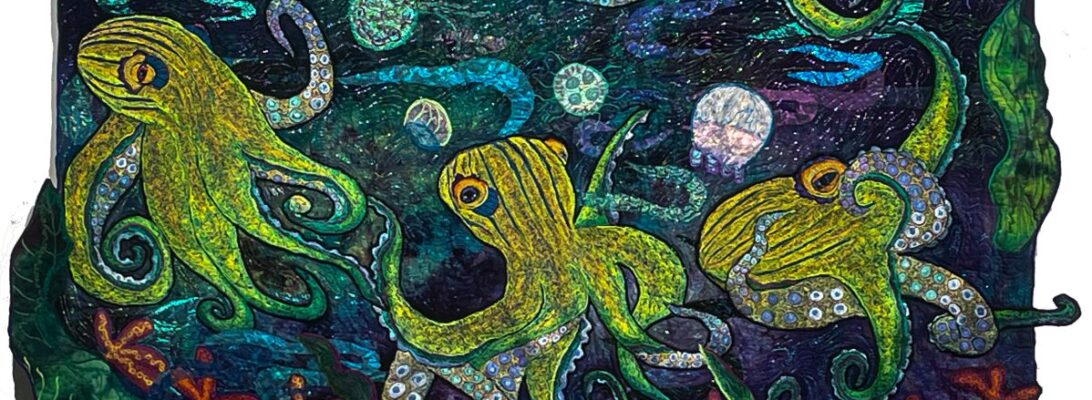

Do You Need an Industrial Sewing Machine?

This has been a burning question for me over the last 6 months. I live and die by my sewing machines. It’s what I do. I sew every day around 4-5 hours a day.

Over that time, I;ve locked up 2 220s, 2 930s and a 770, all Berninas known to be tough and durable. I’ve felt like a general who’s horse has died, getting on another horse and inadvertently shooting the new one. It’s been ghastly.

What it’s about is the intense embroideries. They feel like the heart of my work. They’re intense, detailed, textured, and, pardon my vanity, show stopping.

I can’t seem to make them without breaking machines.

I went through this a long time ago. I burned the brushes off my 930 and bought an industrial 20U Singer. It was not a perfect answer. It was way too fast. It chomped through thread. It was incredibly noisy. And impossible to control.

Eventually, I stopped making those larger embroideries.

Lately I’ve needed to work those large embroideries. And we rescued the 20 U from where I left it at Porter.

It was the right decision. Don put a servo motor on it to slow it down. It did a very nice job with my #40 polyester threads.

What is a servo motor?

I’m not sure of the mechanics of the thing. Functionaly it’s an industrial motor with a rhiostat. You can adjust the speed to your taste. It’s infinately more quiet, and takes up a lot less energy.

I wouldn’t say it was the right thing for everyone.

What can an industrial machine offer you?

It is

  • An incredibly tough machine
  • An incredibly fast machine
  • An extra wide zigzag stitch

Those are very different skillls from a home machine.

There is a down side.

  • They are huge. They take up a large footprint in studio space.
  • They are harder to manuver. I’m still finding my way about managing stitch angle with it.
  • Unless you slow them down, they’re too fast for many threads and applications. The servo motor is the best way to control that.
  • You can’t pick it up and take it to a mechanic. You’ll need to fix it yourself or find a mechanic who does house calls.
  • They’re kind of crude. They’re rough machines mechanically. Simple to work with but they’re not sophisticated.

Don made this work for me by installing a servo motor. That motor is a miracle. So is Don. I’m grateful for both.

Am I sorry to be working with an older machine? No. They don’t change that much. As far as the changes in machines over the last 50 years, the most important one was being able to set needle up, needle down. With the servo motor, it’s in excellent fighting shape. These machines are indestructable.

Am I thrilled? Yes. Downside and all, I can tackle those big pieces without making a collection of broken sewing machines. Will I use if for everything? Probably not. Again, hard to control.

Want to come play with my new machine? Give me a call and come over. It’s like running a tyranasarus that sews.

Try, Try Again:

This is about keeping old work. It’s also about process shots. And it’s about putting things down and picking them back up when the time is right.

There are pieces that never work out. I don’t have a bunch of hopeless little piles in the studio, but there are some. This is one that is old enough that I don’t even have process shots of the disaster.It could vote. If I had process shots, Id know better what I did.

There are 200 fountains in Kansas City in around a four block area. I got to walk there one afternoon. I’m always a water baby. I was mesmerized. I saw a fountain with a cat head that blew my mind. Not the largest fountain. But all I could think of was birds flying through it. Owls. Spoonbills. Swallows. Chickens. Fantasy birds flying over an old stone fountain.

I had to try it.

It bombed. I couldn’t make the fountain. I’m not good at man made structures. I just didn’t have the chops. And I had no Idea how to make flowing water. It took me almost nine months to figure out that I couldn’t figure it out.

That kind of exercize is bad for moral. I never throw things out, but I must have thrown this out. I can’t even find the cat head I embroidered for it. Had I kept process shots and left the pieces alone, I could show you. As it is, you’ll have to imagine. It was hopelessly rumpled and the fountain looked like it was made by 2 3 year olds ready for naptime.

Fast forward 15 years. I rubbed a series of grey texturized fabric for some abandoned city pieces. I wanted birds flying over it. Sounds familiar, doesn’t it? J’d come back to my cat head fountain.

There is an instinct to run. To say it’s too hard. To just back away.

But I’ve decided not to.

What has changed?

  • I do my embroideries separately now so I get much less distortion
  • I can do the fountain as a separate applique and applique it as well
  • I’m much more secure with falling water. I’ve done it now and feel confident I can do it again.
  • I now use oil paint stick rubbing to create old carved stones.
  • I’m working with a better stabilizer (Decor Bond, Stitch and Tear, and Felt)

Strangely enough, I was able to find a picture of the fountain online. Not available five years ago. Somethings just get better.

Will that matter?

It might, It’s worth a try. When an old idea still has that kind of heat behind it, it’s important. It needs to be worked with. We begin to transform ourselves when we interact with images that somehow connect strongly. Most strongly, when those images scare or upset us, but also the ones that delight us. Creating an image gives us some power over what we create. It changes our story. It changes us. All those cave men drawing Bisons can’t be that wrong.

Currently I’m working on embroidering the three swallows, visiting the fountain. While the fountain is a mundane ordinary thing, the birds are anything but. I did them in rainbow colors, because they are the fantasy past all that mundane cold stone. They are delight on a gray cold day.

I originally wanted one with owls and one with roseated spoonbills. I still might.

I’m going to continue this in several posts, because it’s clearly a journey for me, and I’d like to share it with you. Let me know what you think.

Too Large: Managing Big Quilts

I love big quilts. I know my definition of big is not large for those doing bed quilts. I consider a 45″ x 36″ piece large. This is a big larger than that, probably around 45″ square.

I also am terrified of them. A large quilt is a commitment. It’s at least 2 weeks- 2 months of time and energy. If it works, that’s fine. If it isn’t, that time, energy and material is lost. It’s not exactly wasted. It’s education, and education has its costs. But it is demoralizing.

There are also a lot of components in this piece: the spoonbill, fish, birds, wisteria, and iris fronds. They can all look great if they’re place precisely. Placing them precisely is not simple. You have to look at it up on a wall.The view on a quilt on a flat surface is distorted. You can’t see the design well enough.

So a larger piece is a bit scary. They’re harder to design, because it’s harder to see what you’re doing. So I took my time on this piece. The bird is great. Getting her into her pond is a bit harder.

I’ve pinned this piece up 3 times. Partially because needed to use the wall for something else. Partially because I wasn’t sure. In the end I ended up tilting the legs and the iris leaves to emphasize the visual path on this.

This is where a black and white picture comes in. Seeing things in black and white makes a lot of things more clear. I get distracted in the color, and the black and white shows what really is and isn’t popping.

Hopefully she’s in her proper place. She’s mostly stitched down, so it’s what it is.

Sheen!

We talk alot about contrast. Contrast creates all the excitiment in our work. We think about contrast in color, in dark and light, and in shapes. All of those play a big part in how we view a piece of art.

But there is a more subtle form of contrast: sheen. The first thing your eye sees is not the color or the form. It sees how shiny things are. The sheen separates everything from anything that isn’t shiny. It helps the eye comprehend what it’s seeing, what is important.

The easiest way to think about this might be the hardware paint department. You can get paint that is matt, paint that is eggshell, and paint that is high gloss.

Unlike the paint, there are a lot more subtle differences. Thread and fabric have large variations in shine.

In this piece I used several shades of iridescent organza. This is pure fairy dust. Cut in short lengths it makes Angelina Fiber.

Angelina fiber is more blingy. The organza is one step down on the blingometer. It’s a bit hard to work with in terms of color. It acts like any other organza for applique. I fuse it on with Steam A Seam 2, and stitch it with a soft monofilament edge.

The trick is that it picks up the colors around it. It’s not at all the color you see on your cutting table. And it shines like a neon star. These are the atmospheric appliques that form the water reflection. The moon is white. The ripples are a light blue. And the dark is a deep cobalt. It’s not what you’d expect. But I love it.

You do need to tone it down a bit so that isn’t the only thing people see. How to do that? If you can’t beat them, join them.

The fish applique are metallic thread and have a different sheen. But for the background, i covered it with Sliver stippling. Sliver is lurex as a thread. It looks like Christmas tinsel. It acts like an anaconda in heat. But if you put it in the bobbin and stitch from the back it is easy to work with

The result is that it’s all so shiny it fits in. Which is where I added leaves that are matt, just for contrast.

How do I know if I did it right? I take a black and white photo. If it’s all visible and it balances, I’m there. I almost always take a black and white photo of a piec when I pin everything up, because that’s when I can make my corrections most easily.

For more information on working with Sliver, you might want to look at Skimming the Surface: Bobbin Work with Silver.

There’s No Antidepressant Like Color. Except for a New Machine

For those of you who have been following along, you know we had a machine crisis for most of last year. It turns out that what I’m doing is really hard on machines. I’m finding my modern machines are just not up to the challenge.

Enter Ebay and Don!

Don found me a newly restored 930 Bernina, It’s a love. It’s still not a strong enough machine for the denser embroideries, but that’s ok. We have a servo motor for the old industrial Singer 20u. Don says he will be ready to start the switch on the motors perhaps next week.

1169-25 In the Shell

So in celebration for the new baby, and because I finally had the right tool, I got In the Shell finally bound.

Do you remember the feeling when you got a new box of 64 crayons? That’s a large enough number that they had some with silly names like Mac and Cheese. Open up the box. Choose your color. Instant antidepressant!

This quilt had the same effect. It got me through machine withdrawal, over the last months.

Madiera has a line of polyester embroidery thread called Neon. It isn’t all neon color. There are restrained greys and browns. But there are some kick ass oranges, yellows, greens, pinks, and reds, You get the idea.

This quilt was a mood lifter. Partially because I love the idea of a baby octopus in a shell, and partially because the colors could knock socks off.

Between the machine and those colors, I’m feeling so much better now.

Never be afraid to use the brightest, boldest colors. They’re not only lovely. They’re good fiber for your diet. And they fight depression. Eat the rainbow!

I See Spots: Knots and Dots

In a world where sewing machines have automatic cutters, do we need to tie off thread ends?

It’s certainly a time saver to have an automatic cutter. But how good are they? And what do your ends look like once they’re cut?

My 770 Bernina has a thread cutter. I love it when it works. That is part of the issue. But it’s instant, and happens at the push of a button. It does speed things up.

But there are other things lost.

Using an automatic cutter, it works equally well either working from the top or the back.

You can really only tie threads working from the back, unless you’re willing to pull all the threads to the back to tie them. Why go to the bother?

It depends on how you feel about poking up threads, and what kind of threads you are using.

Thread types

I use three kinds of thread for building most images: polyester 40 weight, wound metallic, and flected metallic. I could use rayon, but it breaks more than I want to put up with. I could use cotton, if I could tollerate the fact that it isn’t shiny. So those are my go-tos

Polyester thread is strong. Because it’s all of one piece, it doesn’t fray very much. It’s a softer than metallic.You can clip it right to the edge. You’ll have some poke up but it isn’t wirey.

All metallic thread is different. Since they’re wound of several components, even the best of them are relatively fragile threads, And it frays. The wound metallic is worse than the flecked thread. IF you clip them close. they pop up like the little wires they are, and leave obnoxious poke up endings.

Just because metallics are fragile, I tend to use metallics only from the back side. Thread breaks more through the needle than through the bobbin. But, as a side effect, you can pull the threads to the back and tie them.

It that tiresome? Oh, yes. It slow down your stitchery considerably.

That being said, nothing else looks like metallic thread. It’s a texture that is crisp and shiny. Did I mention that I like shiny?

Is it worth it? It all depends on how you feel about fuzzy threads poking up from the top.

Pulling threads

For this fish, with all his spots, I felt it was essential. I wanted a smoothly scaled surface with separated spots. You can sew all the spots at once and have stitching connecting them through the piece. It works if you intend to stitch heavly over the connections. It tends to be a bit thicker than I like. So each spot was stitched separately and tied off, start and finish. If I just clipped thread, the fish would look furry before I finished.

Could I have stitched in one place and anchored my thread that way? I’m never sure about that. Sometimes I’ve seen it hold, sometimes not. Tieing is sure.

How to pull up thread

  • Come to the end of your stitching line.
  • Pull the piece 4-5 inches away from the needle, with both top and back thread attached.
  • Place the piece under the machine needle exactly where you stopped.
  • Move the wheel through one stitch. when the needle comes up, take the top thread from both where the stitching stops and from where you put in the last stitch.
  • Pull the thread from both places, and your thread will pop to the top of your piece.
  • Cut the ends long enough to make a knot.
  • Tie top and back threads together
  • Clip after the knot

So here is my beautiful fish, ready to jump in the pool. He’s all tied together, and he’s sleek in his metallic finish. And nothing is poking up, laughing at him.

Is it fussy? Well yes. But if it gets the look you want, isn’t that the point?

She Sells Sea Shells: A Study in Contrast

I haven’t made a lot of shells before. Starfish, yes. Jellyfish, inevitable. I find shells daunting. They’re not easy to draw, and they can’t be made to look like they’re moving. So this was an experiment.

Designg for contrast

One way to look at design is how to separate the field from the ground. You need to create differences that help the eye sort out what it’s looking at. The shells should be immediately different from the octopus and the sea.

This quilt required a shell for the octopus, And a tangible difference between them to be visually clear. The way to make things pop is to create a visual difference between differnt design elements of color, texture and size.

The color palate makes a clear separationg. The octopus is strongly orange, contrasted by the complemetary blue sea, and the off white and browns of the shells.

But we can make that contrast even stronger through the texture. Texture is made by stitching patterns, thread content, and thread size. Those design decisions clarify the design.

Shells are deeply textured with a smooth inside. I didn’t show the shiny insides of these shells. So the outsides needed to be crunchy and rough.

So the octopus is garnet stitch in polyester thread. The shells are out of both wound and flecked metallic threads. The threads contrast strongly. Metallic thread is much rougher than the smooth polyester. Both threads are 40 weight.

I also used a zigzagged scallop pattern for the shells. I stitched the rows irregularly with ribbed veins, so they’d seem more natural.

The water is stiched with an 8 weight metallic to separate it from the shells and the octopus.

Thread choices help the eye separate the shells, the octopus, and the water, ‘It helps your viewer unnderstand what is happening in your piece in a glance.

This piece is ready to back and bind. I’m just waiting for a cool enough day.

Saint Don of the Dead Sewing Machine

This is a cautionary tale. I’m hoping someone can learn from my mistakes.

Maybe you can sew too much.

This has been a bad year for sewing machines. I’m trying to figure out whether I’m really sewing that much more or whether it’s attrition, or just bad luck. I’ve broken 3 220s, been told my 770 is worn out at 31 million stitches (in four years) and had two 930s break down.

My mechanic has two of my machines in shop. I was down to working with a 807 minimatic. I love my mechanic. She’s meticulous. On average, she takes 2 months to fix a machine. It’s not an instant fix.

For this discussion, I’m leaving brand names off the machines. You’ll probably know what the numbers mean. They are all machines known for their tough durability. That doesn’t seem to be enough right now.

Thank you, God, for Don.

I knew Don had worked on vacuum cleaners in the deep dark past. I didn’t understand what that meant. Don is a small motor specialist. Sewing machines are about small motors. He had fuddled with several older machines and got them working. I had no idea how skilled he was.

I had two 930s. One was my machine from when I started. I picked up the second because the first was soooooooo good.

I had put them up on the rack and not used them for a while. But as machines kept going down it got more desperate. We pulled them down, decided which was less beat up. It sewed like a top for around a month and then locked. We brought out the second machine, made some adjustments. I got two months out of that. Then it jammed.

I was so upset I couldn’t even cry.

In came St Don. He watched a bunch of videos, took both machines apart. We saw what was fixable, and was not. Then we had the kind of transplant surgery where really only one patient survived. He dusted it off, I oiled everywhere and now I have Frank En 930. But it’s working.

What did I learn?
What would I say to anyone doing the kind of embroidery I’m doing?

  • Skip the bells and whistles. You need something tough. I do think most of the machines today are much more fragile.
  • If you have a machine that’s working for your craft, don’t ever turn it in for another machine. It’s not necessarily able to do the same things for you.
  • If you have an older machine that’s working for you, find an extra one for a parts machine. It doesn’t need even to run. But it means you have the parts to fix things, even down to the right screws.
  • You’ll probably need someone like Don. You can’t have him but you can find a reasonable facsimile. If you do, feed him plates of brownies and videos. Other treats may be applicable. You need someone able and willing to hunt the snark (whatever is wrong with your machine), and brave enough to take the back off the machine. I’m fixing his third batch of cookies today. We can’t let him run out.

My next sewing machine

This has changed how I feel about my machines. Instead of looking for the great new features (which are a wonder) I’m looking for something with alligator blood. Pulling out my 40 year old Berninas was a really good patch on this.

So I pulled out another old machine I hadn;t even moved with me when I moved to Ga;lesburg. Luckily, the man renting my house had left it in a safe place and not disposed of it. A 20 u is the machine I bought when I blew the brushes off my 930 for the first time. It’s the machine you’d find at a drycleaners. Very fast. Uncontrolable except for straight stitch clothes construction. In the end, I stopped doing the elaborate embroideries.

But those are at the heart of what I’m currently doing. I can’t give them up. They are at the heart of my art right now. They are the flame I’m drawn to.

Things change. My threads and stabilizers have changed since then. And what is available for a fix has chnged too.

I’m putting a servo motor on my 20u industrial to see if we can tame that machine to a reasonable speed for embroidery. And I’m looking for another 930. Other than for demo, I’m done with plastic toys.

Don, neither plastic or a toy, is a total keeper. So he is now St Don, for healing the halt, the lame, and the blind stitch.

A Great Frame up: Centering a Design with a Frame

One of the things that’s hard about a circular image is that it doesn’t move very easily. As a design. Circles lie like a lump unless you put them in a row or on a path.

I love this octopus in a shell, but it was static. There are several ways to create motion in a piece. Creating a visual path with rocks or shells would have worked. But I wanted something showier.

The best piece of fabric I had was a half-yard of blue hand-dye. But the shell didn’t fill it up. I could cut it to fit the shell. But a square wouldn’t work

So I decided to make a frame. But a rectangle was no better. There’s nothing square about an octopus. They flow with the ocean tide. They exude curves.

So if I wasn’t going to put the octopus in a rectangle or a square of some kind.

I needed to apply a different aesthetic. When you need design help, go look at great art. They knew what they were doing.

I’m a huge fan of Art Nouveau.

“Art Nouveau is …known for its flowing, organic shapes, curved lines, and reliance on natural motifs like flowers and plants. The movement aimed to unify all artistic disciplines, creating a holistic design experience.” Wikipedia

Art Nouveau has always made my heart beat faster. Natural organic forms that flow in movement, are based on the oriental concept of the visual path and movement make perfect sense to me.

I hadn’t seen an Art Nouveau octopus before. Japanese art is full of them. But tentacles would make a marvelous frame.

One thing about octopuses is that you don’t always see all of them. They hide, they move, they twist in the water. They don’t stay in one place while you take their picture. So I made three tentacles of another octopus, encircling the one in the shell.

Besides, the tentacles interact with the rest of the water and the jellyfish.

This is all pinned up and ready to stitch. I hope none of it splashes into the studio.

Not every frame is a box. A frame centers your design, accentuates it, and interacts with it. It is there to put the subject in the center of attention. Who says you have to be square?