Marching On: Struggling Along to New Tech

Detail of fish in water elements

I have to say that this week has left me exhausted. My new to me 930 froze mid stitch, and I am, again. scrambling. Currently working are the 220 and the 20 U Singer.

If it sounds like a first world problem, you’re probably right. But I sew every day, usually around 3-4 hours a day. It’s more than a job. It’s not quite an adventure. It’s certainly my mental health.

When I was teaching, occasionally I’d get a student who would ask me how to do something. Usually it was an amazing idea. But I’d never tried it. I was sorry to tell them I didn’t know exactly how to do that, but that they eventually would. Art is not all about inspiration, and public statements. It’s often fed by the ability to hunt the snark, find a way to make things as you wish. It’s damn hard work.

But if it’s important enough, you find a way. And many artists have the decency to make their journey available to others, so that our art grows, not just in volume or in content but in ability. It’s why we write. It’s why we teach.

If I said that to you in class at one point, I apologize profusely. Just because it’s true doesn’t mean it’s what you wanted to hear. And I thank you for not having hit me.

The art quilt movement rebuilt quilting. Part of it hunted down old skills: hand stitching, hand quilting, pattern pieces, paper piecing and the like. Part of it is new tech: rotary cutters, machine work, computer design, different materials and stabilizers, different threads.

This is not the glamourous part of art. It’s grueling. Try one thing, try another. Look for an answer. Take the best compromise you’ve got.

Edging with three hoops on the 20U

I’m currently working on a koi fish quilt, working title, Upstream. It includes a kick ass koi and waterfalls over cliffs. I’m proud to say I figured out how to do the detail stitching on the 20 U. It involved 3 metal stackable hoops. I’m waiting with some anticipation for my Maggie Frame to arrive. It may really change the whole hooping process

The hoops are important because I can’t get a foot to work on the 20 U. The one foot that works won’t deal with the thickness of the quilt sandwich. Other feet I tried didn’t work with the machine or allow for a zigzag stitch.

For those not familiar with how sewing machines work, your machine will not form stitches if your fabric isn’t held taunt. Your pressure foot usually provides that stability. Without it, something else has to hold your fabric tight. Hense, the hoop. This video does a nice job of explaining how a stitch forms.

So I have to figure out the hoop thing.

On another front, my new crashed Bernina 930 is in pieces soaking in machine oil. I’m sure we’ll figure it out.

Stitched down with water elementals

I’m struggling with finding ways to utilize the Singer 20U. I added in my cliffs, direct applique with the 20U, using that stack of hoops. It’s a less elegant stitch line, but it worked.

Next steps: stipple in, add water splashes, back, quilt and bind.

A Big Hooping Deal

20 U Singer Industrial

Those of you who follow me know I’ve been working on getting the 20 U Singer industrial to work for zigzag embroideries. I’ve been positive about it, although that’s been more of an affirmation than a reality. We’re still not there yet.

I spoke with a mechanic last week who said, “You can’t get that machine to do that.” He’s speaking out of his experience, but I’m feathered if I let a little thing like someone’s experience stop me. Besides, I did used to work large embroideries on this machine. It went too fast, it broke thread and needles right and left, but I could use it with a screw tight embroidery hoop.

We’ve solved the broken thread fast issue with a servo motor. That’s working quite well.

But did I mention I hate hooping? Stitch three inches, move the hoop. Stitch another three inches. It’s painfully slow. This is the front and back of my test piece. The moth is straight stitch. The squiggle is zigzag. A hoop will work, without a foot.

Maggie Frame

Which is why I’m ecstatic about the hoop I purchased today. Maggie Frame is a magnetic hoop set for embroidery machines. But I don’t see any reason why I can’t use it free motion. The hoop snaps and is held in place with magnets. This video gives you an idea how it works.

Here is a comparison between the Maggie Frame and Mighty Hoop.

The sandwich I’m using to embroider is a layer of hand dye, felt, stitch and tear and totally stable. Stuffing that into a screw down hoop is hopeless. This video showed them hooping four layers of terry towels. I can’t wait!

I’ve ordered a 10″ x12″ hoop. As always, I’ll share my journey with you as I try this new tech out.

Cheesecloth: What Grade Is It In?

20 weight cheesecloth with organza trapped underneath

I’ve used cheesecloth for years. It’s an unexpectedly versatile sheer that dyes beautifully, takes iron heat, and fuses easily. It’s a studio staple for me. When I dye other fabric, I almost always dye a fresh batch of cheesecloth.

40 weight cheesecloth flower

But I wasn’t aware that there were different kinds. No one ever mentioned that it came in different grades. I just bought the box I found at Joann’s. If it had a grade marking, I missed it. My guess is that it would have been perhaps grade 40.

The grades have to do with the purpose of the cheesecloth. As the name suggests, it’s about how it’s used in food prep.

This is a quote from the Organic Cotton Market

Grade 10: The thinnest and most open weave, ideal for applications requiring good airflow and water drainage, such as straining some types of broth or when a very open weave is needed for crafting. 

Grade 40: A versatile medium-weight cheesecloth, good for general food straining, polishing, and crafting. 

Grade 50: Another versatile option, often used for food prep and crafts. 

Grade 60: Suitable for straining, polishing, and cleaning, and is also used in testing for fire hazards. 

Grade 90: The most durable and tightly woven, suitable for tasks requiring strength and fine filtration, like making cheese or nut milk. It’s also washable and reusable, making it a good choice for repeated use in the kitchen. 

Grade 100: The highest grade, providing the tightest weave and greatest durability. 

The grade number reflects the number of threads per square inch, with higher numbers indicating a denser weave according to Organic Cotton Mart. For example, Grade 10 has 20 x 12 threads per square inch, while Grade 90 has 44 x 36 threads per square inch according to Online Fabric Store.  “

The box I bought before must have been a 1. It was wide open, pilled easily and very formless.

#20 Cheesecloth pine trees.

My last box was 60 You can actually iron it onto fabric without a pressing cloth.

Your best clue for unmarked cheesecloth is the usage they suggest for it. If they’re making craft ghosts out of it, you know it’s a lower grade. If they’re straning jam with it, it’s a 90-100,

60 weight cheesecloth leaves

What will I do with that information? I’m almost tempted to have several grades in the studio for different applications. Cheesecloth is my go to for leaves and flowers. Nothing is as light or as easy to iron on and the texture is fabulous. But it never occurred to me that it came in different textures. I have a fish that will need some surf to swim through. It may end up as cheesecloth to the rescue.

Arkwright Cheesecloth was the one that was most clearlly marked on Amazon, and the widest number of choices.

For more information about cheesecloth, check out The Miracle of Cheescloth: Not Just for Turkey Anymore

Walking a Visual Path: How Does The Design Invite Us Into Our Art

I’ve been a long time follower of the visual path. Our eye travels through a piece of art and makes its own journey. We can build that visual path with our objects and their placement.

A good visual path

  • should welcome you into that world,
  • should give you a good tour, covering the surface of the piece.
  • should graciously show you the way out.
  • should breathe.

But part of that pathway is perception. How does the structure of the design direct us to travel on that path? Where do we start?

There are some other good questions as well. What makes an entry point? How do we travel? Are we released from the piece at some point? Or does it try to make us stay focused within the piece?

I’ve begun to think about how we enter a piece when we see it. Where does the eye start? Does it make a difference? Being a good dyslexic, I always thought it didn’t, but I’m thinking I was wrong.

As Westerners, we read left to right. So do we enter a project visually from the left and travel over to the right hand side? And what does that do within the language of the piece? What does that positioning tell us?

Handedness is pretty hardwired, but some of it is cultural. We can see an image either from either left or right like flipping a slide. But how do we normally process that?

What matters is what we see first. Where does it direct us to look?

If it faces directly in front of us, that sort of stops the motion right there. We are where we are.

If the subject is facing us, headed left, we see it as the main object.

If the piece is standing facing from left to right, we see it as a main object, but we also see what it is focused on.

The entry point is either a spot that focus us for being open, or for grabbing our attention.

For our purposes, the red arrow is the entry point and the yellow arrows point out the path.

The entry point here is the from the view of our subjects. Everything carries them along in their quest. The movement is all left to right.

The bird is our entry point. We see what she sees. She’s focused on a pond beneath here.The rocks circle the pond, defining it, but also drawing our eye around it.

Our entry point leads us straight to the mocking bird facing left. . Her glance takes us around the piece following the lizards.

This is just a theory so far. I’m curious what you think about it. How does the facing of the subject change the story of the piece. What is the structural language? What are we saying?

So this is drawn with the eyes facing left. When it’s embroidered, it will be flipped horizontally and it will face to the right. We’ll be in a position to see the world as the fish does.

I’m not sure about this yet. It’s a theory. I’m curious to see what you think as well.

For more information about visual paths, check out It’s the Little Things Building a Visual Path

Try, Try Again:

This is about keeping old work. It’s also about process shots. And it’s about putting things down and picking them back up when the time is right.

There are pieces that never work out. I don’t have a bunch of hopeless little piles in the studio, but there are some. This is one that is old enough that I don’t even have process shots of the disaster.It could vote. If I had process shots, Id know better what I did.

There are 200 fountains in Kansas City in around a four block area. I got to walk there one afternoon. I’m always a water baby. I was mesmerized. I saw a fountain with a cat head that blew my mind. Not the largest fountain. But all I could think of was birds flying through it. Owls. Spoonbills. Swallows. Chickens. Fantasy birds flying over an old stone fountain.

I had to try it.

It bombed. I couldn’t make the fountain. I’m not good at man made structures. I just didn’t have the chops. And I had no Idea how to make flowing water. It took me almost nine months to figure out that I couldn’t figure it out.

That kind of exercize is bad for moral. I never throw things out, but I must have thrown this out. I can’t even find the cat head I embroidered for it. Had I kept process shots and left the pieces alone, I could show you. As it is, you’ll have to imagine. It was hopelessly rumpled and the fountain looked like it was made by 2 3 year olds ready for naptime.

Fast forward 15 years. I rubbed a series of grey texturized fabric for some abandoned city pieces. I wanted birds flying over it. Sounds familiar, doesn’t it? J’d come back to my cat head fountain.

There is an instinct to run. To say it’s too hard. To just back away.

But I’ve decided not to.

What has changed?

  • I do my embroideries separately now so I get much less distortion
  • I can do the fountain as a separate applique and applique it as well
  • I’m much more secure with falling water. I’ve done it now and feel confident I can do it again.
  • I now use oil paint stick rubbing to create old carved stones.
  • I’m working with a better stabilizer (Decor Bond, Stitch and Tear, and Felt)

Strangely enough, I was able to find a picture of the fountain online. Not available five years ago. Somethings just get better.

Will that matter?

It might, It’s worth a try. When an old idea still has that kind of heat behind it, it’s important. It needs to be worked with. We begin to transform ourselves when we interact with images that somehow connect strongly. Most strongly, when those images scare or upset us, but also the ones that delight us. Creating an image gives us some power over what we create. It changes our story. It changes us. All those cave men drawing Bisons can’t be that wrong.

Currently I’m working on embroidering the three swallows, visiting the fountain. While the fountain is a mundane ordinary thing, the birds are anything but. I did them in rainbow colors, because they are the fantasy past all that mundane cold stone. They are delight on a gray cold day.

I originally wanted one with owls and one with roseated spoonbills. I still might.

I’m going to continue this in several posts, because it’s clearly a journey for me, and I’d like to share it with you. Let me know what you think.

She Sells Sea Shells: A Study in Contrast

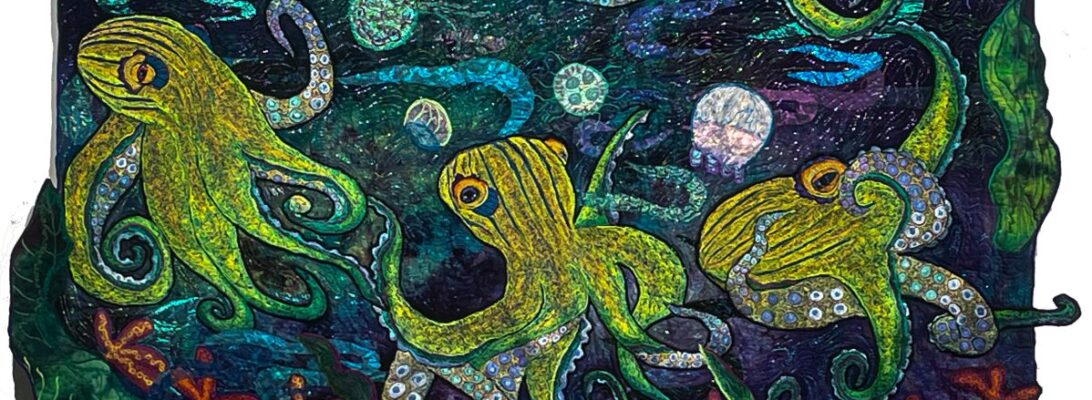
I haven’t made a lot of shells before. Starfish, yes. Jellyfish, inevitable. I find shells daunting. They’re not easy to draw, and they can’t be made to look like they’re moving. So this was an experiment.

Designg for contrast

One way to look at design is how to separate the field from the ground. You need to create differences that help the eye sort out what it’s looking at. The shells should be immediately different from the octopus and the sea.

This quilt required a shell for the octopus, And a tangible difference between them to be visually clear. The way to make things pop is to create a visual difference between differnt design elements of color, texture and size.

The color palate makes a clear separationg. The octopus is strongly orange, contrasted by the complemetary blue sea, and the off white and browns of the shells.

But we can make that contrast even stronger through the texture. Texture is made by stitching patterns, thread content, and thread size. Those design decisions clarify the design.

Shells are deeply textured with a smooth inside. I didn’t show the shiny insides of these shells. So the outsides needed to be crunchy and rough.

So the octopus is garnet stitch in polyester thread. The shells are out of both wound and flecked metallic threads. The threads contrast strongly. Metallic thread is much rougher than the smooth polyester. Both threads are 40 weight.

I also used a zigzagged scallop pattern for the shells. I stitched the rows irregularly with ribbed veins, so they’d seem more natural.

The water is stiched with an 8 weight metallic to separate it from the shells and the octopus.

Thread choices help the eye separate the shells, the octopus, and the water, ‘It helps your viewer unnderstand what is happening in your piece in a glance.

This piece is ready to back and bind. I’m just waiting for a cool enough day.

A Great Frame up: Centering a Design with a Frame

One of the things that’s hard about a circular image is that it doesn’t move very easily. As a design. Circles lie like a lump unless you put them in a row or on a path.

I love this octopus in a shell, but it was static. There are several ways to create motion in a piece. Creating a visual path with rocks or shells would have worked. But I wanted something showier.

The best piece of fabric I had was a half-yard of blue hand-dye. But the shell didn’t fill it up. I could cut it to fit the shell. But a square wouldn’t work

So I decided to make a frame. But a rectangle was no better. There’s nothing square about an octopus. They flow with the ocean tide. They exude curves.

So if I wasn’t going to put the octopus in a rectangle or a square of some kind.

I needed to apply a different aesthetic. When you need design help, go look at great art. They knew what they were doing.

I’m a huge fan of Art Nouveau.

“Art Nouveau is …known for its flowing, organic shapes, curved lines, and reliance on natural motifs like flowers and plants. The movement aimed to unify all artistic disciplines, creating a holistic design experience.” Wikipedia

Art Nouveau has always made my heart beat faster. Natural organic forms that flow in movement, are based on the oriental concept of the visual path and movement make perfect sense to me.

I hadn’t seen an Art Nouveau octopus before. Japanese art is full of them. But tentacles would make a marvelous frame.

One thing about octopuses is that you don’t always see all of them. They hide, they move, they twist in the water. They don’t stay in one place while you take their picture. So I made three tentacles of another octopus, encircling the one in the shell.

Besides, the tentacles interact with the rest of the water and the jellyfish.

This is all pinned up and ready to stitch. I hope none of it splashes into the studio.

Not every frame is a box. A frame centers your design, accentuates it, and interacts with it. It is there to put the subject in the center of attention. Who says you have to be square?

Wisteria Blossoms

Sometimes hand-dye designs your quilt for you.

I had embroidered a radiated spoonbill landing, and I needed a background for her. This purply brown piece seemed nicely swampy and I loved the range of purple running in an arc through it. It looked like a bower of wisteria, so that’s what I went through.

I’ve done wisteria before. I sometimes feel I can smell them in the studio as I stitch on them

I wanted particularly soft glowing wisteria for this very dark swamp. These were done mostly from hand-painted lace, stitched with poly neon.

And small bright birds sitting in them.

On thing leads to another. The bird leads to the swamp background. The swamp leads to a wisteria bower. And the wisteria need bright little birds.

Wisteria, like roses, sunflowers, and hollyhocks, are part of the garden of my dreams. I can’t help but slip them in wherever their fragrance and illumination are needed.

The next step is to fit everything in together with a pond at the bottom, birds, and small fish.

On the other side of the studio, we have 2 torn-up 930 Berninas. Don has been heroically deciding which will live and which will be a parts machine. I’m working on the only functional embroidery machine, an 807 Bernina from around 1970. It’s a tiny machine, originally for classroom. We’re waiting for the resurrection, which sometimes spreads more slowly than you would like. It means I’m not able to work the 2 large quilts I have laid out at the moment. So….

An ocean floor, several external tenacles lots of jellyfish, I think. On a much smaller piece of fabric.

fluffy: Making Feathers with the Long and Short Stitch

This is what I did this week. She’s a secretary bird.

I have to thank John Muir Laws book Law’s Guide to Drawing Birds for its descriptions and information about different kinds of feathers. I’ve been pleased with my pinions, tails and wing feathers for some while, although I wanted them to be less stripey.

I like these pinions. But even with overstitching, they look a bit stripey to me. I’ve been working at overcoming that look by more irregular uneven stitching on the feathers and overstitching.

Body feathers are different. They’re fluffy. They aren’t a part of the flight system. Instead, they are a body cover.

The Long-Short Stitch

I went back to an old embroidery stitch pattern that gave me exactly what I needed, The long short stitch is made by moving your hands unevenly from side to side with your stitching. I made the scallops I would have made for breast feathers, but ragged and without outline so they blend into each other.

Long-short stitch

  • Fills in beautifully.
  • Doesn’t need an outline.
  • Doesn’t need to completely cover the fabric to be effective.
  • Is easy and forgiving.
  • Utilizes a simple zigzag stitch moved from side to side.
  • Progresses nicely. You can add multiple colors of stitchery to build shadow and form without adding a hard line.

The long short stitch in freemotion embroidery has nothing to do with a machine stitch set on your machine. It’s all in how you move your fabric through the needle.

The piece shades from dark underneath to brighter up the neck. But because there’s no internal outline, it looks like fluffy feathers. It’s a bit tougher because we’re shading to white. It needs to look white without actually being a white hot spotlight.

I’m planning this background and sun. Not sure what happens after that. Heavy grasses, I think.

For more information about the long-short stitch check out The Long and the Short of It.