Step-by-Step Guide to Using Color Theory for Thread Art

Outline, dark base, shader, and the beginning of the blue range

The nice thing about color theory is that it works across all kinds of media. What changes isn’t the color theory, but the way the media is applied.

Color theory for thread is different only in the fact that you really don’t mix colors. Instead, you lie them next to each other, and your eye mixes them.

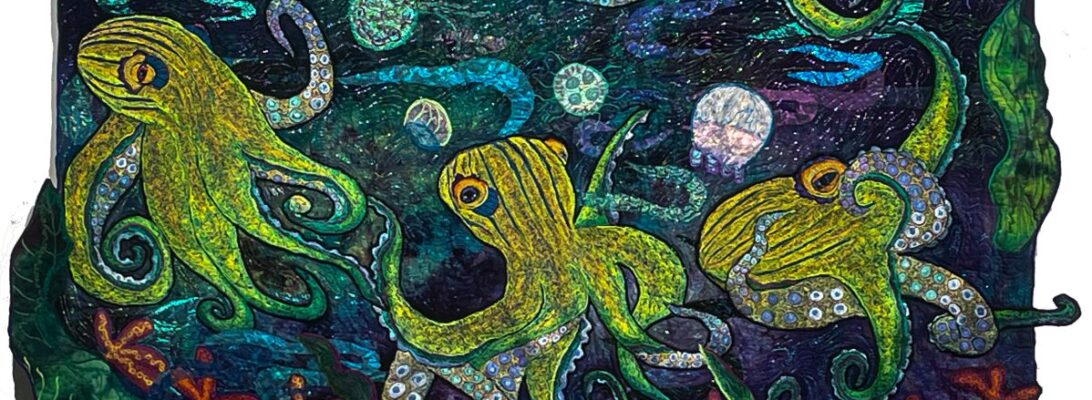
These nurse sharks are part of my octopus garden. I don’t have their octopus stitched yet, but they were compelling. I love the spiky shapes. They will have orange-yellow stripes. I’m not quite there yet. Right now, I want them round and shaded, with a clear indication of which side is up. I need smooth color for that.

Smooth color creates a color range.

The formula for it is

  • A dark base color
  • A dark complementary color as a shader
  • A range of colors in the base family
  • A bright color as a shocker
  • A lighter or brighter shade of the base color to finish.
  • If the subject is too large, I can zone the areas of the image and repeat the formula in a set of lighter or darker shades.
  • I usually work light to dark. The last color will be the most prevalent, so keep that in mind. Sometimes with fish or frog bellies, I color the dark to middle section, add the lightest color on the other edge, and work in my darker colors, so the tummies aren’t so blatant.
Green as a shocker

I chose green as my shocker color. Usually, I would have used either the blue or purple complement, but orange is so strident. I will use yellow for the stripes, but I think I’ll brown them out so they don’t scream at me.

It takes a fair amount of courage to add the shocker. The shader layer makes visual sense. The shocker layer screams at you. There’s a terrible urge to rip it out immediately. But it quiets down once you put the next layer of the base color. And the color is smooth without being bland. The shocker is an electric spark in a range of smooth, quiet color.

It’s time consuming, but I love the base colors. Between the shocker and the shader, the color has a splash of excitement, but creates a flow color base.

What will they look like with yellow-orange stripes? I expect they’ll be quite jazzed up. I’ll show you next week.

Angling for Fish: The Short and Long of It

Last week has been spent in fish production. I can’t really put in the octopuses until I have the fish to create the path around them.

Usually, fish have scales, and the scales divide the space..You progress from scale to scale, picking lighter colors as you get to the underbelly. You fill in the scales darker on top and progressing through lighter colors around the belly. It’s pretty. It gives depth.

What if you don’t divide the space? You can stitch row after row of color next to each other. It looks stripy. There’s a place for that, but it’s not very natural.

It doesn’t work for clown fish.They blend from one color through another without separation.

So how do you fill in a larger space? One way is the short and long stitch.

You need to understand that none of this is a stitch on your machine. It’s all zigzag stitching. The change is the angle in which your fabric goes through the machine.

The long and short stitch is done from side to side. The difference that it spreads from both sides and fills in unevenly, shading the area softly and without stripes. The top and bottom of the image has a solid line to outline.

That kind of shading allows us to put in darker contrast colors to shade that blend right in. These fish are shaded with a dark and then a lighter purple. Since the colors are mostly covered with orange thread, your eye blends them into a shaded solid orange.

All of this is for the octopus’s garden. This is my second pin-up. I think it needs one pillar rock and some water, but it’s ready to back, and stitch.

For more information about the long short stitch, check out The Long and Short of It Blending Stitches with the Long Stitch

Less Is Less: Color Choices for Smaller Images

machine embroidered. not outlined yet.

I’ve whined a bit about larger work this month, mostly because I had 6 full sized pieces to finish. Not fun. But all but one is done.

So in response to that, and in giving myself a break, I decided to do something smaller. These Japanese cranes have been on my mind for a wile. Originally they were on a textile.

People talk about making a smaller version of something and then blowing it up. I’ve never found that works. The size changes what you can do with your stitchery.

When I work large, my thread color choices have to fill in a space. It’s a larger space. I do have a formula for that. And a basic color strategy.

  • I work dark to light.
  • The color of my background is the light within the piece. So that color has to be part of the choices.
  • Everything is accentuated. I choose my colors to be more intense than the overall effect I want
  • Your eye will mix the colors. Even if they don’t seem to go together. Don’t be afraid.

I choose

  • A dark tone of my desired color.
  • A shader, usually either purple, brown, dark green or blue.Often I’ll use a complement from my desired color
  • Several shades of th chosen color.. They can differ in tone and clarity, but they need to be lined up dark to light.
  • A shocker. Usually the complement in a bright form
  • A light color that is the color of the piece.
  • The lightest color. Usually lighter than you want the piece to be as a highlight.

That fills in a lot of space.. It needs to. It allows for some intense coloration.

Smaller work is smaller space. No help for it. The stitching isn’t as intense and you end up with a much small space to fill in. So your choices pull in.

For your thread choices you’ll want.

  • The darkest tone of your color
  • A toner, complement, brown, blue, or purple
  • A mid color
  • Maybe a shocker
  • A light color
  • May be a highlight color

It’s the same theory, but it’s stepped down for smaller spaces. I don’t like to work that way because it makes wild choices feel more intense. It abstracts very quickly

So I worked on these cranes this week. They’re white, but I worked up to that with a lot of soft toned pastels and greys. I was completely worn out on them until I slipped in a bit of turquoise.

I’m not wildly unhappy with this, but I feel limited by it

.The joke is that the ended up fitting into a yard of hand dye, the size I most often use for large quilts.

I don’t often do this, but I have a pervasive urge to redraw the image bigger, and go wild with the colors, just to see what I get.

It’s always good to change things in your work. Any change is a challenge. Chainge the size, change your pallet, change your subject, and certainly at the right moment, change your undies. Change is good.

Too Large: Managing Big Quilts

I love big quilts. I know my definition of big is not large for those doing bed quilts. I consider a 45″ x 36″ piece large. This is a big larger than that, probably around 45″ square.

I also am terrified of them. A large quilt is a commitment. It’s at least 2 weeks- 2 months of time and energy. If it works, that’s fine. If it isn’t, that time, energy and material is lost. It’s not exactly wasted. It’s education, and education has its costs. But it is demoralizing.

There are also a lot of components in this piece: the spoonbill, fish, birds, wisteria, and iris fronds. They can all look great if they’re place precisely. Placing them precisely is not simple. You have to look at it up on a wall.The view on a quilt on a flat surface is distorted. You can’t see the design well enough.

So a larger piece is a bit scary. They’re harder to design, because it’s harder to see what you’re doing. So I took my time on this piece. The bird is great. Getting her into her pond is a bit harder.

I’ve pinned this piece up 3 times. Partially because needed to use the wall for something else. Partially because I wasn’t sure. In the end I ended up tilting the legs and the iris leaves to emphasize the visual path on this.

This is where a black and white picture comes in. Seeing things in black and white makes a lot of things more clear. I get distracted in the color, and the black and white shows what really is and isn’t popping.

Hopefully she’s in her proper place. She’s mostly stitched down, so it’s what it is.

Avoiding the Easter Bunny Look: Shading with Pastels

Anatomy of a Color Scheme

There’s no help for it. If you are shading a pink bird, you’ll need to use pastels at some point. I’m not a fan. But you don’t get to throw out a section on the color wheel. Eventually, you’ll need all the values: tones, jewels, and pastels. Tones and jewels. Yes! Pastels. not that much.

Let me break down the color scheme for you.

There are six color zones, in the feathers of this bird, and then a zone for the neck and thighs, the feet, the head and the bill.

There are two progressive color themes going on. The pink under body and feathers, and the green overstitching. Both progress from dark to light.

Where did it go wrong? I chose the wrong yellow.

White objects are rarely pure white, unless you want a posterized deco look. They’re made up of other colors pale enough to be perceived as white. The bird itself is pink. I pulled in bits of lavender and yellow to blend it and to create a shadowed projection. I chose the wrong yellow. If you look at the top feather, you can see a strip of yellow that’s pretty loud.

You know that kind of Easterbunny pastel. Yellow, pink, blue, purple, and maybe green. It’s only appealing if you’re under the age of five. It missed here. I stitched some cream and natural white thread all over it.

Then I added the overstitching. The overstitching takes center stage, and the yellower bits back off. I think I’ve saved it. It also browns out the pinks a bit. They’re all there, but quieter for the green.

What should I have done? I should have lined up that yellow in a row with the other colors and taken a black and white picture of it. I would have known right there. But I’m happy with it now.

I’m ready for the next step, which is the background. And I think it needs yellow fish and birds.

Greens Are Good For You: Color Theory for Frogs and Turtles

I think the most exciting moment for me when I’m planning a quilt is when I pull my threads for the coloring. Thread painting really does act like painting, with several small differences. You mix paint. You layer thread on top of other threads, and your eye mixes the colors.

Threads are tiny. This means that the colors can be brighter, darker, and showier than you might want for paint. Thread painting is for showoffs.

So here are our color choices. I’m tempted to let the frog be metallic, but the color choices are much more limited. I can dust it with metallic thread afterwards to make a sheen. But I want the full range of colors poly will give me.

The biggest difference is the background fabric I’ve chosen for a base. The background always shows through. The brown background will make the turtle much more brown.

This drawing has three color zones: the snail, the frog, and the turtle. Somehow we need to make those three zones demonstratively different from each other. That is done by contrast. We can contrast color, texture, sheen, and tone. We have to make them visibly different from each other.

Another question. Do I embroider them separately or together? I drew them in one piece. But each image is going to distort, but not in the same way. The textures need to be different so they will tug and pull differently from each other. So I can’t really predict what will happen. The images may distort a bit. So I separated my drawings to embroider them each alone.

I also can place the creatures exactly where I want them. That solves my problem. If I separate the drawings, they’re remain in proportion to each other.

The turtle is easy. There’s some rhythmic patterning in the shell. That can create a textural difference. I also want to lean into the brown/yellow greens that make it contrast against the blue-green water. So instead of blending these colors, I’ve laid them next to each other to create scales.

The frog needs to be the star here. I want to lean towards bright greens that lean into yellow and a smooth skin texture. So he’s on a bright green blue. Bright green threads will make him very green indeed.

Both creatures feature garnet stitch. Garnet stitch is moved in circles across the embroidery. The texture makes for lumpy bumpy turtle/frog skin. For more information, check out “The Variable Garnet Stitch: Building Texture

I used the same accent colors for both. The reds and oranges are exactly the same. I’m hoping that will help tie them together.

The snail is sort of the cherry on top. It’s naturally a beige and brown item, but something fun needs to happen here. Need to do some research. I haven’t stitched on it yet.

The other thing I want to do with this quilt is a water reflection. I’m not good at these, but they are so exciting. I’m going to try again on them. That’s next week’s blog.

\

A Bevy of Sunflowers: Why Aren’t They Strictly Yellow?

Sunflowers are irrepressable. Last summer we had a sunflower field nearby. It’s one thing to see a sunflower in someone’s yard. But a whole field! Fabulous!

So I spent a good two weeks in color therapy making these sunflowers. These were made of organza and hand-painted lace fused to hand-dye, felt, and Stitch and Tear. They were stitched as whole flowers to go on the top, so I could cut away any distortion before I applied them. I used not just sunflower yellow, but the purples, and greens that make the shadows of a sunflower.

Color is a fine antidepressant, and these made me happy. All I need to do now is stitch them into the piece. I placed similar colored birds in and out of the petals. I think I’ll add ladybugs for a dash of red.

But there’s another good reason to add in purple and green. Classical art was always reaching toward realism. When photography was invented, we had all the realism we couldn’t attain as artists. I respect realism. But I know a losing battle when I see one. I can be more realistic, but it’s not my skill or my goal. I want to hold the moment in impossibly beautiful color.

Once I walk outside into the world, realism fails me. Because the sunflowers do have streaks of green and purple and everything is colored by the available light. If the light is purple, everything is somewhat purple. If I’m using a hand-dyed background, the light is defined by the color of the background, and everything fits within that. In blue light, a sunflower would be blue. I haven’t tried that. But now that I’ve thought it….

The light is also colored by my mood. I’m the artist. I can’t help but paint what I see.

Here’s some other sunflowers I’ve made over time. Vincent Van Gogh was right. You just can’t make too many sunflowers. It’s a good cure for the summertime blues.

Right Up to the Edge: Edging with Progressive Color

We’ve talked alot about progressive color. Any image with a flat color scheme is going to be just that. Flat. Shading creates a top and a bottom, a sense of where something is in space and dimensionality. There are a million ways to shade. Shading is about value. it’s also about creating a dimensional image. Shading makes things round. Which helps them look real, even if the color is a bit wonky. But it can be managed many ways. Here are some of the ways I build color schemes.

as a series of the same color

a base color with a shocker and shader, say, orange. warm yellow, yellow. cool yellow, with purple and green (see Shockers and Shaders)

as a undershading with a dark color and creating a layer of complementary over stitching (Under the Skin: Thoughts about Shading)

as colors zoned next to each other.

Almost always, I’m using progressive color. You can see the colors line up from dark to light to create shadows and space.

We’ve also talked about over stitching, edge stitching. I usually do a final stitch over in black, just to clean up the edge from rough stitching. See Hard Edge Applique: Defining the Line.

These birds are by their nature outlined, feather by feather. Not just with black but a bright outline as well.’

One of the basic color rules is that your background defines the light of the piece. If tyour images are in an orange light, then the outlines are orange. So I shaded the outlines as well as the basic shaded background. Do I have that many shades of orange thread? Of course I do!

Shading the orange outline as well as the birds helps establish their round plump little selves.

Next week I’ll share what happened when I tried to do a reflexion of the birds in their pond.

Creating Color by Underpainting

I talk alot about color theory, choosing of threads and creating color schemes. The nature of thread painting is no different than any other art. It’s a creating of colors from components. How you arrange those components changes the effect you get.

I usually line up colors light to dark and add in a shocker and a shader. That color scheme gives us a smooth layer of color that builds on itself. It’s pretty. But it hasn’t got a whole lot of depth.

Sometimes I separate the the scales into a dark and light zone. That creates a deep separation on the scales without any shading. That’s pretty too.

I wanted something different for this fish. I wanted the scales deeply separated and clear. So I underpainted my fish first in blues, purples and greens, and then over painting with yellows and oranges.

Is it extra work? Yep. Would I do it all the time? Probably not.

But one of the wonders of doing Koi is their textures. The textures of fins and scales and their sense of motion is all of that.

So I started underpainting with the complements of the piece. Since the fish is yellow orange, the underpainting should be blue. green and purple.

He’d be pretty if I just continued in that range. Instead, after establishing the darker underpainting, I painted over with yellow and orange threads.

After that, I added a light layer of turquoise metallic thread for flash and black outline for definition.

This is where I think I’m going with this. The underpainting separates and lifts each scale and the outlining nd flash stitching punches it visually.

If you are keeping score of colors on the color wheel, you’ll notice it has a full range of analogous colors from Yellow, green, purple to blue.

Is one method better. Heavens, no! It’s a matter of having choices and knowing what those choises offer you. Now I’m off to stitch rocks and hostas.