the irony of ironing: taming exploding fabric drawers

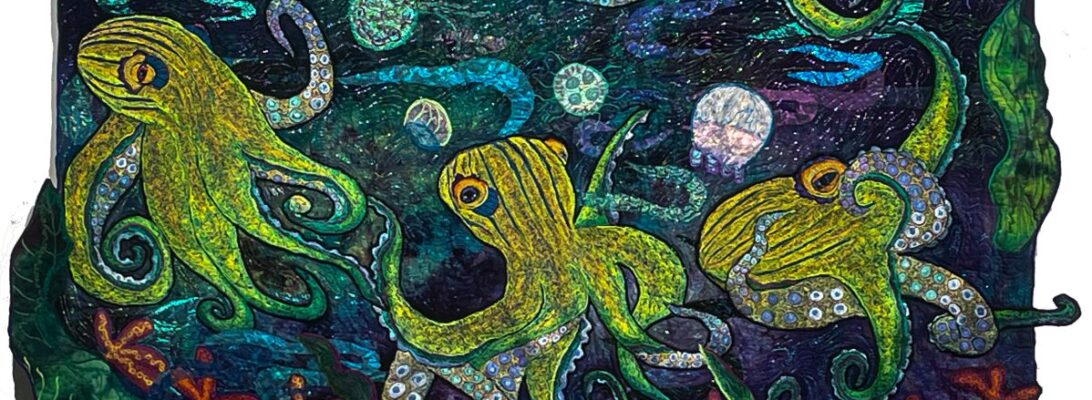
Sheers and metallic lace make the water for this fish

I have several kinds of fabric stashes. There is a small but excellent stash of hand dyed cotton and cheesecloth, and the stabilizers I use. They need to be kept separate because I’d never find anything again if they were not. But there is a sparkle stash, the living falling wall of sheers. And then there is the fabric with no name. I don’t know what you call it. It’s out of the drunken prom queen collection. Sheers with velour. Twinkle organza, sparkle tulle, printed lame. It was originally fabrics samples for fancy dresses.

Much of it came from the Textile Fabric Outlet, which still is at 2121 21st Street in Chicago. But I’ve bought pieces anywhere I found them in my travels. I hope and pray I have a lifetime supply. I haven’t been there in a long time, but they assure me they still sell samples and remnants.


The fabric gets put into different drawers, according to it’s purpose. I have a collection of plastic drawers where I keep fabric and thread. They’re plastic, light weight and cheap. No one ever said they were decorative or stable. But they hold quite a lot of clutter. They pop together like pop bead necklaces. They also unpop from time to time.

That’s when the drawers explode.

Last week one of the stack of two fell of it’s own accord where I usually sit in the cutting room. Thankfully I was not there. Drawers everywhere. Fabric everywhere. And of course since I get lazy and don’t exactly put things away, it all looks like crumply, rumply wads of indescribable stuff that is hopefully fabric. Who knows?

That, and my machine being still out to be fixed led to at least three days of intensive ironing and sorting. Yes, I know, iron is a four letter word. But this time it really helped me out.

Anthony Jones, a fellow quilter who’s taught at many conferences with me once pointed out the difference between pressing and ironing. Anthony started as a tailor and has gone onto quilting. But his early training was in couture. He told me that ironing is the flattening of fabric. It’s a sliding movement across the fabric. Pressing is ironing in one place to persuade a seam to be on one side or another. Pressing leaves the fabric in one place. Ironing moves the fabric, and sometimes your seam as well. There is a difference.

Well, in this case it took ironing. It turned out I could iron 3 drawers in one day. That sounded like process until I counted up to around 40 drawers. I think I have my non-creative fabric project for low energy days for a long time.

One other word about ironing, it’s all in the fabric content. Anything that is a test tube baby,(nylon, rayon, and polyester) can and will melt. I’ve done it once in demo. It was quite dramatic. For regular cotton ironing I use a Black and Decker Classic iron, a recreation of the 1950s black irons. They use very high heat and generate a lot of steam. For the test tube babies, one of the modern irons that are made for polyester clothes is safer. I no longer use expensive irons. These fit my needs just fine.

I found fabric I’d long forgot. I have small sample bridal and dressy fabric samples that make the best dragonfly wings and bug bodies. And wonderful lace and organzas that make landscapes and sky washes. There were wonders I hadn’t seen in years.

And being someone who never really cleans, folds or puts away except when drawers fall out, I had no idea how much less space it takes up to store folded iron fabric instead of stuffing it in a drawer. Who knew?

My machine is home, 6 drawers are ironed and we will resume the channel to chaotic embroidery until the next disaster occurs.

Into White: The Search for White Thread Painting

Some things are an experiment. Some things are a quest. Some things are like the holy grail and you keep searching for them interminably.

White is one of those things. When you’re working with thread painting, the easy answer is many shades of grey and then white, or many shades of beige and then white. Both are incredibly boring.

Why couldn’t you just make it white? I hear you say. You could. If you want it to shine out stronger than any other element in the quilt and you don’t care about dimension, you could. Pure white can be like an out of place spotlight in a quilt.

So the quest is, what mix of colors, greys and beiges will make a white that will have good depth, cast and drama. And look like it’s white.

In that quest, I’ve done a step by step photo study on this bird, in hopes to study it.

I’ve talked about zoning and shading before so I won’t flog that in this blog. “Rethinking White” is a post about shading white applique flowers. It’s a bit different than totally building color in thread. Because it’s built on sheers instead of strictly thread. But you may find that a useful difference.

Dimension is made by arranging colors from either dark to light or light to dark. It builds the illusion of shape. The progression of colors creates shade and shadow.

Here is my thread range I chose. It’s a mix of blues, purples, greens greys and beige, laid out dark to light.

I’ve put together some process shots to help explain.

Head Shots

Dimension comes from having a dark, medium and light area in each color zone in your piece. If you can establish dark, medium and light, you can make depth, something that isn’t by nature flat. Then for interest’s sake I added a shocker and a shader color to spark it. Of course the beak and the eye bring it to life.

Changing Cast

The two things you are building are cast and dimension. Cast is the color under the color. Most colors either lead towards the sun or the shade. You get the clearest colors by using only sun or shade colors in an embroidery.

But sometimes clear color isn’t the goal. If you want to come to a neutral shade, you mix both. And try not to go too far from the center. It makes a fabulous blended shade, but it’s hard to accomplish.

The cast on the under feathers was more yellow than the rest of the bird. An over stitched layer of a bluer grey pulls the color closer to center.

White doesn’t have to be boring. Or grey, or beige. With a little thinking and a close eye we can create a blended white with dimension.

Thread Shopping: If You Can’t Order It All, What Should You Order

We’ve talked a lot about thread choices for one particular piece or another. But when you’re buying thread for a stash, what’s a good strategy? The notion that you need one of everything only works if you’re unbelievably rich. And if you’re faced with a thread chart or a whole display of thread it’s overwhelming anyway. Here’s some ideas about how to think about the threads you’ll really use. And some strategies for buying thread.

There are some threads where I really do need all the colors. I tend to have a whole sliver range because I stipple with it, and I can change the temperature across the piece by changing thread colors. Love that trick! I need all the colors there are.

Range gets defined several ways. Every color should have at least a dark, a medium and a light to shade with. You kind of can’t shade without that. Everything looks flat without.

It comes back to the color wheel. I want a range of everything. This helps check off the boxes. You may prefer darks, or tints or jewels. But it helps to have the wheel in front of you to make sure you have a bit of everything.

But there’s also differences in tone and tint. jewel color is just bright shades. Tone is darkened with black or brown. Tint is lightened. But mixing yellow greens and green yellows with some blue greens gives a more normalized green that is much richer. To get a good range, you want to go much darker, brighter and lighter than the color you want to achieve. I rarely do an embroidery with just light dark medium. It depends on the size. But for a large embroidery, I may use over 80 colors to mix what I want. You can’t use it if you don’t have it.

I put my go-to threads on the list every time. There are things I’m always running out of. Black polyester, FS Madeira 490, Black Supertwist, YLI Candelight Rainbow, certain shades of purple and green I use a lot for binding. If I know I’m going to use it a lot, it will probably trash me to run out of it. And I won’t want to wait for one thread to arrive. Don’t feel bad about ordering an extra spool if you just can’t run out of it. Your list may vary. Pay attention to favorites.

I keep a thread journal. As I run out of a spool of thread, I write down the color number so I can reorder it. I think I can keep that in my head but it really doesn’t work that way.

I make an inventory of whatever thread I’ve got first. When I’m working on a project everything gets garbled. I’ve recently bought a wall thread organizer, not for storage but for arranging threads for a project. But at the end of the day, odd colors go in the wrong bags, and I need to check to see what I’ve really got.

Threads on the right bottom are globbed on.

While I’m doing that, I pull out all the stepped on or smashed threads, almost empty threads, and really old stuff. Old thread is no bargain. It helps to seal thread in a plastic bag, but really old thread just breaks. You can probably use it in the bobbin easier than the top, in a pinch. But it’s not a pet. You don’t owe it anything. Although you can easily use it for globbing. Globbing applies thread in a glob on the surface of your quilt. It makes for beautiful foliage, swamp pond and river bottoms. For instructions on globbing, check out my post, Another Fine Mess: What’s on Your Floor

Bagging thread has another good use. I bag thread by colors mostly. All the blues, pale greens, dark greens, olive greens, reds, oranges, yellow oranges, pinks, purples, greys, teals, get their separate bag. That way I know if I have a range.

About white: Yes. Sometimes I really want white. But most of the time, it’s just too bright for the other colors around it. Instead try pale pastels or greys. White metallic is an exception. It is softer, so it doesn’t have such a high contrast, and that makes it much more usable. Make sure to use a complementary color in that pale mix for shadows. A pink bird probably wants soft green in the coloration.

Remember that colors always are in relationship with each other. The names are a verbal thing, and color is visual. So the names will fail us every time. Look at your colors in relationships with each other and with the background. The background fabric is the color of the light in your piece, so it sets the tone.

Don’t feel bad about having favorites. I love purple, so I buy more purple. I’ll find a way to use it because I love it. I have to make myself buy peach, but that’s ok. I probably have 10 purples to each peach, and that probably will work out in what I ordinarily choose for colors.

Try to pick your colors in decent light. I will do a blog about lighting soon, but you know what I mean. Lighting can change everything.

When I bought thread for students, I made the rule of light dark and medium shades in each color, extra black for outlining, and anything that struck me as marvelous eye candy. It’s not a bad rule. It usually worked. It’s candy without a calorie in sight.

It Came from the Dollar Store: Including Silk Flowers and Leaves in Quilts

Willow Marsh

Whether you think they’re great or their tacky, silk flowers and leaves make a great three dimensional addition to a quilt surface.

From my fall leaf collection

At one guild meeting someone gave me some silk leaves that had been packaging for the tables. I didn’t know what I’d do with them. But the colors were great. I tucked them in my bag and said thanks. Then I forgot about them.

They cluttered around the studio for some while, and then I had a quilt that needed them. This quilt ran on the tension between oranges and blues. Those hot orange shaded leaves were wonderful! And I was hooked.

Cheese cloth leaves

I’d spent a lot of time making leaves of numerous things: cheesecloth, organza, hand dye, felt, and lace. I love them too. But it’s a more abstracted look. The silk leaves gave me instant leaves with fabulous detail.

Since then, I’ve haunted the dollar store and craft shops looking for leaves and flowers. What’s available changes with the seasons and the fashions. The fall leaves are obvious, but the flowers change with season as well. The good news is that even a small garland or batch can give you petals and leaves for years and years of quilts

‘A word about the fiber content. These aren’t silk. I’ve never heard them calling anything but that, but they are actually polyester. Sometimes they’re already heat treated for texture. Do they wash? Probably about as well as most things I use on quilts. They withstand water just fine, but they don’t handle abrasion and folding well. They need to be treated gently.

This quilt needed a few flowers in the background. I tried stitching them in with thick thread, but I really didn’t like the look. I found a silk mum I took apart. I didn’t like it at all as a flat flower, but when I folded it in quarters, it was perfect. I stitched in a green calix , stem and some lines to define the flowers. I’m in love.

Willow Marsh

Every flower is a surprise and not everything works the same way.

hydrangea petals

Smaller flowers work better stitched down as a whole.

Golden Cicada

You may need a wire cutter to take the flowers apart. They have those at the dollar store too.

Wire cutters

I keep bins of different leaves and flowers I’ve dismantled. I never know when I’ll need them. They add extra texture, color and pizzazz

Drawing on Distortion: Give it a Kiss, Because It’s Going to Pucker Up

One of the issues with free motion embroidery is that it always puckers up. You always have some distortion. The worst is that the distortion is uneven and unpredictable. Sometimes it pulls the piece out of shape or makes it unrecognizable. Free motion objects take a lot of time. It’s heart breaking to have them distort past usability. It’s best to adjust for that from the start.

There’s some time honored ways to deal with distortion. First make the embroidery off the surface of the quilt. It can be applied afterwards with minimal distortion. I will be talking about separate embroideries in this article, although the information works for both off and on the quilt surface.

Stabilizers help a lot. Small embroideries under 2″ use three stabilizers all together. The drawing itself is on Totally Stable. It’s a lightweight stabilizer that irons on and is removeable. Stitch and Tear is the next layer. It’s a stiff tear away Pellon. Then I use a layer of acrylic felt that absorbs much of the stitching. I prefer the thinner versions. I attach the stitch and tear and felt with 505 spray. For anything larger, I use a layer of hand dyed fabric as the top layer.

Do remember that the drawing on the back will face the opposite side on the front. I know, I know. Think of it as looking through a slide backwards.

Now it gets confusing. My drawing layer is on the back. I’m going to turn it upside down to stitch. I’m not going to call them top and bottom. The sandwich has a front and the back. For stitching purposes the front is on the bottom and the back is on top. Got it?

I am using two hoops. Sharon Schamber’s red weighted halo hoop is my very favorite. It has a weighted core and a rubber coating. It grips and the weight supplies support.

Now it’s all up to the drawing. We can’t accurately predict the distortion but we can take some good guesses. To do that we need to look at the zigzag stitch

The zigzag stitch pulls across the stitch. The more layers of stitching, the more distortion. For a larger piece, you need to draw to adjust for that distortion. Mostly that means that things need to be a lot wider and bit longer. But you need to analyze the drawing to see where the distortion is likely to be bad.

So if you’re doing a straight zigzag stitch down the legs, it will shrink in the width. You’ll want to make it a bit wider there so it doesn’t become pencil thin.

Bird feathers end with a band of stitching around the end of the feather. Again, making the feathers longer and a bit too wide gives your a bit of extra space there will help eliminate the shrinkage effect.

I’ve elongated the wings and body on the kingfisher. I wasn’t able to get it completely embroidered to show you, but you can see the shrinking on the feather and the wings

It’s not a science. But you can hedge your bets for your best look. Keep watching my face book page to see how this bird looks finished.

What happens if you guess wrong? Several things. Sometimes that wrong guess works better than a correct guess. Sometimes I cut into an embroidery and anchor it with stitching to address the error. One thing is certain. Perfect happens somewhere else. I’m content with beautiful.

But Where Will It Land? The Spotlight on the Background

I’m a long time hand dyer. I started dyeing fabric when I was ten. My fabric is sponge dyed, which means it can include endlessly different shades. It creates a light source and a small world in itself. What I’ve been reminded of this week is that the background changes everything. It isn’t like you take the elements for a quilt and just transfer them over. The background has an opinion of it’s own. And it demands different things.

This week I embroidered a green heron. I’m pleased with it. Because it worked out so well, I found myself fussing over the background. Originally I tried this background. I liked it. It had an excellent place for a stand of lady slippers. It was right with a moon. I pinned up the heron and watched it disappear before my eyes.

It broke my heart. I thought I knew what I was doing. I went back to my fabric drawer and found several more pieces that might work.

Second green background

There was a green background that gave a little more contrast with the bird. I moved the rocks over on it. Hung it up. Pinned on the bird and found it disappeared there too. There was a huge chrysanthemum clearly in the piece. But it was wrong, wrong, wrong.

Red background

So I pulled out the crazy fabric. Two bright pink/purple/red pieces. It changed the season. The red one needed swirling leaves and a muddy pond rather than a blue one. And there was a sort of “where’s the fire? quality to it.

The darker of the pinks was sort of crazy but fabulous. The bird popped. And it desperately needed fish.

Purple background

What am I doing now? Drawing the fish for it. Not so many but some. And falling leaves. Go figure.

Fish drawing

And it appears this has started me onto a series. I have the backgrounds all prepped and ready. I think I need a kingfisher and a blue heron. Back to the drawing board. Quite literally.

Diving kingfisher. I think it’s the next step.

I could use any kind of fabric. But hand dye is the only fabric that helps me design this way. It’s bossy. But I’m willing to listen, because it gives really good advice.

Romancing the Rose

Dragonflies and roses

Commissions force us to do many things. I don’t do realism well. Realism is why God made cameras. Art isn’t limited to realism. But there are people who love it. And need it. Truth to be told, l’m not good at it.

So my birds have purple and blue in them, and so do my frogs. It’s part shading, part colors building.

Dragonflies and roses detail l

I tend to make roses on spirals. It’s the way petals unfold.

Sometimes I let the tails spiral out. I like their motion. I’m told it’s not very realistic.

I have used rubbing plates for a more real rose. This is oil paint stick on hand dyed fabric. Outlined in metallic threads.

Lately I’ve tried roses with the points trimmed away or tucked in.

Will they be realistic enough? That remains to be seen. But they are probably as real as I can get.

Other People’s Colors: Commissions and Color Choices

I was talking to a friend who wanted a quilt for her mother. She was looking over a number of quilts, none of them right. “Can you do it it Monet colors?” Well, yes. It’s not like I don’t like Monet colors. They were my childhood favorites. I grew up on them. By now I would say I out grew them. But they are pretty and they suit people’s needs. So off to sky blue pink land we go!

Actually color is the least difficult thing for an artist to change within their work. It’s a good exercise. Working with a color you just don’t like is a great way to stretch your art.

Most people who are not artists think of color in terms of the colors that look best on them. That’s deeply sensible. If it’s in your environment, you might as well feel pretty next to it. I spoke to one woman who had done interior design. She’d go into people’s closets and ask them for their favorite shirt or dress. Genius!

The best book on color choices I ever read came out in the late 1980s. Color Me Beautiful, divided people into warm and cool colors, clear and muddy colors, Summer, Fall, Winter and Spring. It was never foolproof, but for the most part it works for people. If you were a winter you would pick clean clear colors in jewel or ice tones. A fall would pick oranges, browns taupes and beiges. Knowing the colors that will suit yourself or suit others gives you a strong tool for making art you love and that others will love.

But past that, it’s always worth taking the color you really hate out and and using it. If you’re doing natural art, all the colors will come in eventually anyway. And if your being impressionistic, it never hurts to go to the colors you never use. Or that you’ve felt were worn out. You may surprise yourself.

For me, it’s always been peach. After she asked for some Monet colors it occurred to me that it might be my time to sit down and work with the colors that would make some people happier. Even yucky peach pink.

Commissions always ask more of us that we are used to. Sometimes they are an invitation to something new. Or a revisitation of something old. Or a stretch. Or an impossibility.

But it’s always good to stretch.

You’ll find Color Me Beautiful on Amazon. It’s an excellent way to explore the colors that make you your best.

Time Considered as a Helix of Semi-Precious Fabric: With Apologies to Samuel R. Delany

I’ve worked on cleaning up the studio over the last two days. Finishing The Garth left me done in a lot of ways. It’s hard to change gears and start something new. Usually I fish around for what’s left over from something else to make something new. It’s kind of like stone soup. You start something out of pretty much nothing and throw things in. It works for me. It isn’t often I start something out of complete nothing. There’s something left over, and it needs it’s own place.

You can really measure time in objects. Certainly you can measure time in work you’ve done. I was thinking about how my work has changed over the years. I’ve been quilting since I was 21. I’m 68. I have had time to see the art quilt movement start, grow, boom, explode, and retreat a bit . But if I’m honest about it, much of what I did was about the fabrics that were available to me. So I thought I’d look back at some of my work, and show where it shifted for me. Please forgive some of these photos for their size and detail. Some of them are quite old and out of my hands.

Solid colors:

I made my first quilts as bed quilts. I made them. We used them. They died, as most bed quilts do.

After that I fell in love with Amish quilts. That kind of stitching can only show up on solids. They arrived on the quilt scene around in the beginning 1980’s . Of course I couldn’t hand stitch them either. I was a dreadful hand quilter always. I worked with a walking foot and quilting by counting four stitches over for each row.

Hand Dyed Cotton

I’d been dyeing fabric since I was ten. But it was a game changer when I started treating dyed fabric with sponge painting. It gave me a light source within the quilt that I didn’t need to piece.

Sheer Fabrics:

I discovered sheers and laces as applique for translucent things like water, air, fire and flower petals. It gave me a way of layering things objects. It’s a cool trick and I still use it.

Weird brocades:

I first came into fancy brocades at the textile discount outlet in Chicago. But I’ve hunted them ever since. They make magnificent bugs.

Hand Dyed Cheesecloth:

Hand dyed cheesecloth makes a marvelous sheer. And It acts just like cotton because it is cotton. Here I used it to make mountains, but I’ve used it for flowers, mushrooms, rocks, and all kinds of things. The texture is cool too.

Oil Stick Rubbed Fabric

Oil Rubbed Fabric.

For as much as I avoided prints and textures, I’ve now fallen in love with the textures I can create with paint stick rubbed fabrics.

As I was cleaning out my studio I found all of these things. Some of them I use constantly. Some of them I see as a thing I outgrew a while ago. But art is not measured by our products. It’s measured by learned skill, new ideas and inspiration in use.