A while back I decided to see if I could recreate the energy from a piece I was particularly pleased with. If you’ve been following the blog, I’ve documented it as I’ve worked.
I wouldn’t call it a success. I went through three separate fish, not happy with any of them. I embroidered the best of them and still felt bland.
So I passed on the bass and did a catfish, which I’m not displeased with. The bass went back into the pile.
I can plan all I want. There’s a serendipity to art that is inescapable. While I was scraping out the studio, I found a piece of fabric I’d totally forgotten about.
All of a sudden, my wallflower fish had gone dramatic. I built him a whirlpool/vortex.
My fish fooled me again. I spent some time embroidering some nice metallic minnows that shyly blended right into the background.
They are pretty, but they have no punch.
So I’m trying these brighter gold minnows. I’m still not sure. They’re embroidered from poly, and they might stand out too much. I may need to do some from metallic gold.
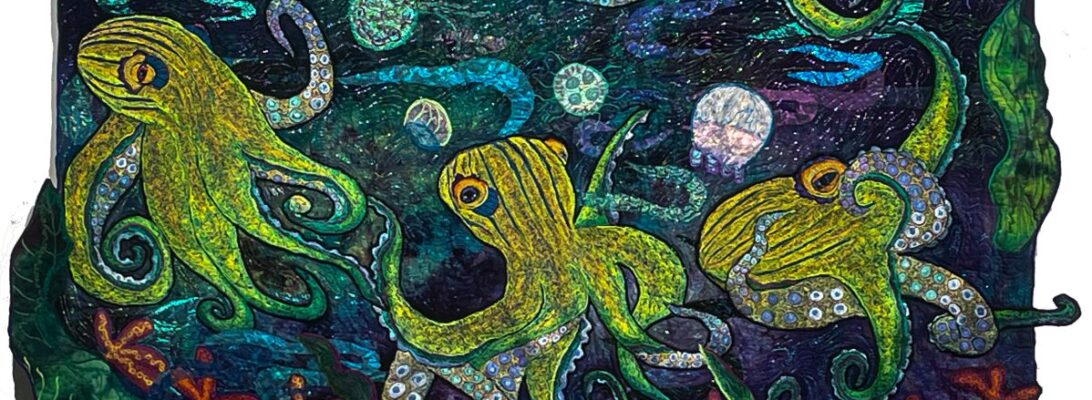
The octopuses’ garden series is working up. I finished up with the MAP kids, got enough rest to face the studio, and discovered that we had to find it to face it. Prep for a class leaves endless clutter and many nice neat piles sprawled everywhere.
It will be a while before we find the table. Then we can search for the floor.
But in that process I’ve started the next step for the octopuses.
Why do I need all those fish? The octopuses are all well and good, but they’re not going to be dynamic without something building a path. So we are making fish. The fish are what will make the octopus quilts move.
I mean a lot of fish. Ive got somewhat close to 50 fish drawn for four quilts. Will I use them all? Maybe.
This is about fabric scarcity. A year ago, we could get almost any fabric. This December, I had to beg a dye house for my order of pdf cotton. They had 50 yards in-house that they were portioning out to their clients.
I hate that. I hate depression economics and carefully crafted source shutdowns. I hate the idea of saving rubber bands and string. We’re there. All of a sudden, hand-dye is precious, and I need to be careful to use up the little bits.
Today I went through felt, hand-dye, and stabilizer scraps. It was a good thing I was cleaning up and sorting. There are some scraps I keep good account of. Anything brown, gray or stony ends up as rocks in another quilt.
But here I was scrounging for backgrounds for fish. Normally, I dye fabric especially for the larger embroideries. This last year, normal has fled out the windows.
I’m not going to talk about why. It’s incomprehensible anyway. Why was Joann’s so reckless as to go defunct? I suspect greed and stupidity dancing arm in arm off to court. Joanns is gone. Our place to run out for everything sewing is gone.
Walmart used to have a decent fabric section. Now it has an isle of highly unappealing cuts made from mostly poly blends. I’m deeply underwhelmed. I suppose you could use it for Halloween costumes.
Thank God there are quilt shops. But so much is catch as catch can on the internet. Do you need needles? Sheers? Felt? Not always at the quilt shop.
So all of a sudden, all of my hand-dye is limited. And precious. And I’m digging scraps out of piles to embroider on.
If I sound like I’m whining, I am. I hate scrapping for fabric. I’ve spent the day digging through fabric scraps, trying to make it work out. I’m not open to discussion about this. This is just how I feel.
The real question is, do I really want to do my art? No matter what?
I don’t understand making an arranged shortage of anything. I don’t get it. It’s stupid with a funny hat on it.
But I’m dammed if I won’t do what I can with what I have.
So, how do we find the fabric that is out there? I’m not sure.
This is a brave new world I don’t like very much. Women don’t count. Art doesn’t count. Sewing doesn’t count to the point where it’s not even treated as an industry anymore. Everything plastic glitters golden.
When the quilt world started, men really didn’t notice. It was something women did for each other. Men considered it pin money. Quilt shops flourished from the early 70s to the 80s before men inserted themselves into the industry in a “professional” way. Things changed. Fabric was a big business. They waded in and took over. Now they drop it like a stone.
So if it’s not an industry anymore, what do we do now? We need to figure it out. And since the male fabric industry has no interest in our needs, we need to figure it out together. We’ve always known how to find fabric for each other.
We need to support any fabric store we can. If we need them to be here for us, we have to be here for them now.
We need to find new ways to find fabric.
And I’m finding scraps to embroider fish on, because it’s what my pieces need.
Last week I did my first class with the MAP kids at the Peoria Art Guild. Yesterday we did the follow-up class.
These are amazing kids. Already serious and accomplished artists at 17, they can do anything.
We did collage with all kinds of fabrics. We had three more kids arrive yesterday. They jumped right in.
The MAP program is a mentoring project for hight school students. They’re exposed to all kinds of art and processes. There will be a show of their work early summer. It should be eye-opening.
Here’s some of their wonderful works.
Working with them was a privilege. Can’t wait until summer to see their show!
Late last year I did a fish quilt that I thought was really successful. As an experiment, I took some of the same elements to see if I could make something that matched it in energy and beauty. Not copying. Just trying for the same feel. It failed. It laughed in my face.
This is not a new thing. I have piles like an archaeologist’s dig of pieces that didn’t work, tucked into the corner or another. And I raid those piles regularly, looking for the next thing.
Here is my failed experiment. I found it tucked in one of those piles. Could it work a different way?
first fish for fish rising
I blame the fish. He’s a nice fish. A little clueless. But not compelling.
New catfish
So we/re trying again. Same background. New fish. Something with more drama going on.
At that point, I abandoned the idea of using the same components. This quilt needs its its own water and world. I put in sun motes across the surface. I decided against small embroidered fish because I already had some wonderful ones rubbed into the fabric in gold.
Fish Rising, with a different fish
Once I added the new fish, I felt more assured. Full disclosure, I cut off the white tail ends since they made it look like Pac-Man. Much improved.
We’re not done yet. Lots of layers of stitching and sheers left to go. But it doesn’t feel like a loser anymore. My experiment was very useful. You really can’t step into the same piece of art twice.
Yesterday I had the pleasure of working with the MAP kids at the Peoria Art Guild. We worked on layered collages in fabric with everything from wild prints, hand dye, shees and an old slip someone had donated. The slip made a great fabric for bones.
We had bones and roses, space opera, a lazy jellyfish, a pond with a butterfly and koi, ducks in a pond and a frame for a tiger head that needed more research. The kids were magnificent. They dug in and created wonder.
Don did the photos for these. When I looked at them this morning, I was struck with their hands. Their hands were as individual as the works they were creating. Next week, we’ll stitch and embellish. I’ll get more formal photos. But the energy there in their hands was magical. And I love the creative energy of piles of fabrics waiting to be put into place.
As artists, we create through our hands. Our hands are our first tools, trained from birth to trace, to touch, to mold our world into beauty, order, pleasure, and good sense. It knows no age. We are born with that as we are born with hands. But hands or no, art is our birthright. If we are human, art is part of the genome. It’s what we’re born to do, Art is how we tell our stories, and how we mold our lives.
The MAP program is a free mentoring project for 17-year-olds that exposes them to all kinds of art. I’m privileged to have done this for 3 seasons. I am amazed. I am awed.
The Peoria Art Guild is by the river, free, open, and fun. You need to go there! It’s at 203 Harrison St. Peoria, IL, 61602
One of the things I miss from my childhood was the women’s sewing circles. It was old-fashioned even when I was a girl.It died out as women took jobs outside their homes. We have a version of it at yarn shops and at quilt guilds, where we get together and show each other how we work.
But my neighbor, Mary Annis, did it with her children. It wasn’t formal. She gathered her 3 girls together and included me when they sewed doll cloths, crocheted, knitted, or made art projects. Later on, when I learned to sew, it was at her feet. She was my first mentor.
I met Mary when I was eight. She saved a quilt out of the trash for me, taught me to be late, messy and not to answer the phone, explored knitting, crochet, quilting, quilling and tatting, and gave me room to breathe. I can’t imagine who I would have been without her.
Even in the days of YouTube, we still need to learn from people. We don’t just learn a skill. We also learned about how and why. It was an introduction to being a creative adult, a crafter, and a maker. It was, for me, life-changing.
Art has its own form of mentorship. We teach art in colleges. We have art classes. We can learn all the techniques and tools. What the classes don’t teach with the hows is why.
Studio hygiene. is about making creative space inside and outside your head. The outside is about work, protecting your body, and making work physically easier. The inside is about making a space where creative work is possible. That is part of the how. That space shuts down judgment, rude comments, negativity, and fear. It opens the doors to new worlds, knowing that perfection is neither possible nor necessary, nor even helpful. All we need is a safe place to try things.
Which leads me to another mentor from my past. As a brand new teacher, I taught art and music at a Catholic school. It was a flawed place. The books were ancient, the equipment was nonexistent. The headset was mid-70s Catholic repressive.
Except in one room. Midge Gamble was in her sixties. She taught 3rd grade at this very 3rd-rate school. She had precisely the same books and equipment. She refused to let in was the 3rd-rate attitude. Where the other classes were angry, hostile, her classroom atmosphere didn’t allow that kind of repression or the anger that fuels it. She helped me understand that the teacher makes the classroom
We learn from models. We learn from what we see. At some point, we show others.
Next week, I have the privilege of teaching in the MAP Program at the Peoria Art Guild. They’re a group of high school kids full of potential, passion, and ability. The program gives them experiences with all kinds of artists. It’s a great experience for these very talented kids.
So I come back to Mary. They had a memorial for her at the home where she lived. One of the ladies turned to me and said, “She tried to teach me to knit.” I said, “She tried to teach me, too.” Whether we could learn or not, Mary had shared it with open hands.
Learn one, do one, teach one. It’s how we build community and civilization. I hope you had wonderful mentors. And I hope you get to share with others who are passionate to learn.
Check here for more information about the Peoria Art Guild’s MAP program. It’s a free program they offer every year to serious high school artists. And a wonderful community.
IF you’d like to read more about Mary, her daughter Betsy did a wonderful blog of this amazing woman’s life. You’ll find it at Marygram.blogspot.com
I’ve been working for some time on my octopuses, and I’ve begun to build up backgrounds. I’m working on three of them simultaneously. It’s complicated. But if I work one piece at a time, changes in construction creep in. It’s almost unconscious. I may have worked the water a different way, or the rocks are different, and won’t fit in. This way, I’ll have three pieces that flow into eachother seamlessly.
This week I worked on seashells and jellyfish. I’ve been collecting stencils ( there are no commercial seashell rubbing plates I know of) to make rubbing plates. I used foam board for a base, and modeling paste to make rubbing plates of the stencils. You’ll find full instructions for this in Modeling Paste: All it Needs Is Peppermint Flavor
I used this rock backsplash I got from Lowes to make the pebbles.
This is one of the backgrounds I chose for the octopuses. I’m still not sure about Octopus 1. I’m tending towards the green-blue background. I wanted seashells and pebbles on the sea floor, and jellyfish floating above. I found I couldn’t place them correctly all at once. I put in the shells, then the jellyfish and finally the pebbles.
It’s a work in process. I’m waiting for them to dry to get the next photos and then we’ll add what’s needed. I think today will be cloudy with a chance of fish drawings.
You can blame this on three stinky days when I couldn’t get to the studio due to bad weather and hinky cars. I do not do well in captivity.
Usually, when I’m working on a piece, there’s a moment when I sit with 3-4 backgrounds, deciding which will work best. What I’ve found is that the background tells the story. The image is the who. But the background is the where, what, and when, Here’s a blog that talks about it. Telling the Story: The Background Changes Everything.
So I pin up backgrounds and move images from one to the other until I have the background that either shows up best or explains things better.
With three pieces in a display, that’s overwhelming. My arms aren’t that strong. So I’m going to use Photoshop and the art boards to interview my fabric choices. I don’t need to see the actual placement. I need to see how they go with each other. The octopuses are my pin-up girls and this is a virtual pin-up.
What am I looking for? What do I need my backgrounds to do?
They need to be 45″ tall
They need to match in intensity
They do not need to be blue
They need to flow into each other
They need to show off each octopus well
In the end, just like Highlander and Sudoku, there can be only one chosen for each octopus. There is no way of reproducing hand-dye.
I need to say this was not seamless. Photoshop seems to change every ten minutes, and I was not up to the latest artboard information. But it’s given me a chart to help me decide what works best.
I chose my fabric so I’m looking at 1 yard pieces, 36″x 45″. The edges will be irregular, so they don’t need to be exact.
My third octopus is not completely done and is only partially cut out. I don’t think that will make a big difference.
Here are some of my best choices.
This is a reasonable amount of pin-up. Once I’m back in the studio, I can put up the best choices and turn them in different ways. Strangely enough, the orange went with everything. I’ll put them up on the board and fussy-place them to settle it.
Would I have done this if Don hadn’t called a winter day off? Maybe not. The cats and dogs are way out of the way. That may have involved screaming at the computer. It was not simple. At one point Photoshop locked up and we had to give it the purge. No, I’m not kidding.
But it did give me a way to sort my tops all in one piece.
Why am I fussing? I’m planning on a layer of rubbed sea shells and pebbles on the bottom of each. I’ll get one crack for each to get it right. Testing out my options just seems smart.
I’ve been noodling around the idea of a series planned as a surround. I’ve done many series over the years, but this is different.
I suppose you could plan a series. But I’ve never seen it happen. You do one quilt with a subject that is either so fun or compulsive that you do another five more. That’s an organic process that I enjoy. But it doesn’t lend itself to consistency.
Spoonbill Series
These birds just happened. I love the shape of them, the bills and that crazy pink coloration. So I’ve made a number of roseated spoonbills.
We’re talking something different here. A surround has to be planned so that each piece flows into the other one. I can do that somewhat with the drawings. They need to flow across the different quilts into eachother. I can do that somewhat with background images. Rocks and seashells can make a pathway. I can also do that with small fish. I’m thinking of clownfish and something small and gold in color. That is the plan.
The coloration should be easy. The hand-dye needs to be all of the same intensity, and we’ll keep the octopuses bright. They should fitin with each other well.
The first octopus is embroidered and ready to place in background elements.
The second octopus is almost embroidered. I need to outline the suckers.
He’s already had a large change. Originally, I had one sucker tentacle closer to the head. It worked in the drawing but not in execution. So I cut it out, and moved it. I think it works better.
shell rubbings from another project
The next steps will be tricky. I plan to rub seashells into the fabric on the bottoms of all of these. They’ll need to fit into eachother. I’m not sure if I can display them all on one photo wall. But they need to dance across four pieces altogether. The last time I did something this large, I hung it off the back porch of my apartment building and walked down the alley to where I could see it as a whole. That was three homes ago. We’ll need to figure it out.
I’ll keep you posted as I work on this. I think it’s going to be a wild ride.