I didn’t have any shows this year. Which is ok. Every artist has ideas they aren’t quite sure how to approach. Instead, I spent a lot of time trying out ideas I wanted t do my quilts. That takes time and effort. It messes with production significantly. So I’m glad to have spent my studio time this last year in this way.
I learned how to make waterfalls.
There and Bacl Agaom
I learned how to make a reflection of my subject in water.
In the shell
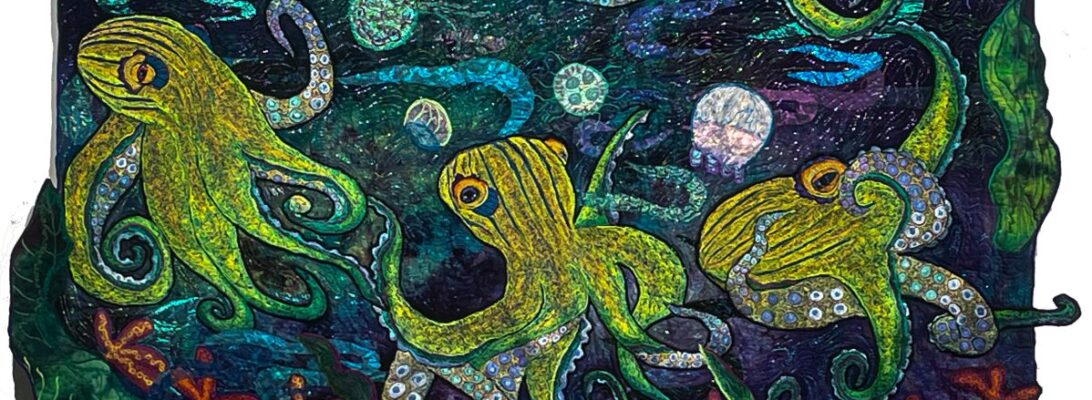
I worked on seashells and tenacles.
B;lue Herons
I experimented with extreme borders.
I learned to make my own rubbing plates from stencils.
Three Cranes
I learned to incorporate those plates into my work.
I worked in desert landscapes.
I finally worked out the cat head fountain.
It’s been a good year for learning. If you’ve followed my blog, you know, because each week I show you what I’m working out, working on, and working through.
Here’s to 2025:
Major quilts
Small work
Unfinished work
I couldn’t do this without your support. Not necessarily monetarily, but spiritually, personally, and energetically. No art is in a vacuum. I suspect that I would do art if it were just me arranging deck chairs on the Titanic, but your company on this journey has made it much more worthwhile.
This is an ongoing series about making rubbing plates, part two.You’ll find part 1, Hunting for Rubbing Plates in last week’s blog. I’ve been exploring making my own rubbing plates with modeling paste and stencils.
Modeling paste costs the earth. And it comes in pretty tiny jars. Not to fear. It turns out to be easy to make with dirt cheap supplies.
I’ve seen several recipes, but none of them seem fussy. People just pour in ingredients and mix them until it’s the right consistency for their work. The peppermint comment is a rememberance to school paste and a joke. PLEASE DON”T EAT THIS STUFF.
Basic Recipe
Corn Starch
Colored Acrylic Paint
White School Glue
Container with Lid
Spritz bottle with water
Roughly equal parts glue and corn starch. Add a dash of acryllic paste, mix, sprits with water if it’s too thick.
Something no one seems to say is that the cornstarch seems to thicken quickly. It may help to spritz it several times in a session. Covered it will last for 3-4 days.
Colored acrylic paint is a nicety I discovered by accident. I didn’t have white. You can see how your stencil is working if you are working with colored paste. Much recommended.
I’m using foam board as a background. It’s a compromise. Wood is just too heavy and cardboard is to light. I’m using washer weights to hold down the larger pieces from curving as the dry. I cut the foam board into stencil sizes with a boxcutter and a plastic ruler. Foam board can come apart at the edges. I’m using blue masking tape around the edges to hold it together.
Picking Stencils
There is a staggering amount of stencils available. Once you banish the cute puppies and cats, there is an endless amount of choice.
Look for stencils that:
Don’t have large empty spaces within the design
Have a moderate amount of internal design
The right size for the designs you intend. This won’t stretch or shrink in any way.
Are made of tough plastic you can reuse
Don’t have really tiny lines in them
Making the Rubbing Plate
Set your stencil where you want it. Use a pallet knife to apply the past. A flat scraper or dead credit card is a good tool for smoothing things. Cover your design thouroughly and scrape off all the extra. Lift the stencil off carefully.
I have a bucket of water I put the used stencils in. That makes clean up easier.
You’ll find the design is lightly raised from the surface.
I usually smooth the edges a bit with some sylicon brushes and water.
Let it dry thoroughly.
That’s it. After it dries, you can take a nail file and smooth any rough edges.
Next week I’ll explore what I can do with these plates and some fabric.
I’ve whined a bit about larger work this month, mostly because I had 6 full sized pieces to finish. Not fun. But all but one is done.
So in response to that, and in giving myself a break, I decided to do something smaller. These Japanese cranes have been on my mind for a wile. Originally they were on a textile.
People talk about making a smaller version of something and then blowing it up. I’ve never found that works. The size changes what you can do with your stitchery.
When I work large, my thread color choices have to fill in a space. It’s a larger space. I do have a formula for that. And a basic color strategy.
I work dark to light.
The color of my background is the light within the piece. So that color has to be part of the choices.
Everything is accentuated. I choose my colors to be more intense than the overall effect I want
Your eye will mix the colors. Even if they don’t seem to go together. Don’t be afraid.
I choose
A dark tone of my desired color.
A shader, usually either purple, brown, dark green or blue.Often I’ll use a complement from my desired color
Several shades of th chosen color.. They can differ in tone and clarity, but they need to be lined up dark to light.
A shocker. Usually the complement in a bright form
A light color that is the color of the piece.
The lightest color. Usually lighter than you want the piece to be as a highlight.
That fills in a lot of space.. It needs to. It allows for some intense coloration.
Smaller work is smaller space. No help for it. The stitching isn’t as intense and you end up with a much small space to fill in. So your choices pull in.
For your thread choices you’ll want.
The darkest tone of your color
A toner, complement, brown, blue, or purple
A mid color
Maybe a shocker
A light color
May be a highlight color
It’s the same theory, but it’s stepped down for smaller spaces. I don’t like to work that way because it makes wild choices feel more intense. It abstracts very quickly
So I worked on these cranes this week. They’re white, but I worked up to that with a lot of soft toned pastels and greys. I was completely worn out on them until I slipped in a bit of turquoise.
I’m not wildly unhappy with this, but I feel limited by it
.The joke is that the ended up fitting into a yard of hand dye, the size I most often use for large quilts.
I don’t often do this, but I have a pervasive urge to redraw the image bigger, and go wild with the colors, just to see what I get.
It’s always good to change things in your work. Any change is a challenge. Chainge the size, change your pallet, change your subject, and certainly at the right moment, change your undies. Change is good.
Do you remember in the Wizard of Oz when they fixed the tin man with an oilcan?
Let’s just start this out by saying I am not a mechanic. By training or inclination. I have 60 years of working with sewing machines by way of experience. I am in no way recommending this proceedure. I’m telling you it worked for me.
You know I’ve been wrestling with my machines. It all came to a head last week when the working 930 Bernina froze solid, mid stitch. This is the fourth machine that has done that.
Don looked at me and said, “Have you oiled it?” Of course I oiled it. All the places in the book.
Fixing is Don’s job. Oiling is mine. Besides, I was restless and distraught and desperate. I got out the new shop light and oiled everything that moved metal against metal. There were a lot of places I would have never found without the light. It felt fruitless. Don said, “Let it sit.” That felt awful, but there wasn’t anything else to do.
The next day, the wheel budged just a bit. I pushed at it. It rotated a bit in a jerky way. Don said, “Let it sit.” I oiled it again like watering the garden.
The next day it didn’t move at all. Or the day after that, Or the day after that. I kept oiling.
Today was the day I pushed the wheel and it moved. All the way around. I got out the light and saw a hunk of thread I’d missed. I pulled it out bit by bit with a hemostate. I oiled again He put it back together and it ran. I kissed both him and the machine.
It sounds simple, but it’s not. The manual on your machine suggests several oiling parts. The idea is that your mechanic will get the other spots during a tune up. That assumes your machine is under ten years old. And being serviced regularly. And that your mechanic knows the older machines. As machines age, they get dry. In places that are hard to reach and not documented.
So the oil can be the cure. Except when it’s not.
Know your machine
What is your machine made of? Outsides don’t count. Insides do. Oil will abrade plastic, and possibly nylon. So you NEVER oil something that’s plastic on metal or plastic on plastic. Only oil metal on metal. Tap on it with your screwdriver if you aren’t sure. You’ll hear the difference.
I was shocked with what I could see with a magnifying shop light. I have several, but this is clearly the best of them. I found places on my machine I’d never heard about, and I do have a mechanics manual.
You also don’t want to open anything that will void the waranty. My machines are 20-40 years old, so that doesn’t matter. Newer machines are also much more complex. You may want to talk to your dealer.
If you’re cleared, take off the panels you can. We’re looking for the secret spots. They hide in the dark.
This is an answer for a machine that is stuck. If your machine is really truly broken instead of stuck, it will tell you. Listen. Pops, bangs, screams, grinds, smoke, the smell of burned plastic, or sounds like it’s chewing, are all indications that something broke. Stop immediately. This will not self heal. Oil it, but don’t expect that to fix the problem.
When and where do you oil?
If your machine is working well enough to move the wheel by hand, you can see all the places where it moves. Oil moving parts that are metal on metal. You will find more places if you can turn the wheel to see where they are.
If it’s not moving at all, oil what you can see. Check that what you’re oiling is metal on metal.
Don’t be upset if you don’t get an immediate response. Oil seeps in. If it won’t move at once, give it some time to penetrate.
What kind of oil? Buy your oil at the dealership. Oil is not all the same. Some kinds actually have shellac in them. If like me, you have many machines, you can buy in bulk. Bernina Jeff. of High Fashion Sewing, in Junction, CO, was kind enough to show us the oil he uses: Velocite # 10 spindle oil. I trust Bernina Jeff. His videos are accessible. He is knowledgeable and kindly. I purchased a number of small bottles and a pint of oil.
Can you oil too much? Of course you can. If you’ve got a puddle, there you are. Wipe it up and call it done. I like to use flannel to clean up oil.
Do check out Bernina Jeff. He has great machining toys for sale, knows his stuff and is a good and gentle teacher.
I do hope you never need this. But I intend to oil every machine I’ve got down to the nubs.
I have to say that this week has left me exhausted. My new to me 930 froze mid stitch, and I am, again. scrambling. Currently working are the 220 and the 20 U Singer.
If it sounds like a first world problem, you’re probably right. But I sew every day, usually around 3-4 hours a day. It’s more than a job. It’s not quite an adventure. It’s certainly my mental health.
When I was teaching, occasionally I’d get a student who would ask me how to do something. Usually it was an amazing idea. But I’d never tried it. I was sorry to tell them I didn’t know exactly how to do that, but that they eventually would. Art is not all about inspiration, and public statements. It’s often fed by the ability to hunt the snark, find a way to make things as you wish. It’s damn hard work.
But if it’s important enough, you find a way. And many artists have the decency to make their journey available to others, so that our art grows, not just in volume or in content but in ability. It’s why we write. It’s why we teach.
If I said that to you in class at one point, I apologize profusely. Just because it’s true doesn’t mean it’s what you wanted to hear. And I thank you for not having hit me.
The art quilt movement rebuilt quilting. Part of it hunted down old skills: hand stitching, hand quilting, pattern pieces, paper piecing and the like. Part of it is new tech: rotary cutters, machine work, computer design, different materials and stabilizers, different threads.
This is not the glamourous part of art. It’s grueling. Try one thing, try another. Look for an answer. Take the best compromise you’ve got.
Edging with three hoops on the 20U
I’m currently working on a koi fish quilt, working title, Upstream. It includes a kick ass koi and waterfalls over cliffs. I’m proud to say I figured out how to do the detail stitching on the 20 U. It involved 3 metal stackable hoops. I’m waiting with some anticipation for my Maggie Frame to arrive. It may really change the whole hooping process
The hoops are important because I can’t get a foot to work on the 20 U. The one foot that works won’t deal with the thickness of the quilt sandwich. Other feet I tried didn’t work with the machine or allow for a zigzag stitch.
For those not familiar with how sewing machines work, your machine will not form stitches if your fabric isn’t held taunt. Your pressure foot usually provides that stability. Without it, something else has to hold your fabric tight. Hense, the hoop. This video does a nice job of explaining how a stitch forms.
So I have to figure out the hoop thing.
On another front, my new crashed Bernina 930 is in pieces soaking in machine oil. I’m sure we’ll figure it out.
Stitched down with water elementals
I’m struggling with finding ways to utilize the Singer 20U. I added in my cliffs, direct applique with the 20U, using that stack of hoops. It’s a less elegant stitch line, but it worked.
Next steps: stipple in, add water splashes, back, quilt and bind.
Those of you who follow me know I’ve been working on getting the 20 U Singer industrial to work for zigzag embroideries. I’ve been positive about it, although that’s been more of an affirmation than a reality. We’re still not there yet.
I spoke with a mechanic last week who said, “You can’t get that machine to do that.” He’s speaking out of his experience, but I’m feathered if I let a little thing like someone’s experience stop me. Besides, I did used to work large embroideries on this machine. It went too fast, it broke thread and needles right and left, but I could use it with a screw tight embroidery hoop.
We’ve solved the broken thread fast issue with a servo motor. That’s working quite well.
But did I mention I hate hooping? Stitch three inches, move the hoop. Stitch another three inches. It’s painfully slow. This is the front and back of my test piece. The moth is straight stitch. The squiggle is zigzag. A hoop will work, without a foot.
Which is why I’m ecstatic about the hoop I purchased today. Maggie Frame is a magnetic hoop set for embroidery machines. But I don’t see any reason why I can’t use it free motion. The hoop snaps and is held in place with magnets. This video gives you an idea how it works.
Here is a comparison between the Maggie Frame and Mighty Hoop.
The sandwich I’m using to embroider is a layer of hand dye, felt, stitch and tear and totally stable. Stuffing that into a screw down hoop is hopeless. This video showed them hooping four layers of terry towels. I can’t wait!
I’ve ordered a 10″ x12″ hoop. As always, I’ll share my journey with you as I try this new tech out.
I love organza and lace for natural elements. I can make water easily with some fusible and sheers. I cut c shapes in various sizes and colors, and fit them into pond or river water.
This is a process I usually do right before I put on my embroidered components. I get everything embroidered, so I’m sure it fits in, and then add the elements (air, wind, water, clouds, smoke) to the background itself before I stitch down any of the embroideries. Only after tthe sheers are stitched on, do I stitch the components down.
There is one problem with that. It leaves my fish and reeds all out of the water. They are in front of the water, but not in it.’
What I’m looking for is the feeling of layers. I usually cut c shapes and swirls. Then I mix them together until I have water amalgamated with different temperatures and depths.
If you think about real water, it’s always in layers. You put your toes in, and maybe you feel the sun warmed top layer, Go further in, and the lower levels feel colder. How do we express that as art? I think the deeper the colors are, the colder they feel. We can make layered water, warm on the top, but colder as we go further in.
So the last thing I often do is to lay a few pieces of organza and lace over top of the fish. Not completely. but enough that they’re completely clearly in the water.
My work contains a lot of different processes. It can seem a bit overwhelming when you’re looking at the inished piece. But there is a flow to it.How do I start? What makes sense out of what comes first? And next. And why?
I’m using the cat head fountain as my example here because it’s what I’m currently working on. This is a repeat of a quilt that never worked out.( see Try, Try, Again). Every piece has its own challenges and processes, some of which are unique to that piece. This one isn’t reallly typical. I’ve been trying to fix my problem with man made structures for some while. The fountain itself was a separate process I’ll skip over for right now.
I’d like to say none of this is written in stone. This is generally how I approach a piece of art.
Which comes first, the background or the subject?
It can go either way. It’s a chicken and egg problem. I need both. It doesn’t matter which comes first.
Background
The background answers many question. Sometimes there’s a piece of hand dye has really strong opinions and tells you exactly what to put on your quilt. It’s worth listening. So I put the background up on the wall and let it tell me the story. Is it a swamp? A meadow? A river? The background often tells me exactly where I am. What time it is? This background was a piece of oil paint stick rubbing on gray hand dyed that made perfect old stone.
Sometimes there’s a piece that’s perfect but it’s just too small. I may strip piece it to stretch it. I did piece a border to this, to get it to the right side.
Subject
The background does all of that xcept when it doesn’t. Then I go looking for images. I do use books for reference. I’m a poor enough artist that once I’ve drawn it, it’s pretty much unrecognizable. But I do like to get the numbers correct on how many toes my creature should have.
I draw on Totally Stable, an inron on, removable stabilizer. The stabilizer stays witin the piece. It’s drawn backwards because I’m stitching from the back.
Either road, I never prep the back until I’ve embroidered the subject. The embroideries shrink. And not in an even way. The shrinkage comes from the width of the zigzag stitch you’re using. Usually it’s around 11 percent, it’s not consistant, or predicable.
Stabilize the Background
Once the subject is embroidered, I stablize the back with felt and Decor Bond.
Elementals
Elementals are things that are see through fire, water, air,clouds, flower petals. If it’s a flat applique, I back it wit Steam a Seam 2, iron it down, and stitch it in a loose zigzag with monofilament clear thread.
First Pin Up
Once I have the elements in place, I pin up my subject into the background and assess what I need to make a pathway
Components
These can be any smaller images that direct the eye through the piece: bugs, fish, birds, or stones. In this case it’s leaves, roses and small yellow birds
Second Pin Up
I add in the components to create a visual path. This it that last moment to adjust for everything The smallest angle of a leaf or bird can change it dramatically.(see Turn of the Head) After it’s stitched down, I’m committed. This is where I currently am with this quilt. The next part is to leave it on the wall for several days to be sure everything is where it should be.
Stitch Down
At this point I stitch the elements into the background
Stipple
Most pieces do not lie flat unless they’re stitched all over. Some kind of stipple will accomplish that.
Back, Quilt, and Bind
Finally I back the piece, quilt it, and cord bind it. Check out Way over the Edge for instructions on cord binding.
This is not always the path. But these are all things that need to be accomplished.
I regularly walk you through my projects step by step. But I don’t often show it in a more macro form. For more information on work flow check Deciding Rather than Designing.
I’ve been a long time follower of the visual path. Our eye travels through a piece of art and makes its own journey. We can build that visual path with our objects and their placement.
A good visual path
should welcome you into that world,
should give you a good tour, covering the surface of the piece.
should graciously show you the way out.
should breathe.
But part of that pathway is perception. How does the structure of the design direct us to travel on that path? Where do we start?
There are some other good questions as well. What makes an entry point? How do we travel? Are we released from the piece at some point? Or does it try to make us stay focused within the piece?
I’ve begun to think about how we enter a piece when we see it. Where does the eye start? Does it make a difference? Being a good dyslexic, I always thought it didn’t, but I’m thinking I was wrong.
As Westerners, we read left to right. So do we enter a project visually from the left and travel over to the right hand side? And what does that do within the language of the piece? What does that positioning tell us?
Handedness is pretty hardwired, but some of it is cultural. We can see an image either from either left or right like flipping a slide. But how do we normally process that?
What matters is what we see first. Where does it direct us to look?
If it faces directly in front of us, that sort of stops the motion right there. We are where we are.
If the subject is facing us, headed left, we see it as the main object.
If the piece is standing facing from left to right, we see it as a main object, but we also see what it is focused on.
The entry point is either a spot that focus us for being open, or for grabbing our attention.
For our purposes, the red arrow is the entry point and the yellow arrows point out the path.
The bird is our entry point. We see what she sees. She’s focused on a pond beneath here.The rocks circle the pond, defining it, but also drawing our eye around it.
Our entry point leads us straight to the mocking bird facing left. . Her glance takes us around the piece following the lizards.
This is just a theory so far. I’m curious what you think about it. How does the facing of the subject change the story of the piece. What is the structural language? What are we saying?
So this is drawn with the eyes facing left. When it’s embroidered, it will be flipped horizontally and it will face to the right. We’ll be in a position to see the world as the fish does.
I’m not sure about this yet. It’s a theory. I’m curious to see what you think as well.