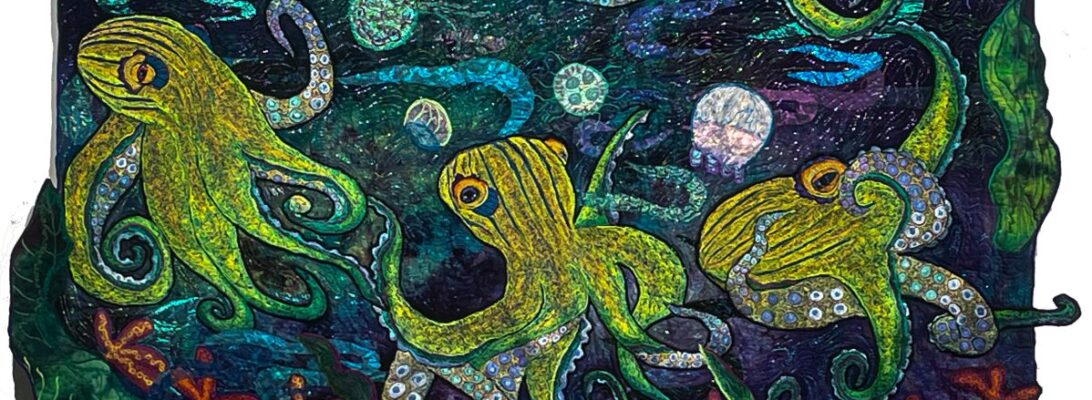
Rubbing Elementals: Using Oil Paint Stick Rubbing to Create Water, Air, Mist and Trees

What are elementals? They’re not the subject or the background. They are layers of sheers usually that create the ilusion of air, water, clouds, fire. Things that are usually translucent or transparent. They change color and texture within the piece without being obtrusive. Usually they have no hard edges. Instead, we see through them, but they help create the illusion of those elements by shifting the colors.

I put in my elementals directly after I’ve chosen my background and finished embroidering my subject.

Up until now, I’ve made my elementals out of sheers, lace, hand painted lace, and dyed cheesecloth. I love those. But I always want more options.

Since I’ve been able to make my own rubbing plates, I’ve had options to create that layered effect. Most rubbing plates create texture or give you a subject. The ones I made with stencils are created to make trees, clouds, waves and waters. Why does rubbed fabric work for that? It has soft edges, It blends into colors, and you can layer your rubbings just like layers of sheers..

I’m very pleased with the background and the fish. But I wanted the feeling of reflected trees and pond surface.

Fish placed in background rubbed with tree images and water reflectons. Rocks added.

The water and the reflected trees add a hazy elemental layer. What now? I’m unsure. I think it needs a layer of sheer waters as well.

Layers suit water. If you’ve ever walked into a pond, you can feel the layers of water, warmer or colder. It makes sense in fabric as well. I’m hoping to create three worlds, the bottom of the pond, the surface of the water, and the bare trees above the surface. Time to get out the silk leaves and organza.

Modeling Paste: All It Needs Is Peppermint Flavor

This is an ongoing series about making rubbing plates, part two.You’ll find part 1, Hunting for Rubbing Plates in last week’s blog. I’ve been exploring making my own rubbing plates with modeling paste and stencils.

Modeling paste costs the earth. And it comes in pretty tiny jars. Not to fear. It turns out to be easy to make with dirt cheap supplies.

I’ve seen several recipes, but none of them seem fussy. People just pour in ingredients and mix them until it’s the right consistency for their work. The peppermint comment is a rememberance to school paste and a joke. PLEASE DON”T EAT THIS STUFF.

Basic Recipe

  • Corn Starch
  • Colored Acrylic Paint
  • White School Glue
  • Container with Lid
  • Spritz bottle with water

Roughly equal parts glue and corn starch. Add a dash of acryllic paste, mix, sprits with water if it’s too thick.

Something no one seems to say is that the cornstarch seems to thicken quickly. It may help to spritz it several times in a session. Covered it will last for 3-4 days.

Colored acrylic paint is a nicety I discovered by accident. I didn’t have white. You can see how your stencil is working if you are working with colored paste. Much recommended.

I’m using foam board as a background. It’s a compromise. Wood is just too heavy and cardboard is to light. I’m using washer weights to hold down the larger pieces from curving as the dry. I cut the foam board into stencil sizes with a boxcutter and a plastic ruler. Foam board can come apart at the edges. I’m using blue masking tape around the edges to hold it together.

Picking Stencils

There is a staggering amount of stencils available. Once you banish the cute puppies and cats, there is an endless amount of choice.

Look for stencils that:

  • Don’t have large empty spaces within the design
  • Have a moderate amount of internal design
  • The right size for the designs you intend. This won’t stretch or shrink in any way.
  • Are made of tough plastic you can reuse
  • Don’t have really tiny lines in them

Making the Rubbing Plate

Set your stencil where you want it. Use a pallet knife to apply the past. A flat scraper or dead credit card is a good tool for smoothing things. Cover your design thouroughly and scrape off all the extra. Lift the stencil off carefully.

I have a bucket of water I put the used stencils in. That makes clean up easier.

You’ll find the design is lightly raised from the surface.

I usually smooth the edges a bit with some sylicon brushes and water.

Let it dry thoroughly.

That’s it. After it dries, you can take a nail file and smooth any rough edges.

Next week I’ll explore what I can do with these plates and some fabric.

Less Is Less: Color Choices for Smaller Images

machine embroidered. not outlined yet.

I’ve whined a bit about larger work this month, mostly because I had 6 full sized pieces to finish. Not fun. But all but one is done.

So in response to that, and in giving myself a break, I decided to do something smaller. These Japanese cranes have been on my mind for a wile. Originally they were on a textile.

People talk about making a smaller version of something and then blowing it up. I’ve never found that works. The size changes what you can do with your stitchery.

When I work large, my thread color choices have to fill in a space. It’s a larger space. I do have a formula for that. And a basic color strategy.

  • I work dark to light.
  • The color of my background is the light within the piece. So that color has to be part of the choices.
  • Everything is accentuated. I choose my colors to be more intense than the overall effect I want
  • Your eye will mix the colors. Even if they don’t seem to go together. Don’t be afraid.

I choose

  • A dark tone of my desired color.
  • A shader, usually either purple, brown, dark green or blue.Often I’ll use a complement from my desired color
  • Several shades of th chosen color.. They can differ in tone and clarity, but they need to be lined up dark to light.
  • A shocker. Usually the complement in a bright form
  • A light color that is the color of the piece.
  • The lightest color. Usually lighter than you want the piece to be as a highlight.

That fills in a lot of space.. It needs to. It allows for some intense coloration.

Smaller work is smaller space. No help for it. The stitching isn’t as intense and you end up with a much small space to fill in. So your choices pull in.

For your thread choices you’ll want.

  • The darkest tone of your color
  • A toner, complement, brown, blue, or purple
  • A mid color
  • Maybe a shocker
  • A light color
  • May be a highlight color

It’s the same theory, but it’s stepped down for smaller spaces. I don’t like to work that way because it makes wild choices feel more intense. It abstracts very quickly

So I worked on these cranes this week. They’re white, but I worked up to that with a lot of soft toned pastels and greys. I was completely worn out on them until I slipped in a bit of turquoise.

I’m not wildly unhappy with this, but I feel limited by it

.The joke is that the ended up fitting into a yard of hand dye, the size I most often use for large quilts.

I don’t often do this, but I have a pervasive urge to redraw the image bigger, and go wild with the colors, just to see what I get.

It’s always good to change things in your work. Any change is a challenge. Chainge the size, change your pallet, change your subject, and certainly at the right moment, change your undies. Change is good.

Tackling the Task: Where Are My Big Girl Panties?

I’ve been prepping for a show proposal for weeks now. While I was working through my machine woes, I couldn’t back and bind the larger quilts. Now that I have a functional 930, I could accomplish that.

Two years ago, I started this heron piece. I don’t know what I was thinking. It’s a heron drawing I found in my files. It was lovely. So I embroidered it and fit it into a quilt.

But it’s large. The word large is inadequate. It’s roughly 59″ x 59″ It’s larger than I’m tall.

Embroidering it wasn’t’ the problem. But after you add a back and a layer of felt, you have a lump. A very large lump.

So it sat the corner. And I became afraid of it. I made a myth of it. It was too large. It wouldn’t fit through the machine. My arms aren’t as strong as they used to be.

I had a friend ask if I could make it work if I cut it up in some way. That shook me loose. It wasn’t a bad quilt, or even a failed quilt. It was just too big. And I was being a coward.

After that I went hunting my big girl panties.

All of those things are true. It’s too large, it did not fit prettily into the machine. I had to jam it under the machine head. And my arms may be less strong, but my will..? Never doubt my will. No one can tell me no but me.

There’s no can’t like won’t, Sometimes we build myths about our work. “It’s so good.” “It’s no good.” “It will never lie flat” Almost all of that is irrelevant. I won’t know i it’s good for some while after I finish it. I need to stop the negativity and just step into the task. It was backed, quilted and bound in 3 days.

Here’s the details on Great Blue

Here are the other quilts I’ve set up for my proposal. I think the heron’s really necessary. Big girl panties and all. Wish me luck.

When the Wringer Won’t Wring

I’m feeling old.

Along with a number of other studio failures, my wringer washer is not wringing. There are several answers for this. Most of them demand manual strength. I suspect we’ll call the mechanics at Dillan’s before that’s over. The wringer washer is really old. But then again, so am I.

But for right now, I need to dye fabric. Which means I need to soak fabric. Which means I need to wring out fabric. Which means a lot of wringing of hands.

I have in the past, asked for help. I think it’s geographically more difficult right now. If anyone would like to help me dye fabric, I will send you home with a pile of lovely hand dye as a thank you. But everyone I know to ask is too far away to ask.

Time to get creative. What else holds wet fabric and wrings it out?

Modern washing machines. It’s an idea. It is, constitutionally, wasteful. Washing soda lasts forever if it isn’t contaminated. I can hold water in the washer. I can get it to wring it out. But the soak water will only be good for one shot. It’s discarded in the rinse process.

And it’s a large shot. I looked up the capacity of washing machines. It suggests that an older top loading machine that the capacity is between 15-20 gallons for a small rinse load. I’m not sure if that includes just the rinse water or the wash water as well.

The formula for washing soda soak is 1 cup of washing soda per gallon of water. 15 cups of washing soda per load is a lot. Then again, what would it cost in chiropractic dollars? Chiropractic dollars measures how many trips to the chiropractor you’ll need after accomplishing your task the hard way. If it costs less than the chiropractor, it’s a bargain.

So I did it. I have 25 yards of fabric ready to wash out today. We’ll know if it got enough washing soda for the fabric to connect with the dye.

Short answer, it worked sort of. It’s massively wasteful of washing soda, It also leaves fabric dryer than I like. But I didn’t have to wring out anything. It still wore me down to a dirty rag at the end of the day. I also didn’t get the most intense color I rely on. I will not be doing this again.

The washer isn’t the only one who’s getting older.

I also just found out they don’t make StaFlow starch any more. Stay flow has been my secret weapon against wimpy fabric. Rather than mix it and spray it, I put it in the last rinse in the softener cup of the washer with a dolop of milsoft fabric softener.

Starch gets a bad rap. We usually wash out our fabric from the store, partially to remove the startch but mostly to get any bleeding and shrinking out of the way. And it removes other bad chemicsls, But starch give your fabric body, and the softener gives it a beautiful hand.

I sent Don into Walmart for Sta Flow. There is no more Stay Flow being made.. There are left over bottles available for $28 dollars a bottle on Amazon. I refuse to mix my own cornstarch. So we’re trying a new liquid starch called Linit Starch. I hate having to try new products. It leads to uncertain outcomes, where you once knew what the results would be. It’s another learning experience. I’ll keep you posted.

Things change, products change, methods change. We change too. Sometimes it’s even better. At least I’m telling myself that. And I have fabric again. If it takes longer, that’s just how we need to roll.

Try, Try Again:

This is about keeping old work. It’s also about process shots. And it’s about putting things down and picking them back up when the time is right.

There are pieces that never work out. I don’t have a bunch of hopeless little piles in the studio, but there are some. This is one that is old enough that I don’t even have process shots of the disaster.It could vote. If I had process shots, Id know better what I did.

There are 200 fountains in Kansas City in around a four block area. I got to walk there one afternoon. I’m always a water baby. I was mesmerized. I saw a fountain with a cat head that blew my mind. Not the largest fountain. But all I could think of was birds flying through it. Owls. Spoonbills. Swallows. Chickens. Fantasy birds flying over an old stone fountain.

I had to try it.

It bombed. I couldn’t make the fountain. I’m not good at man made structures. I just didn’t have the chops. And I had no Idea how to make flowing water. It took me almost nine months to figure out that I couldn’t figure it out.

That kind of exercize is bad for moral. I never throw things out, but I must have thrown this out. I can’t even find the cat head I embroidered for it. Had I kept process shots and left the pieces alone, I could show you. As it is, you’ll have to imagine. It was hopelessly rumpled and the fountain looked like it was made by 2 3 year olds ready for naptime.

Fast forward 15 years. I rubbed a series of grey texturized fabric for some abandoned city pieces. I wanted birds flying over it. Sounds familiar, doesn’t it? J’d come back to my cat head fountain.

There is an instinct to run. To say it’s too hard. To just back away.

But I’ve decided not to.

What has changed?

  • I do my embroideries separately now so I get much less distortion
  • I can do the fountain as a separate applique and applique it as well
  • I’m much more secure with falling water. I’ve done it now and feel confident I can do it again.
  • I now use oil paint stick rubbing to create old carved stones.
  • I’m working with a better stabilizer (Decor Bond, Stitch and Tear, and Felt)

Strangely enough, I was able to find a picture of the fountain online. Not available five years ago. Somethings just get better.

Will that matter?

It might, It’s worth a try. When an old idea still has that kind of heat behind it, it’s important. It needs to be worked with. We begin to transform ourselves when we interact with images that somehow connect strongly. Most strongly, when those images scare or upset us, but also the ones that delight us. Creating an image gives us some power over what we create. It changes our story. It changes us. All those cave men drawing Bisons can’t be that wrong.

Currently I’m working on embroidering the three swallows, visiting the fountain. While the fountain is a mundane ordinary thing, the birds are anything but. I did them in rainbow colors, because they are the fantasy past all that mundane cold stone. They are delight on a gray cold day.

I originally wanted one with owls and one with roseated spoonbills. I still might.

I’m going to continue this in several posts, because it’s clearly a journey for me, and I’d like to share it with you. Let me know what you think.

Deciding Rather than Designing: Starting from Scratch

I wish I were someone who could take a design and execute it. I can try. It’s a case of man proposing, and God laughing. Instead, a series of decisions are to be made at each point. Each decision points to the next.

One of the most useful things I do in a class is to start a piece from scratch. It’s not like there is a direct list of what you do next. But there are some decisions to be made. It helps to have a plan.

Here is the list of things I need to decide for each piece.

  • Background-The hand dye creates the light and the atmosphere for the piece. It usually is the first choice. Does it have a sunspot? A pool? A field of flowers within it? It dictates almost everything, especially the lighting in a piece.
  • Major Images-These are the main focus. I draw them in Totally Stable, backwards. They iron on to the back of the piece and remain inside the piece as a pattern.
  • Atmospherics-Water, light, smoke clouds, and sometimes leaves and flowers are atmospherics. They are usually made of commercial sheers, handpainted lace, and dyed cheesecloth. They make a translucent presence in the piece.
  • Details/pathway-These are smaller embroideries, or stones, or leaves that can be used to create a visual pathway through the surface.
  • Texturizing the surface/stippling- after all that embroidery, the rest of the piece needs to be integrated. The stippling over the surface can pulls the piece together.

There are no right or wrong answers. There are simply decisions. Each defines the piece. What I choose not to do also shapes the definition. I’m OK with that. I’ve learned that each decision I reject can be featured in the next piece. Or the one after that. I’m not making one perfect piece of art. I’m creating a body of art that explores the limits and range of my techniques and my skills.

This piece, like most of them, started with a piece of fabric and the idea of herons. I dye a number of pieces of fabric as cenotes, wells of color. Some times the cenotes make a light source, but this piece made a wonderful pond.

The birds started as whistling herons. But at a certain point, they were indistinguishable from the Louisiana Blues. So I did them as blue herons. It’s important to finish the major embroideries first because they shrink. You don’t know how they’ll fit in until they’re embroidered and cut out.

The atmospherics for this piece are water and grass. The grass is an oil paint stick rubbing of a ceiling tile. The water is accentuated with c-shapes of hand painted and commercial lace. Then I put in rocks to anchor the pond and direct the eye.

I decided on damsel flies and grasshoppers, as pathway elements. They did not work the way I had hoped. The damsel flies fit in, but I’m not sure of the grasshoppers. I’ll have to finish them to be sure.

Finally, I wanted seedlings growing up through the water. I made big beautiful bold seedlings the size of God’s underpants. Again, not the best choice. I scaled that down and it was much more effective, although I might want bigger ones at the bottom.

This piece is pinned in position. I’ll be stitching soon. But most of the decisions are made, step by step, before it’s stitched down.

In Reflection: Creating an Image Reflected in Water

i need to start this post with a full disclosure. I am deeply dyslexic. I wasn’t diagnosed until I was teaching myself, but the b’s, p’s and t;’s periodically spin like tops for me. I’m not so hot on left and right either.

So when I wanted to add a reflected image into water on a quilt, it wasn’t an easy thing.

I start most quilts start with a good dyslexic exercise. I draw in pencil and trace a copy with a Sharpie. The drawing is ironed onto the back as a pattern and is backward. My thread colors top and bottom are the same, so I know where I’m going. This is charted water.

But a reflection isn’t exactly the same. I wanted to put a reflection of the birds in royal rails.The reflection in the water needs to be flipped vertically. But not horizontally. Add to the confusion that if you trace the shapes with Steam a Seam 2, the pieces will be cut flipped horizontally. I thought I could accommodate that by flipping it upside down. Nope. That did not work. I ended up with feet that pointed the wrong direction, Here’s the thing. By the time you take the drawing, trace out the pieces for the shadow in organza and put them on to Steam a Seam 2 to glue them, they’re backward again.

I never figured it out for this quilt. When I put in the water there wasn’t enough space for the reflection. It whipped me.

I can see it if I make a model. If I try to hold it in my head, my head explodes.

I finally made a little model. Both images are flipped horizontally. The bottom frog is flipped vertically.

I made several color layers from the drawing tracing out the frog, the turtle and the snail bits in separate color layers of red, dark green, and light green. I laid the turtle layer over the whole drawing, and placed the cut-out bits in. It was tedious, but it worked.

Now what is left is to place in water over and under the shadow image. And add waterlilies.

I feel like I have a new tool for my tool box! All kinds of reflections coming.

Romantic Roses: Valentine’s Day for the Somewhat Grown Up

Do you remember Valentine’s Day as a kid?

I loved it. My mother made me a red and white dress for the day, and you brought valentines for everyone, and then you filled their mail box with them and found your own filled.

I was not much of a social butterfly. And I’m not sure I would have gotten any valentines if everyone didn’t send them to everyone.

But most of all, I loved all that color in the middle of the snow. Red, pink, and orange warm my heart whatever the temperature. Add a dash of purple. I could get drunk on it.

Valentine’s day is sort of a bust for a number of reasons around here. Mostly, Don doesn’t do holidays. And if either of us really wants something, we just go buy it. But I still get off on the colors.

Don takes me for a color bath every fall. He drives me around the stately homes of Galesburg and I gasp at the amazing leaves. This time, I happened to look down at the red roses beneath the trees. Absolutely breathtaking. Red, orange, pink. I might as well be drunk. So I started with a batch of red roses. I’d been wanting to do a garden quilt.

I have several ways I make roses, but my favorite is with spirals.

After cutting spirals, I glue them to felt. The felt is red because the color will show through. That’s a promise.

Once they’re all stitched, you can see the form better from the back.

Here’s how they look cut out.

I intend a sunflower and some hollyhock for this quilt as well. Yellow birds as an accent.

This is just pinned up and the leaves for the roses and the hollyhocks aren’t finished yet. But I’m excited. With all those fall leaves falling, we’ll need a garden in bloom. It’s just like Valentine’s day.