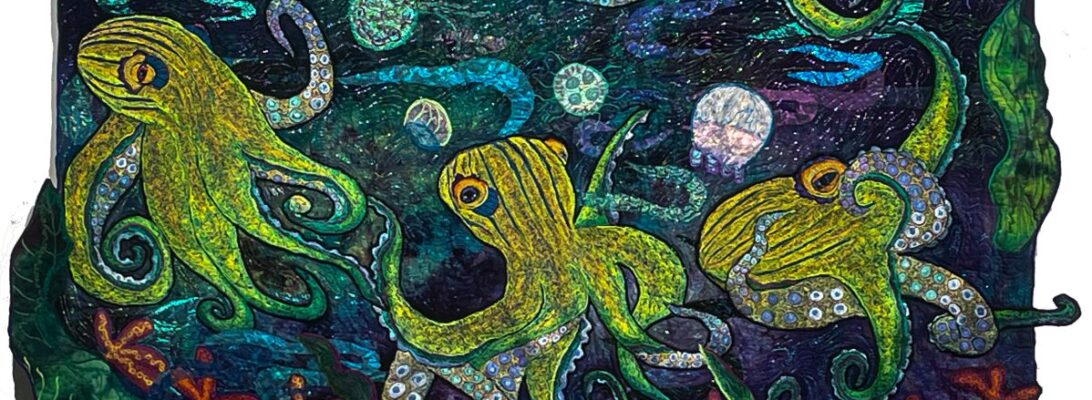
I am happy to announce two events. I have the first couple of showings I’ve had in 10 years.
Open Studio: Quilted Tapestries of Ellen Anne Eddy Saturday, August 27th Quilts, tapestries, books and hand dyed fabrics available for sale!
Hours:- Saturday 9AM – 3 PM Contact: Ellen Anne Eddy219-617-2021Galesburg Art Center, 309-640-0005
Birds of a Feather: Quilted Tapestries by Ellen Anne Eddy Cove Center, Havana, IL
The Cove Center, in Havana, IL announces Birds of a Feather, a show of quilted nature tapestries by Ellen Anne Eddy August 30 through September, 30th 2022. The Cove Center is in the Wahlfeld Building at 120 N. Plum St., downtown Havana Illinois. Hours: Monday – Saturday8 AM – 1PM CLOSED SUNDAYS ~Gallery Opening: September 2nd 4 – 8 PM Contact: Ellen Anne Eddy 219-617-2021Cove Center: 309-640-0005
Splash!
How do I feel about all of this? I haven’t hung a show in ten years. I’m past panicked.
Now, for an artist, panic is your friend. It’s the thing that helps you through the hoop of finishing, binding, hangers, signage and all the little details you remember the night before the opening. Along with raw terror, there’s all that extra energy if you can harness it. By now I’ve run out of steam and Steam a Seam 2 and most of my larger fabric chunks. My friend, Deborah Christman kindly embroidered a Don’t Panic towel In support.
But here’s the cool thing. I have, due to show panic and a small amount of hysteria, 15 new quilts and two new series to show.
So it’s not like I don’t have something to show. Or cool new work for sale. Please come join me! If you can’t make those dates, call and we can make a time for you to see things at the studio. Let me know what you think about the new work. And buy a quilt if you fall in love with one. I’m still out of Steam a Seam.
I know it’s not supposed to be quilter’s fabric. Sorry. I can’t leave it alone. It’s too much fun to play with test tube babies. Over the years I’ve collected a special stash of laces, organzas, chiffons, brocades and just plain weird stuff.
It’s not anything I would piece. But no one would call me a piecer so that’s moot. But it’s wonderful for the things in this world that are, by nature transparent and/or translucent. I’ve talked earlier about finishing sheer edges with a soft edge finish, Sun Rocks, Wind, Water: Elements with Soft Edges.
But there are times you want that edge to show. Edging lace and sheer applique is a way of not only defining the edge of the applique but of controlling the color and controlling exactly how transparent it is.
I’m working on some moonflowers and some snow drops for a quilt called Splash. The quilt features a dark mostly blue background, and I wanted glowing white flowers for the background. Moonflowers are morning glories that bloom only at night. They’re perfect.
It’s also a way of lightening a darker quilt.
I used both lace and organza for my flowers. I do like them to have small differences, so they have their own individuality. Then I placed them with Steam a Seam 2 on a piece of white felt, with some green leaves. Why felt? It’s a spectacular stabilizer, with a layer of Stitch and Tear underneath. Why white? Because it’s all going to show. Whatever color felt I put under the lace will show through and define the color of the finished flowers. Organza will show through the most, lace less so, and Angelina fiber the least.
Knowing that is power. Felt comes in a full Crayola box of colors and it allows me an extra layer of shading in the process. The thread I use will also define the colors and shade things into darks and lights. Here’s a collection of flowers with different backing felt colors.
white over pail blueangelina fiberwhite over pale bluewhite over pinkwhite over whiteWhite on Whitewhite over turquoise
I use a number of pastels as well as different whites to stitch the edges to give depth. As usual, it’s darker where the sun isn’t shining.
shading the flower
I stitched the flowers with a free motion zigzag. Here’s a little video showing how that works.
I did these moonflowers separately from the piece because they’re relatively large and would have distorted the surface. But for the smaller snowdrops, I applied them directly with Steam a Seam ad then stitched on them directly. The cool thing about this is that the background peeks through, like all translucent flowers. It’s a cool effect.
snowdrops directly on the fabric
And it’s a great reason to play with sparkle lace. There should always be a reason for sparkle lace!
One of the hardest things in embroidery work is to get over the match instinct. After years of perfectly matching thread to my project, I’ve had to learn to pick out the highest contrast threads to make an image that really shows up.
In embroidery, contrast is everything. If it all mushes together color-wise then you have a very mushy image indeed. Smooth color exchanges that are analogous and sit next to each other on the color wheel are pretty. But they don’t have much punch. So what you want is color that builds not on similarities but on differences. There are several kind of contrast: color, tone, clarity, and temperature.
Today we’re talking about color ,which is simply the hue. Is it red, blue, or yellow? Or an odd shade of green? It’s not a simple as it looks. There a million reds, blues and yellows and they are not the same.
Thermal shock is about the temperature of a color. Every color, no matter whether it is a cool or warm color, leans either towards having a cool or warm cast. It doesn’t matter if it’s a cool color or a warm color. There are cool yellows, there are hot blues. If all the colors are either cool or warm they’ll flow into each other like analogous colors. But if they’re not? You get thermal shock. Like standing in a cold water sprinkler on a steaming hot day. The effect is kind of visually electric.
Blue and Yellow Don’t Make Green is an excellent book discussing thermal variations and how that creates differing colors.
I wanted this fish to jump off the surface and I’d decided on yellow, to give it some definition from the floral like background. But I wanted it showy. So the colors I picked, cool orange, cool and warm yellows, cool and warm blues left it shimmery and gave it impact.
Of course it helps if you have shocking thread to begin with. This particular florescent is a Madeira polyester 40# called Poly Neon. Neon has a around 800 colors of every hue, but it has a select section that really is neon. I went through my collection of those threads and chose my shockers.
fish scales
FaceTail
Each scale on this fish has a blue outer ridge, a purple, and 2 yellows. It’s been shaded in gradations to create the underside separately from the top.
The face and tail are a looser gradation that just shades from darkest/brightest to softer shades.
Here’s a video showing how that’s stitched.
I’ve written a lot about color because it matters to me. Building color in threadwork is done shade by shade, one color on top of another. The eye mixes those colors, which keeps them clear and crisp. But when the colors are fire and ice, prepare to be shocked!
We talked earlier about soft edge applique. Soft edge is a minimal treatment that simply covers the edge of an applique with monofilament nylon or poly thread with a zigzag stitch. For things like water, air, fire, rocks, mist, suns and moons it’s perfect. Sometimes it’s good for flower petals as well. It’s for anything that doesn’t need a hard defining edge. It creates soft color shifts across the quilt.
But some things need that edge. Bugs, birds, frogs and fish all need that hard definition. Or you can’t really see them at a distance. And it makes a huge difference when you go to photo your piece.
You know I’m a color girl. I’m going to want to use color every time I can. But over the years I have learned, if you want it to stand out, use the black for an outline.
green outlineblack outline
I particularly have tried it with bugs. Metallic thread green thread always gets my attention, and I reach for it much in the way you might reach for cherry cordial chocolates. But I’m mildly disappointed with it in the end, because it never gives as defined a space.
basic outline
I’ve been working on this egret, and the my process shots reminded me how important that outline is. Again, I’ve been working on doing a dimensional white bird, so it has a lot of contrast underneath to shade to white on the top.
The bare bones outline define the areas to shade with color. I’ve come to rely on 40 weight Madeira Poly neon. It comes in several blacks, but the definitive one is color #1800. I’m using a free motion zigzag stitch to outline, which is why the width is variable. (See post Zigging Upended for a tutorial on zigzag stitch).
I build color, from dark to light from the outline. For more information about choosing those colors, check out this post: Into White: The Search for White Thread Painting. But it’s coloring within the lines. As you can guess, I’m not so good at that. The threads encroach over the line and things get mushy. So the final act is that reoutline.
Redefining the outline
You can see the difference that second outline makes. All the edges that are fuzzed and mussy are now tightened up and out there.
The outside edges will be defined as I stitch the bird down. But having the inner edges cleaned with an extra edge of stitchery redefines all the lines.
finished egret
When I applique the bird on, again I’ll use my zigzag stitch with black thread. It gives the outline definition and punch and helps separate the bird from the background.
The hardest technical thing to deal with in free motion embroidery is the distortion. Any time you stitch rhythmically and close together, the fabric will distort, trying to make room for the extra thread in it. More so if you’re using a zigzag stitch. Zigzag stitching pulls on both sides and can make a top wave like a flag.
There are several easy cures: Using a stabilizer, using a hoop, using smaller width stitches. All that being done you can still end up with a crumpled mess lying like a hat. It’s not a happy moment. It’s made worse by the fact that the fabric made by that kind of stitching is usually pretty fabulous. Just lumpy.
Can you steam it? You can try. Sometimes it helps. Can you cut it apart and put it back together? I’ve done it. It’s a last resort, but it’s better than lying in lumps.
Or you can cure it by cutting off the rumple. I’ve done that a lot with embroidered subjects. But can you do that with elements of the background?Why not!
Cheesecloth mountains
This is a direct applique technique. I have some cheesecloth mountains for this owl in the meadow. If I stitch them down on the quilt surface I will end up waving the flag. So instead, I’m going to glue them on felt and do my detail stitching before we attach it to the front.
Do I lose something by this? Several things. I lose the look of the hand dye behind the cheesecloth, which I like quite a bit. And I lose the distortion. I hate the distortion. Do the math and make your choice.
The felt I’m using is a cheap acrylic felt from Joann’s. It’s stable, doesn’t fray, and stitches well. I’m making my mountains out of cheesecloth and Steam a Seam 2. On the back, I have a layer of Stitch and Tear stabilizer to help control the distortion and give support to the stitching.
Cheesecloth is porous. The glue will come through when you iron it. I’m using a Teflon pressing cloth to protect my iron.
The glue will come through onto my pressing cloth. I can clean that off with a Scotch Brite No Stick Scrubby.
Once I’ve got it glued down and stabilized, I can start stitching.
The stitching on these is moved through the machine from side to side. That creates a long stitch that fills the mountains quite nicely. It also distorts the fabric a lot. You can see the pull of the stitch on the fabric as the stitching fills.
When it’s all cut away the distortion is gone and all is left is a thin margin of felt that can be covered with minimal zigzag stitching. All those textured mountains with two small rows of zigzag that should not distort much.
I’ll pull off the last of the glue before I apply the mountains to the piece. I use a small square of plain cotton (something I never want to see again) as a pressing cloth and iron the embroideries on high heat. The glue will bubble through to the pressing cloth and pull right off. Make sure you remove the pressing cloth while it’s all steamy hot. Throw the cotton pressing cloth away. It will transfer that other bit of glue on to another piece if you reuse it.
This is a hard edge applique technique, because when I stitch it down, the stitching will be a visible line of polyester zigzag stitching.
everything but the owl
Now all I need to do is stitch down the flowers, add the owl and stipple.
For more information about cheesecloth check out: The Miracle of Cheesecloth: It’s not Just for Turkey Anymore and
One of the constants of quilting is that the methods of fabric care we enjoy now don’t always work for quilting fabric. Why? Quilts are mostly cotton. Cotton is not perma-press. It can be made so, but it’s hardly cotton after that. It dries at a different temperature, it shrinks, it is more vulnerable to mildew. It does not act like a polyester fabric. And it never will. It’s cotton. It’s a natural fiber that does not ever act like a test tube baby. And it rumples. There are no wrinkles like cotton wrinkles.
So, many of the tools our grandmother’s used to work with cotton still work best. I have a wringer washer and mangle for dyeing fabric. They both are made pretty specifically for cotton and still do the job they were made for.
We talked several weeks ago about cotton and irons. Cotton takes real heat. The old fashioned irons do that.
Here’s the other unspoken bit about cotton. It’s made of fibers that move, shift and don’t stay steady. You can tear fabric straight on the edge and have it still not lie square. There is, however, a secret weapon. Starch.
You know that wonderful crisp feeling that your cotton has off the bolt, when it feels like a thin piece of paper, only fluid. That’s created by starch. Starch is one of several chemicals they use to finish fabric. So is formaldehyde. If you’ve ever walked into a fabric store and smelled a strong chemical smell, that’s probably it. A good prewash removes much of that smell. But it also removes the starch.
We joke about starch in someone’s underwear and complain of too much starch in new clothes, but for quilting, it really helps us out. It means things are more stable and don’t move around. Those moving, shifting, shifty fabrics stay flat and stay straight, making it easier to piece straight seams. I’m told it’s excellent for hand piecing. It keeps the fabric smooth and steady underneath the needle.
I became aware of the starch factor when I began to dye all my fabric. It just didn’t have the same body as unwashed fabric. I experimented with spray starch and found it expensive but helpful. It was also very hard to control how much starch you got. And you often got spots.
Then I found liquid starch. Stay Flo has turned out to be the best I’ve used. It comes in a jug and you mix it to the level you want. I usually use 1/3 cup of Stay Flow to 2/3 cup of water. Roughly. I mix that in a cheap spray bottle.
But here’s the secret weapon. On my last wash out, I put in a cupful of starch in the softener cup of my washer. I also put in a capful of a professional softer called ProSoft or Milsoft. On it’s final rinse, it starches all my fabric evenly. Then I let it hang dry and iron it while damp. Perfection.
Here’s an interesting article from The Spruce with more technical information about sizing and starches.
Starched fabric is so much easier to piece because it doesn’t shift as much.
I’ve been piecing another landscape gradation, and I gave it a final starch before pressing it. It changes how your fabric lies, how it irons, and how it handles under the needle. And you don’t need to stop and smell the formaldehyde. How good is that?
The leaf is all one piece of fabric. The threadwork defines the fold.
If you’re making nature quilts, you’re likely to need to answer the leaf question. Leaves ripple and rumple and almost never lie flat. And they fold. How do we make that happen on the quilt surface?
Here some approaches.
defined by stitch
I tend to use a free motion zigzag stitch mostly to apply leaves. It’s fluid. It follows curves. And I can change color at will. I also tend to use a polyester Neon embroidery thread by Madeira. It’s strong, bright as a button and light enough to stitch over several times until I get what I want.
Dividing a leaf in half and coloring it with one side dark and the other light creates an immediate sense of dimension for this quilt. It’s the same fabric, but the coloration changes with the thread choices.
defined by applique method
Direct applique is applied right to the top of the piece with glue. I use Steam-A-Seam 2 by preference because it allows me to move the piece around before I iron it into a permanent place.
This makes simple shapes easily. But it doesn’t allow for wild curves and vines
The leaves are drawn on a separate fabric and stitched to the top. Then the access is all trimmed away.
cutaway leaves
Cut-away applique is done with a cloth laid over the top and stitched in the shape you want. Then the leaves, vines and trees can be cut away along the stitch line, leaving more fluid shapes.
Leaves formed by cut-away applique continue the background shading through peek-a-boo holes.
Cheesecloth leaves
The sheer qualities of cheesecloth and the texture mimics the cell structure of the leaves and lets bits of the background through. Cheesecloth makes fabulous leaves and can be dyed any color with Procion dyes. The wild stitching with lime and orange makes them look crinkled.
Making the leaf fold
This cheesecloth leaf folds along the darker blue line of thread. The threadwork itself defines the fold. The purple line on these leaves folds the center and the two slightly different thread colors top and bottom help confirm that.
Mostly leaves are defined by threadwork. These are some ways to make leaves look like they popped out of the background. And that’s pretty much what you want.
I don’t piece well. It’s not my skill. Anything that takes accuracy and careful cutting really isn’t my skill. The new 770 Bernina came with a foot that does make it better, but I don’t normally do large pieced tops. I know better. It’s not pretty when I do.
But there are rare occasions when I piece a split light source top.
Why? Why walk into accuracy land and piecing?
A light source brings you fabric with direction, and a built-in world. That world can be integral by itself. But if you want to filter the light as if it were through haze, woods, or shadow, you can piece two light source fabrics to create that shaded look. There are several approaches, with different effects.
Vertical Piecing
Where the Heart is
Where the Heart Is was pieced from two separate yards of the same blue/orange color range. I lay both pieces together on the cutting board and cut them in gradated strips, 2″, 3″, 4″, etc. Then I sewed them together with the narrowest light of one to the widest side of the other, in gradation. Set in a vertical arrangement, it makes for light flowing through the trees.
Horizontal Piecing with a Frame
Envy
Envy was one horizontal light source yard, split in gradations with a half yard cut in 2″ strips put between. The piecing creates a sense of space. The narrowest strip in the gradation defines the horizon line.
Piecing within Multiple Frames
Sometimes I split the two fabrics with the light at the widest on one side and the dark widest cut so they can carry the light across the piece. Twightlight Time was also double framed with a 2″ and a progressive border. Having a narrower border on the top weights the bottom of the piece.
Piecing Machines
Lately, Don found me a Singer 99 at a yard sale. For those of you not familiar with these darlings, they are a featherweight industrial drop-in bobbin Singer. They only straight stitch, but the stitch is impeccable. They are tougher, and faster and they use bobbins that are still commercially available. I’d never seen one before, but I fell in love instantly. It took a little work and some creative parts searching, but Don got it working for me and it’s perhaps the best piecing machine I’ve ever had. Did I mention Don is my hero?
So I pieced the guinea hen’s background on it.
How do you keep it straight? It’s tricky. If I get them out of order the fabric doesn’t progress correctly through its colors. I make all my cuts, leave the fabric on the cutting board until I can number the pieces all on the back side. Since there are two pieces of fabric cut, I label my fabric, 1a,2a, etc. and 1b, 2b, etc. and chalk in the sequence on the ends so I can always keep them in order.
Expanding Fabric Size
Sometimes there’s just a beautiful fabric that needs to be bigger. That’s been known to happen too.
I needed a background for What the Flock, a grouping of guinea hens. I’m low on fabric and money right now, so I have to make do. I found a purple piece that should make a great meadow, but a yard was just a bit small. So I pieced in another half-yard to expand it. I cut the half yard in 2.5″ widths and graded the yard-long piece in segments of 9″, 8″, 7″, 6″, and 5″,
Seam Rollers
For those of you like me, who hate to run back and forth to the iron, there is a seam roller. You can use this gadget to flatten your seams right where you’re sewing. Roll it over the seam and you’ll have flat, ready-to-sew seams without the iron woman run.
I don’t piece often, but these backgrounds are worth it. I love the shaded light and the action of light of the fabric across the piece.
Sheers and metallic lace make the water for this fish
I have several kinds of fabric stashes. There is a small but excellent stash of hand dyed cotton and cheesecloth, and the stabilizers I use. They need to be kept separate because I’d never find anything again if they were not. But there is a sparkle stash, the living falling wall of sheers. And then there is the fabric with no name. I don’t know what you call it. It’s out of the drunken prom queen collection. Sheers with velour. Twinkle organza, sparkle tulle, printed lame. It was originally fabrics samples for fancy dresses.
Much of it came from the Textile Fabric Outlet, which still is at 2121 21st Street in Chicago. But I’ve bought pieces anywhere I found them in my travels. I hope and pray I have a lifetime supply. I haven’t been there in a long time, but they assure me they still sell samples and remnants.
The fabric gets put into different drawers, according to it’s purpose. I have a collection of plastic drawers where I keep fabric and thread. They’re plastic, light weight and cheap. No one ever said they were decorative or stable. But they hold quite a lot of clutter. They pop together like pop bead necklaces. They also unpop from time to time.
That’s when the drawers explode.
Last week one of the stack of two fell of it’s own accord where I usually sit in the cutting room. Thankfully I was not there. Drawers everywhere. Fabric everywhere. And of course since I get lazy and don’t exactly put things away, it all looks like crumply, rumply wads of indescribable stuff that is hopefully fabric. Who knows?
That, and my machine being still out to be fixed led to at least three days of intensive ironing and sorting. Yes, I know, iron is a four letter word. But this time it really helped me out.
Anthony Jones, a fellow quilter who’s taught at many conferences with me once pointed out the difference between pressing and ironing. Anthony started as a tailor and has gone onto quilting. But his early training was in couture. He told me that ironing is the flattening of fabric. It’s a sliding movement across the fabric. Pressing is ironing in one place to persuade a seam to be on one side or another. Pressing leaves the fabric in one place. Ironing moves the fabric, and sometimes your seam as well. There is a difference.
Well, in this case it took ironing. It turned out I could iron 3 drawers in one day. That sounded like process until I counted up to around 40 drawers. I think I have my non-creative fabric project for low energy days for a long time.
One other word about ironing, it’s all in the fabric content. Anything that is a test tube baby,(nylon, rayon, and polyester) can and will melt. I’ve done it once in demo. It was quite dramatic. For regular cotton ironing I use a Black and Decker Classic iron, a recreation of the 1950s black irons. They use very high heat and generate a lot of steam. For the test tube babies, one of the modern irons that are made for polyester clothes is safer. I no longer use expensive irons. These fit my needs just fine.
I found fabric I’d long forgot. I have small sample bridal and dressy fabric samples that make the best dragonfly wings and bug bodies. And wonderful lace and organzas that make landscapes and sky washes. There were wonders I hadn’t seen in years.
And being someone who never really cleans, folds or puts away except when drawers fall out, I had no idea how much less space it takes up to store folded iron fabric instead of stuffing it in a drawer. Who knew?
My machine is home, 6 drawers are ironed and we will resume the channel to chaotic embroidery until the next disaster occurs.