Normally, when I do a large embroidery, I’m working from the back. This works because I’ve got my pattern drawing on the back and it gives me all the information I need to fill it in. That assumes I can see my stitching.
Well, I do things the way I do unless I don’t. After a week of working on these guinea hens, I turned them right side up last night and stitched from the top.
Why? The stripes on these things are making me crazy. It’s sort of like matching plaid pant seams. Do you remember that hopeless enterprise? These birds depend on precise white stripes. The white doesn’t show up against the stabilizer, so you can’t see if it’s dense enough or smooth enough. What I thought was a bold smooth line looked raggy. These birds are fussy.
But I think they’re worth it. I also wanted you to see that you can overstitch. And sometimes that’s the answer.
I overstitch for a number of reasons: to outline a piece, to clarify the edge line, to add extra texture, or to put in highlight. I can put down a wonderful range of colors. But sometimes thot range needs the context of texture as well.
I wanted the dots separated so they went on first. The stripes went on, but I had no idea how raggy they looked from the front. So now, I’m going back to redefine them so they’re smooth and dense enough to please me.
The point of this is it’s not over until the fat lady sings. Until you say it is. So don’t be afraid to restitch, redirect and redesign something that isn’t quite right
I’ve just finished Little Blues! I’m delighted with this quilt. It took me a while to get it finished off. In that process, on a whim I added some red silk flowers to the background.
Why red? Why not orange or blue or white? I did try those. But red was it.
I really think it’s worth the while to put up your color decisions on a color wheel. Just how you can see how they relate.
The color wheel gets a bad rap. It’s old fashioned, it’s boring, we all know how colors are made, it’s incomprehensible…. It’s still the best way I know to show the relationships between colors. It shows how colors are created. But most importantly, it shows how they react to each other.
The farther colors are apart from each other, the more tension there is between them. And like every good soap opera, more tension means more excitement.
At which point, you need to ask, where is this quilt going? If it’s in a baby’s bedroom, you might want to keep the tension and excitement to a minimum. But for a gallery? Bring on the excitement!
I was surprised when I put the colors up on the wheel. I didn’t realize how far around the wheel I had gone. But as you can see, the red zings across from the green. I don’t have much in there, but it wakes up a piece that has that sleepy analogous color thing going on without it. Not much. Just a handful of red silk flowers.
I consider using the whole color wheel a visual trick of sorts. It wins awards, and it’s showy, but color needs to be the focus of a piece for that to work well. But this almost full-color wheel is rich, satisfying, and just red enough to get attention.
I’ve been working on this pair of herons for a while. The working title is Little Blues. When I put it up on Facebook someone asked me, what happens to the frog?
Usually, I talk with you about how I do things. But that’s a why question. Why did I put a frog in that kind of peril?
Why questions are troublesome. Sometimes we’re happier not knowing. Sometimes it just needs to be asked.
And it would be easier to answer if I actually did know why. Sometimes I just don’t. I’m compelled to work with certain images. I’ve learned to follow that down because my nature quilts aren’t strictly just nature quilts. Most of the time it’s people I know in situations. Before they actually happen. Most often, it’s me in some regard. The tricky part is that the part of me that makes art knows things long before the rest of me does.
But in answer to the question: the frog lives! He may be in a perilous state, but he thrives in spite of it. You may notice the butterfly over his head that he has not yet seen. His hunch is here too.
I think most of us live almost unconsciously in a state of peril. It’s a dangerous world out there. But we find our safety and thrive despite it. Art is a part of that. How we build our own stories changes our place in those stories. We make your safe space: physically, emotionally, and spiritually. It may be right next door to uncertainty, but we build our own safety and joy within it.
Is it true? How would I know? I just get images, and they eventually tell me where they should go.
We’ve been talking about the variability of the zigzag stitch in free motion. Most of the time, I’m filling in a space where I want a line of color to show up. This is a trick that will give me a soft blend of color across the image without a hard line. I’ve heard it called the long stitch, although the old-fashioned description you hear with free motioners is the long short stitch. As with all free-motion zigzag stitching, the difference isn’t a setting on the machine. It’s how you move your fabric through the machine as you’re stitching.
Most of the time when I’m filling a space, I stitch a zigzag line at an angle around the edge, I shade the piece by stitching from side to side, and then I smooth the edges with a zigzag that moves straight through.
But when you just move from side to side you get a long blending stitch that flows into itself. The breast of the bird is done from side to side. The feathers are done with an outline, shading, and smoothing. You can see the difference.
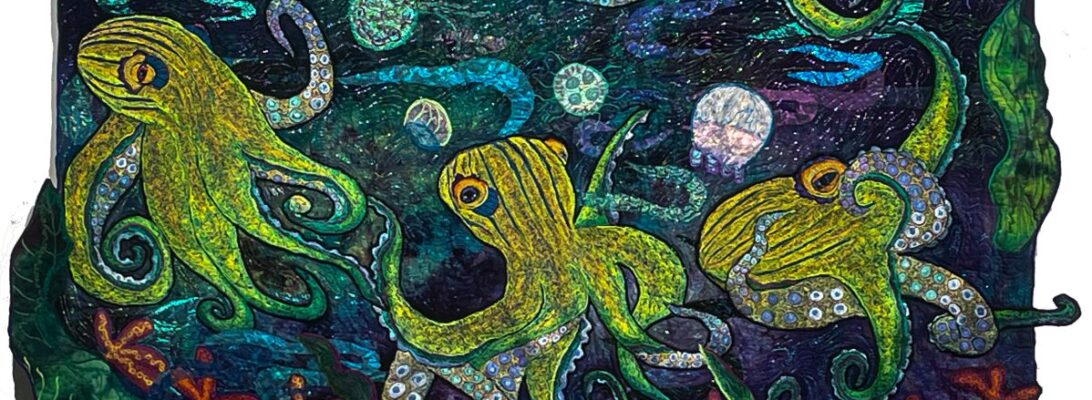
After having worked for some while on Octopi Dance, I decided I needed jellyfish to add to the flow of the piece. If you’ve been reading this blog for a while, you know I’m obsessed with creating a visual path through each quilt as a significant design feature. That can be done a number of ways, either through the background, the flora around your subjects, or with smaller objects that the eye follows across the piece.
For the octopi, jellyfish were a simple choice. They float and can be pointed in any direction. And the purple, green, and iridescent qualities are perfect against all that hot yellow.
What I really wanted after all that very solid garnet stitching was something translucent. I can do that fairly with organza and lace. But if I glue organza to the background, the background becomes a major part of the jellyfish. Some of the transparency is lost.
So I decided to make jellyfish with only the organza on the back. There are several ways to do that. One is to use a dissolvable stabilizer.
Dissolvable stabilizer is usually made from some kind of starch. There are a lot of brands but there are really only two types. One is see-through, and one looks like paper. They both dissolve in water. The see-through variety is usually a topping, put over your piece so you can embroider details without having your foot caught in the textures. It can also be worked in a hoop. If you want more information about dissolvable stabilizers, Embroidery Online has a wonderful article about them here.
The paper varieties don’t dissolve quite as well, but they make a better stabilizer for embroidery. Since I didn’t want to fuss with a hoop this time, I used a paper dissolvable called Paper Solvy, available at Amazon. It comes in a pack of 8.5″ x 11″ sheets.
It’s hard to make a stable embroidery just out of thread. You have to be sure you’ve connected all of it to itself, or it will fall apart when you remove the stabilizer. So I glued the organza onto the stabilizer with Steam a Seam 2, partially for color and partially to make the pieces more stable.
You can’t stitch as closely with this stabilizer. It will either tear or jam or both. I also ran a straight stitch around the outside of the pieces and then stitched my zigzag stitch over it. That holds the piece together better after the stabilizer is removed.
There are some good and bad things about this stabilizer It did dissolve quite well. It stitched fairly well, although I had a lot more thread breakage. And one was not enough.
I tried one set with a sheet of Tear Away behind the Solvy, and had to tear away that background. Not recommended. It took forever and it tended to tear away the stitches as well.
I’m quite happy with the ones I did on two layers of Paper Solvy. They dissolved well and the stitching stayed mostly in place. They can join in the dance,
For more information on the visual path check out Building a Path.
Last week’s octopi are growing. And the stitch to use for anything as lumpy and bumpy as an octopus is the garnet stitch. The fun thing is how many variations there are.
Reviewing Garnet Stitch
Garnet stitch is not a stitch on your machine. It’s working free-motion and moving your hands in circles. You can make all kinds of circles or half circles to different affect. It works either straight stitch or zigzag. It sounds simple.
It’s defined by how fast you move your hands, how large your circles are, and whether you let them overlap or not. The range of effects you can get is stunning. Visually it stands out like nothing else.
zoning
The first thing you do with a project such as this is zone it. Usually, I zone for color. With this project, I’ve zoned for texture as well. For working purposes, I marked the tentacles dark and light, since that was a major concern. Light tentacles are sucker side up. The suckers are different from the main surface, which is different from the eyes, and also different from the skin between the suckers and the main surface. The colors slide through a range between a bottle green and bright yellow, with blue and purple streaks. Nothing subtle here. But zoning my drawing helps me to know where my colors and textures need to be.
The suckers are a bull’s eye garnet stitch: dense stitching in a complete circle with no overlap, There’s a small rim garnet stitch in purple to punch out the suckers.
The general skin is an overlapping loose zigzag with layers of color on it. I’ve topped it off with a seed stitch to make it truly lumpy.
There’s a ridge over the edge where the suckers meet the main skin. I put a red violet edge of garnet stitch overlapping on one side to build the ruffle on.
The suckers seen from the side and the ruffle are pure zigzag stitching.
Finally, I stitched a large seed stitch across the skin to get that lumpy bumpy look.
Octopi are made for garnet stitch! Next week, jellyfish.
I get caught in themes. I get excited by birds or fish or bugs, which I do for a while. That’s fun, and it lets me explore different stitchery. But every so often, something new lures me elsewhere.
I’ve been mesmerized by octopui lately. About their wonderful movements and their textures. I’ve been reading a book called Remarkably Bright Creatures, by Shelby Van Pelt. It’s a delightful tale largely of an octopus and a cleaning lady.
I’ve lived almost all of my life with my creatures as my closest companions. Can an octopus and a 70-year-old lady be friends? I’m jealous. I’d love an octopus as a friend.
And Matisse. How do octopi and Matisse mix together?
Matisse did a lot of work that centered on movent and patterns. I deeply love his paintings for their rhythms and movements. Can you see how this starts to mix together? The alien grace of an octopus reminds me of these ladies in their dance.
I’ve always loved these dancers. Now imagine them as octopi. I know. It’s kind of an art joke. But I’ve been wanting to do this for months.
These are the octopus I have planned for the quilt. I think they should all join tentacles and dance. Again, it’s about movement together.
Both the quilt and the painting are about fluid motion, the dance between us as a group. So that must be what I’m working on. I rarely understand a piece until it’s finished, sometimes much after that.
Why do art jokes? Because they make us think differently. And that is largely what art is for. And things need to lighten up a bit right now.
I’ll be showing you more of these octopi as I go along. Next week we’ll talk about garnet stitch zigzag and straight and how to shade with it. Right now I’ve been doing sucker.
I taught twice over the last two weeks. I had a magnificent class with Gems of the Praire Quilt Guild and with a group of teen artists at the Peoria Art Guild. Seeing that I hadn’t taught a full day class for over ten years, it was a wild experience. I haven’t quite caught my breath. But I had a great time. I hope they did too.
At Gems of the Prairie, I did a classroom book for them, just because I hadn’t done one for that class. Over the years I’ve done a number of classroom books. I taught the Thread Magic Stitch Vocabulary Book, where we make a book out of samples of different kinds of free motion work. The booklet covered it all with step-by-step photos, tips, and tricks. It’s available now from Amazon in Kindle and in print.
Classroom books are not just for a pretty coffee table. I’ve always loved designing eye candy books. Who doesn’t like eye candy? And feeding your eye is an important part of any art. You need to see things that excite you to go on to exciting work of your own.
But classroom books are for a different purpose. They may feed the eye, but they’re there as a guide through a class and as notes for someone who doesn’t normally take good notes in class. Why would I do that?
Because different people learn in different ways. Some folk learn auditorily. They need to hear everything. Some learn visually and need to see everything. Some learn only by doing. In class, you hope all those modes will be covered. If I offer a comprehensive class guide, I’ve doubled down on the visual mode which is usually the most common
How do you know which mode is operating for people? They’ll usually tell you. “I see that…..” I hear that…”The kinetic mode is the least common, but it’s obvious when you see it. They have to touch everything. And they are the ones who probably take the most thorough notes. It involves physical motion.
None of that is good or bad. It just is. Most folk operate in all modes to some extent. They do better when you hit on all three, but they can absorb information from each mode.
Unless they are in some way dyslexic or distracted. At which point, it’s crucial to have a mode ongoing that they can utilize.
Why does that matter? I came out of school to teach first grade. I don’t believe in the bell curve. I believe everyone needs to learn their colors, tie their shoes and read. And have a fighting chance to learn what they want to learn. I believe in meeting a student where they are and leaving no one behind.
So rather than do dense note handouts on boring white paper, I’ve made classroom books for my students. Due to the wonders of print on demand, it costs as much to print a short booklet as to bring in handouts. And the handouts don’t have as cool pictures.
Sadly, the company I printed my other classroom books discontinued my books, when they stopped doing saddle stitched books. So they’re now out of print.
I don’t know that I’ll take up traveling to teach again. But I do think I’ll teach, just because it’s something I really like to do. And I think that the books I did for class are still important ways for people to learn whether I teach them or not.
The downside of a classroom book is that it’s meant to cover just what’s in a class. Usually, they have a supply list, patterns, step-by-step pictures and instructions, a short gallery, tips, and a source guide. They cost more because they are self-published. It’s a limited scope.
So I’m revisiting those books. I’m hoping on reprinting them, although the format needs to change a bit to accommodate perfect-bound books.
Because, even without class, a classroom book is there to share information, to teach whether you are there or not.
So I’m planning on reprinting these with booklets put together in a series of books called Skill Builders, What do you think? Is it something you’d like?
Like most little girls, I had a pink bedroom. Unlike most other girls, mine was seafood bisque pink with brown. Needless to say, I’m hesitant about using pink. I certainly don’t wear it..
But in spite of my feelings about pink, I know better than to dismiss a color from the color wheel. They’re all in relationship with each other. It’s like putting up with weird Uncle Fred because you really like his wife Ethel. They are deeply connected and you get the one when you choose the other.
And some things are just unabashedly pink. Like roseated spoonbills. So here we are.
She’s a nesting bird, and I loved her pink and brownish background. You can push past your color preferences when you try,
These flowers were mostly white sheers and lace, stitched over in pinks, cream, and whites. The white glowa behind and the thread gives a pink blush. To my mind, they register as white flowers but the shadows echo the burgundy background. It’s a delicate look.
I haven’t done lady slippers for a while. And I wanted a white creeping vine around the outside. But you can’t make something just white. It has no dimension. So this time I used white sheers to form the flowers, but I pulled in other colors to shade them. Because the background is fuchsia, I went for soft pink shading for the white flowers. For the lady slippers, I went into brighter pinks and burgundies, with the white shining through just a bit.
Now, what makes the color of a flower? Or any other thread work? Is it the thread? Or are there other factors.
No matter how much you stitch over something you always see the background. Always. Usually I am for a background color that accentuates the threadwork.
What happens if it doesn’t blend or match? It glows from beneath. I’ve started with iridescent white organza to create an inner glow for the lady slippers.
I stitched from both sides, leaving just a bit of plain iridescent organza in the center to round out the flower. The iridescent background creates an inner glow and a subtle pink.
Here I chose pink sheers and stitched over them with various pink/apricot threads. The effect is vibrant and full of color.
The background I stitch over is as much a part of the color as the threadwork. The differences are subtle but very cool. The combination of light and color creates dimensional blooms that glow.