
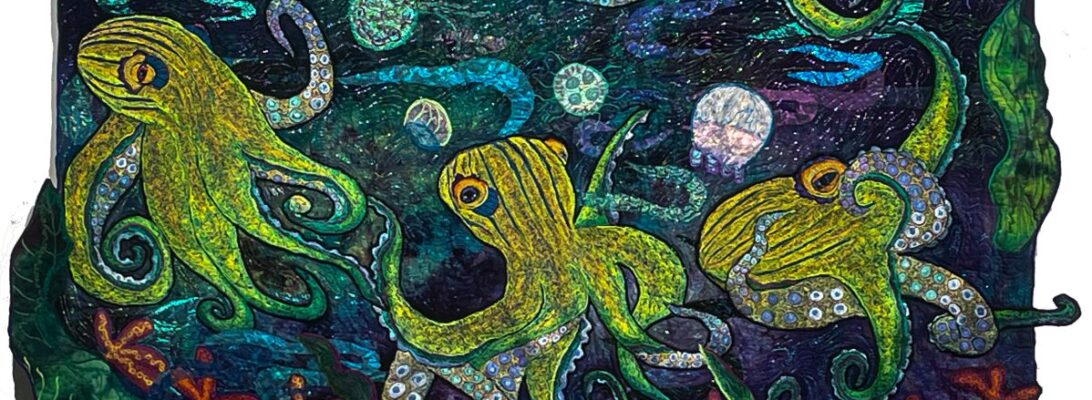

I’ve been in love with oil paint stick rubbing for some tine. The ritchness of the patterns and colors adds a fabulous dimension to my art.
IT’s not for every quilt. It’s not for every image. But when it’s right it’s magical.


My first usages for them were little quilts, experiments more than anything. To my surprise, they have been popular. People have bought them and been pleased to have a small quilt at a more accessible price. I’ve continued to make them.


They’ve crept into my larger work as well. I found I could use plastic ceiling tiles as rubbing plates,
What am I missing?: Rain, frogs, birds, grass, pebbles, water reflections, clouds, sea weeds, and who knows what else.
It’s limited. There are some fabulous rubbing plates, but they are finite. No one seems to making new ones. And as a phase in the quilt world, it seems to have come and gone.
But that’s the thing about phases. If they have a glory of their own, then perhaps they shouldn’t go. I keep wanting more images. At a certain point, it has to come from somewhere else.
I’ve tried desperately to make my own.
This has been a quest for a while. I tried making plates on a CNC. As it is, it’s past my ablity. If anyone is willing to help me learn, I would bless you. I do think it’ s a possible answer. I’m not currently able.
I’ve tried block cutting erasers. Words fail me. Not my skill. I’m willing to do something badly to do it well, but not that badly.
I’ve tried piping modelling paste, with limited success. You can pipe modeling paste through a piping bag like frosting. I can too, but mine is lumpy and weird, even if I smooth it out with a brush.
If it’s too hard, too long or too miserable, you have the wrong tool.

I saw someone stencil with modeling paste. They weren’t making a rubbing plate of it They were building a raised image. . But I sure could. The number of available stencils appears to be endless. I still wish I could make my own designs work.
Here’s my first efforts. The colors are irrelavent. They’re whatever acrylic paint I had. I do think it’s helpful to use a color because you can see your raised surface better and correct it easier if needed.
I’ll be exploring this for a while in the next couple of blogs. Next week, how to make the plates.
2 thoughts on “Hunting for Rubbing Plates: When You’re Desperate You Make Your Own”