Last week has been spent in fish production. I can’t really put in the octopuses until I have the fish to create the path around them.
Usually, fish have scales, and the scales divide the space..You progress from scale to scale, picking lighter colors as you get to the underbelly. You fill in the scales darker on top and progressing through lighter colors around the belly. It’s pretty. It gives depth.
What if you don’t divide the space? You can stitch row after row of color next to each other. It looks stripy. There’s a place for that, but it’s not very natural.
It doesn’t work for clown fish.They blend from one color through another without separation.
So how do you fill in a larger space? One way is the short and long stitch.
You need to understand that none of this is a stitch on your machine. It’s all zigzag stitching. The change is the angle in which your fabric goes through the machine.
The long and short stitch is done from side to side. The difference that it spreads from both sides and fills in unevenly, shading the area softly and without stripes. The top and bottom of the image has a solid line to outline.
That kind of shading allows us to put in darker contrast colors to shade that blend right in. These fish are shaded with a dark and then a lighter purple. Since the colors are mostly covered with orange thread, your eye blends them into a shaded solid orange.
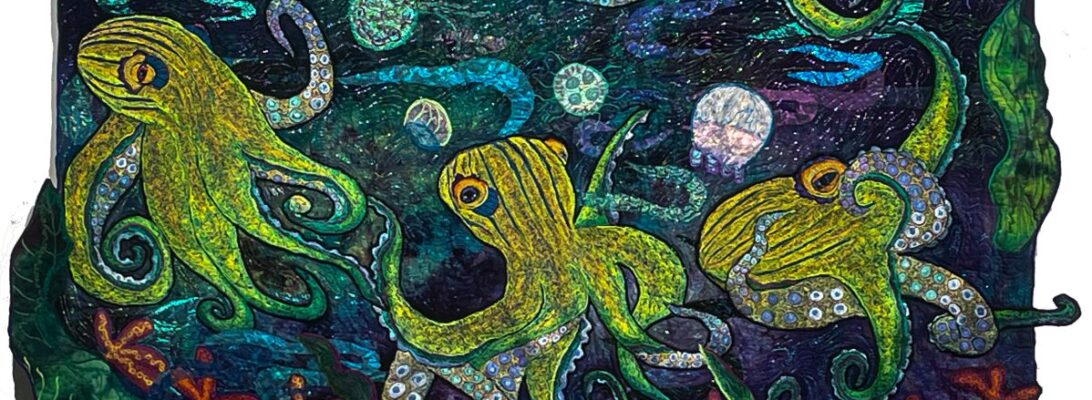
All of this is for the octopus’s garden. This is my second pin-up. I think it needs one pillar rock and some water, but it’s ready to back, and stitch.
For those of us who use bobbin work, there is always the quest for empty bobbins. For every color of thread I use, I need a bobbin with that color of thread.
So it’s no surprise when I get a new kind of machine, I usually buy 200 new bobbins for the machine.
Unfortunately, bobbins cost more. My Bernina 770 uses a $5 bobbin. They are pricy. But truly, like being too rich or too thin, there are never enough.
Thread is pricey too. It won’t go back on the spool. So you either use it up or pull it off the bobbin and waste it.
So when I went to do a run of minnows, I looked at my bobbin box and made a plan.
I didn’t want the fish to be in any way identical. That’s not the nature of nature. Nature is endlessly variable. So I decided on green fish and yellow fish, and planned to empty each yellow or green bobbin dark to light, top to bottom.
The fish I’d drawn had cross hatched details. I lined up my bobbin colors and made a progression of colors square by square, dark to light. I think I filled 4 bobbins for the whole batch. How many did I empty? The empty bobbin count at the end was 16.
Here’s the finished fish. Because I wasn’t micromanaging the colors, they clash a little and contrast not only in color but in tempurature. Which makes them shimmer a bit. Like fish.
My dad would have been pleased to make that catch. And I have enough empty bobbins to tackle the birds next.
I love minnows! My dad used to bring me home minnows when he’d been fishing, so I could watch them. They aren’t exactly like fish visually. They have parts that are solid, but they also have fins and underbits that are really translucent. How do you do that in thread?
I used to not pay much attention to the kinds of metallic threads I used. I mixed them all together by color and that was that. But lately, I’ve been paying more attention. Metallic thread is not only shiny. It comes in different kinds of transparency.
Why would that matter? A more transparent crystal thread gives a translucency to your embroidery. It’s not quite see-through. Most wound metallic threads are not at all see-through. But the flecked metallic threads can be to some extent.
Most metallic threads are not. They are a strictly shiny surface that reflects, in both ways, the solidity of metal.
Metalic-colored threads have the shine, but they are not see-through either.
Crystal metallics are different. They have a translucency that translates into your stitching as being see-through.
With some careful planning, the bodies of the minnows are mostly solid, but the mixture of metallic silver and iridescent white crystal makes for transparent-looking fins.
It’s a trick, but it’s a cool trick.
These minnows will be in Shadow on the Shore. I’m not sure how many minnows we’ll use, but there’s always room for leftovers.
This piece has been sidelined several times this year. I’m grateful to have it up on the wall ready to back and bind.
I’ve lately been hearing people saying, “Don’t stipple.” I couldn’t quite figure out what they were talking about. Stippling serves to anchor and detail the negative space in your work. One of the problems with intense embroidery is that you can’t just leave the fabric around it blankly unstitched. It looks very puffily unfinished if you do that.
The stipple also sets the shine for the piece. Depending on the threads you chose, the difference in the shine can help your eye separate sky from land and sea. The moon is stippled with monofilament nylon. All you see is the waves in it but no color change. The area around the heron is air, stippled with a multi-colored Madeira Super Twist.
The water stipple is with 8 weight metallic thread. Both the Supertwist and the thick metallic threads are stitched from the back. The 8 weight thread is too thick to go in the top so it’s in the adjusted bobbin. The Supertwist is a bit fragile, so it’s stitched from the back with a regular bobbin case.
The cool thing about stitching over the sheer overlays is that includes them in the water movement. I did not do that with the air overlays.
So what was that lady talking about? I finally figured it out. She was talking about that random puzzle piece kind of stipple. She is right. There are a million ways to stipple a piece. But that puzzle stipple does nicely in the air here. The thick and thin metallic threads separate water and air.
The stitching you use as stippling defines and fills the negative space in between your objects, giving them meaning that goes with their gorgeous looks.
If you are looking for other ways to stipple look up Leah Day’s 365 Free Motion Quilting Designs. It will give you all kinds of ways to add texture and free motion without the puzzle piece stipple pattern. It’s a brilliant book!
Here’s Chapter Three of the Stitch Vocabulary Book! This time we’re focused on bobbin work. For more information about bobbin work check out Topsy Turvy and Skimming the Surface both on bobbin work.
Thread Magic Stitch Vocabulary Book will be available for sale in early May!
There’s nothing like new threads. You know I love thread. It’s the most important component in my art. I love my fabric but I am nuts over thread.
One of the things that is different for me now that I am no longer on the circuit, is that I don’t have to make threads that are commercially saleable. I’m not constrained by that so I can explore threads that can’t be reproduced in regular quantities for students. I’ve used # 8 pearl cotton because it came in dye hanks. I could easily dye it for myself but also for also for students who were in my class and needed access to the threads I worked with.
#10 pearl cotton
Now that I just in my studio working my own art, I have the freedom to work with things that can’t easily be put up for sale. This last dye load, I dyed up a load of thread that I’m so excited by. I’m looking forward to trying out my #10 pearl cotton.
You can’t dye thread wound in a ball. You can hank it off with a swift, but there’s no way to make even skeins without counting accurately. Those of you who know me know how likely that is.
8 and 10 pearl cotton
The smaller ball is #8 pearl. The larger on is #10 pearl. The larger the number the smaller the thread. The #10 still needs to be worked in the bobbin case, but it will give a finer grain stitching. I’ve started the first row on this frog in the #10 so you can see how it stitches up. I am so excited!
frog in #10 pearl cotton
Sometimes a change in materials changes our work immensely. Sometimes it makes a little change. Sometimes it changes nothing. There’s no way to know until you work with things. But the possibilities make me giddy.
Up until now in this series, we’ve worked on images both in thick and thin threads, in zigzag and straight stitching. There’s one other place I use bobbin work. I use it for stippling.
Why? More of those wonderful, beautiful, difficult threads.
It’s no secret I’m a magpie. I love things that are shiny. And I always want to pull the eye across the quilt.
I often use Sliver, which I’ve shown you before, as a stippling thread. It’s fragile. It can be used with Sewer’s Aid and a #90 topstitching needle but it’s always easier to put it in the bobbin and match it with a polyester or rayon 40 weight. I’ll start with the lightest color around my light source, and shade outward one color after another.It helps define the light source, carry your eye across the piece and make it all shine.
I love sliver as a sky stipple or as water. So many colors! And so many ways to shift the color across the surface of the quilt.
But sometimes I like to do something different with water though. I love sliver, but it doesn’t show up as well over organza or lace. So I like to use the #8 weight metallics, again in the bobbin. They make wonderful waves and rivulets. This is a thread you can use only in the bobbin. It defines the movement of water beautifully.
Everyone always worries about not being able to see from the back, but it ‘s not that hard. Here’s an unfinished piece almost ready for stippling. You can see the sun, the dragonfly and the rocks all on the back side, All you have to do is stipple.around them.
I hope this series leaves you excited and able to try all kinds of threads you thought were too hard or too difficult to work with in the bobbin. It’s a brand new world of possibilities, and beautiful choices.
The last two posts we did looked at bobbin work for thick thread. This time we’ll look at a whole other reason to work from the bobbin and a whole different result.
Everyone loves metallic thread. It’s beautiful. I’ve heard it described as candy. I concur. That is until you start to stitch with it. There are a number of things that make it “easier” to work with metallic thread. But no one ever says it’s easy.
Why? If you look at the construction of metallic thread, it’s pretty obvious. Metallic thread comes in a twisted flecked thread, a metallic colored lurex wrapped around a core, and a thin strand of lurex. Either way, it’s thread made to be shredded. It’s not one solid strand of one thing. It’s a combination that uncombines with ease.
How do we get around that? Sewers Aid (silicon treatment for thread) and a number 90 topstitching needle help. But the easy answer is to put it in the bobbin and work from behind.
I know. I know. I can hear you screaming “What????” at me through the computer screen. Sensibly enough. But any time my thread goes through the top of my machine, it goes through the needle 50 times. It gets pulled up through the bobbin once. Are you wondering why your thread broke? It’s so much easier to put the breakable thread in the bobbin.
Madeira Supertwist Metallic Thread
For this, I used #40 weight metallic thread. I really like Madeira’s Supertwist for it’s color and shine and the color range. So we don’t need an adjusted bobbin case. We can use the regular bobbin case. But we still want to match the needle thread color to the metallic thread color. You will see both threads on the right surface of the quilt.
I do these most often as appliques. Why? Because they really pucker up. The distortion on zigzag stitching is ferocious. I make the same sandwich as last week, my drawing on Totally Stable, Stitch and Tear, felt, and hand dyed fabric.
I’ve talked a lot in this blog about free motion zigzag stitching. What matters is the angle that the fabric goes through the machine. Straight through gets a thick clunky line. At an angle gets you a very nice outline. Going from side to side gets you a great shading stitch. All out of the same zigzag.
I started by zoning my piece so I know the areas where the color changes.
I began with a black out line zigzag. Then I built my colors in, first with an outline, then the shading and then that clunky line to smooth it out, one shade after another, starting from dark to light. The last color I put on will be the color I see the most.
Here’s the process shots for this frog.
spots
spots from back
outline
green shading
purple shading
turquois shading
medium green
lighter green
medium purple
lightest green
soft purple stomach
apricot shading
light yellow
finished frog
After I’ve stitched it completely, the stitching lay flat, but the area around it ruffled like a party dress. I cured the whole thing by simply cutting off the background.
To apply it to my quilt, I stitched it down with the same black thread outline, run through at an angle to make a great smooth edge.
What is the difference between thin thread and thick thread?
Thick Thread
Bobbin Case Only
Adjusted Bobbin Case
Always Abstracted by Stitching
Puckers Up Some
Thin Thread
Use in Needle or Bobbin Case
Regular Bobbin Case
Can Be More Detailed and Shaded
Puckers Up Mightily
The other major reason to use bobbin work with thin thread is because you can tie up the ends on the back. Every time you clip your threads from the front, there’s two thread ends poking up. For multiple layers of stitching, that can make the whole piece look fuzzy. I always prefer to work from the back and tie my ends up from behind, to keep them out of sight.This works just as well for poly/and or rayon threads as well. These moths were done upside down as well, but with poly threads only.
Don’t be afraid to work upside down! You’ll find all kinds of threads that have been fiends are now your best friends.
Thick metallic thread and pearl cotton bobbin work make up the heron
Do you like instant gratification? But of course! Using thick thread in the bobbin is showy, exciting and quick as machine embroidery goes. It’s one of my favorite techniques.
Bobbin work is the only way I know to free motion with thick threads. I’m defining thick threads as #3-8 threads. What those numbers mean is that if you put 8 threads side by side, they would make an inch. This is what thread count means.
adjusting a bobbin case
Thick threads can’t fit through the needle. They do fit easily in an adjusted or bypassed bobbin case. How do you know what kind of machine you have. If you open up your bobbin and it’s in a little silver housing that comes out of the machine, that’s a bobbin case. For thick thread, you loosen the bobbin case by turning the screw about 3/4 of a turn to the left. It’s best to have a separate bobbin case for the purposes. Bobbin cases get old, so it’s never a bad idea to buy a fresh one and make your new bobbin case your true bobbin case. Mark the old one with nail polish, and keep it just for thick thread.
If your bobbin just drops into a housing in your machine, it can be bypassed. You simply don’t put it into tension. No need to adjust anything.
I tend to keep extra bobbins to hold and store thread I’ve wound off. One bobbin per thread. If I don’t use it for one project, I’m bound to use it for another.
Never wind a bobbin on top of thread on the bobbin. It messes terribly with your tension.
I usually stitch on a similar fabric to the background, or one that matches the color of the embroidery. Don’t fool yourself. IT WILL SHOW!
a different frog, zoned
Your image is always backwards. Think of it as a slide. You can see it through either side. I use Totally Stable as my patterns, drawn with marker. It irons on but the excess will tear away.
Stitching in a creature is like coloring with different crayons. I pick black as my outline, and then I zone my drawing. On this frog, there’s a tummy zone, a stripe zone, an eye zone, and the basic body.
I choose my darkest thread in that zone first, the color I want to be dominate. I add a shader color, usually purple, brown or a complement to the color. Then I go through a range of the color, dark to light, and add a shocker color, usually the complement right before the last lightest color.
eye colors in sliver
The eye is always done in sliver thread so it’s shiny and wet. I use black for the pupil, an iris color, and iridescent white for the spark.
Eye
Here’s a progression of stitching and thread on this frog
thread one green zone
thread two green zone
thread three green zone
thread four green zone
thread five green zone
thread one stripe zone
thread two striped zone
finished frog on background
Some basic things about thick thread bobbin work:
Only work with a straight stitch: Zigzag stitching tends to sew your piece to your needle plate and jam your machine.
When you fill in your stitching, remember that the thick thread fills up more space than the thinner thread on top. Leave a little space.
Pick a #40 weight embroidery thread for the top thread. I like polyester, for it’s strength. You should either match the color to your bobbin thread, or like the mix of them together. You will see both on the front of your piece.
New project, new needle! New day, new needle! I use #90 topstitching needles because they’re strong and have a large eye that reduces thread breakage.
Midnight Stroll
I could stitch directly into my top as well. It integrates better into the background, but it tends to distort things. If an image is under three inches square, I may well embroider right on the surface.
frog cut out and ready to go
But if it’s a big enough image, It’s better done on a separate sandwich of felt, Tear Away, Totally Stable and suitable hand dye to match. It can be appliqued onto the surface and will look like it belongs perfectly
Don’t be afraid to be upside down. Bobbin work makes the most impressive images quickly and easily.