Angling for Fish: The Short and Long of It

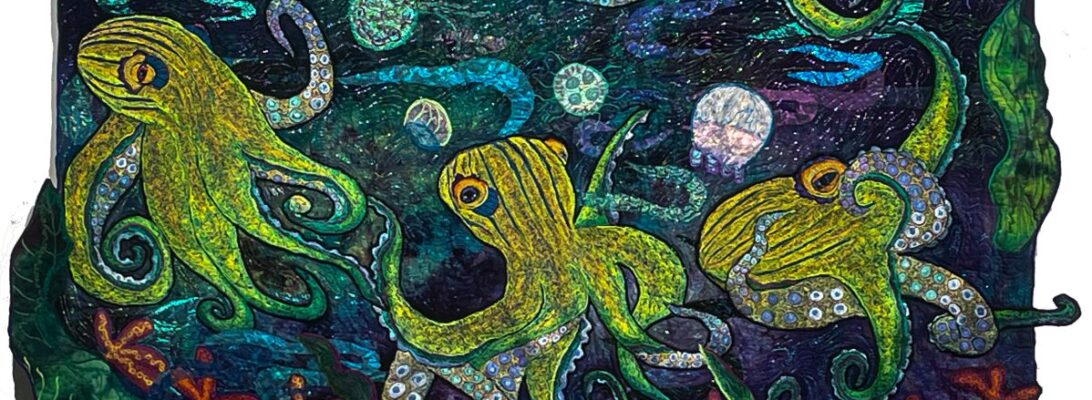
Last week has been spent in fish production. I can’t really put in the octopuses until I have the fish to create the path around them.

Usually, fish have scales, and the scales divide the space..You progress from scale to scale, picking lighter colors as you get to the underbelly. You fill in the scales darker on top and progressing through lighter colors around the belly. It’s pretty. It gives depth.

What if you don’t divide the space? You can stitch row after row of color next to each other. It looks stripy. There’s a place for that, but it’s not very natural.

It doesn’t work for clown fish.They blend from one color through another without separation.

So how do you fill in a larger space? One way is the short and long stitch.

You need to understand that none of this is a stitch on your machine. It’s all zigzag stitching. The change is the angle in which your fabric goes through the machine.

The long and short stitch is done from side to side. The difference that it spreads from both sides and fills in unevenly, shading the area softly and without stripes. The top and bottom of the image has a solid line to outline.

That kind of shading allows us to put in darker contrast colors to shade that blend right in. These fish are shaded with a dark and then a lighter purple. Since the colors are mostly covered with orange thread, your eye blends them into a shaded solid orange.

All of this is for the octopus’s garden. This is my second pin-up. I think it needs one pillar rock and some water, but it’s ready to back, and stitch.

For more information about the long short stitch, check out The Long and Short of It Blending Stitches with the Long Stitch

Seeing Spots: Some Strategies for Shading around Garnet Stitch

We worked with garnet stitch to do octopi several weeks ago. That was an all-over garnet stitch that could be shaded across the piece. But what if we want separate spots and smooth shading around them? How do we go about that?

What we need to do is to define the spot clearly, and then shade around it. But shading with one color around the spot negates a color range shade. We need to put in our spots and then shade around them defining different sides of the spot with different colors.

We start dark to light with the darkest threads first. The first color needs an outline stitch done at an angle to define the shape. Then we’ll shade out to the side, and then smooth the line between the outline and the shading.

But after that row, there’s more shading than outlining. When we come to each spot we outline the spot on that side and shade past the edges of it. Then in the next color row, we outline it from the other side and shade it into the earlier colors. The spot is clearly in the color range but it’s defined by the outline around it that fits the shading as it changes.

It’s a cool trick for including spots in a smooth range of colored stitchery.

For more information about shading colors check out The Long and the Short of It: Blending Stitches with the Long Stitch.

The Long and the Short of It: Blending Stitches with the Long Stitch

We’ve been talking about the variability of the zigzag stitch in free motion. Most of the time, I’m filling in a space where I want a line of color to show up. This is a trick that will give me a soft blend of color across the image without a hard line. I’ve heard it called the long stitch, although the old-fashioned description you hear with free motioners is the long short stitch. As with all free-motion zigzag stitching, the difference isn’t a setting on the machine. It’s how you move your fabric through the machine as you’re stitching.

Most of the time when I’m filling a space, I stitch a zigzag line at an angle around the edge, I shade the piece by stitching from side to side, and then I smooth the edges with a zigzag that moves straight through.

But when you just move from side to side you get a long blending stitch that flows into itself. The breast of the bird is done from side to side. The feathers are done with an outline, shading, and smoothing. You can see the difference.

You can find more information about the angle of stitching in the Thread Magic Stitch Vocabulary Book or this post, Stitch Vocabulary: Zigzag Stitch.