This is not the first time I’ve done three-D jellyfish. But I’ve tweeked what I did this time and I’m happier with the results. If you’d like to see the earlier attempt, they are at Jellyfish 3D Transparency
I wanted three-dimensional transparent jellyfish with opaque areas.
This technique depends on the stabilizers. But there are a number of different stabilizers that will work. They are made for very special purposes.
Stabilizer Sandwich
This time I made my stitching sandwiches out of a layer of Totally Stable for my drawing, Paper Solvy, lace or organza, and Badgemaster, All the stabilizers except the Totally Stable will dissolve out of the work. What I want when I’m done is a clean outline and edge, with some white areas and some transparent.
You can make an image just with your stitching. But you have to make sure all of the stitching connects with itsself or it will fall apart when the stabilizers are gone. Instead, I used commercial nylon lace and organza as the fabric
What do those stabilizers do?
Totally Stable: Iron-on, tear-away. Good surface for drawing a pattern
Paper Solvy: Paper-like, tearaway that provides stabilization without a hoop that will dissolve in water.
Badgemaster: Heavy-duty corn starch topping that dissolves in water.
The order of the sandwich was, from top to botton, Badgemaster, organza or lace, Paper Solvy, and Totally Stable. Snce we’re working upside down, Totally Stable drawing layer is on top where we can see it.
The threads I chose were a polyester white top thread and a Cristalyn white metallic in the bobbin. The metallic is more fragile, and that is why I have it in the bobbin. I chose white because the background is so dark, and I wanted them to shine out. All of the stitching is done from the back.
You’ll notice that I used 2 different magic markers for my drawings. That was an error. Even with all the stitching, the marker colors showed through. I don’t mind either the blue or the orange, but they don’t work together in the same piece.
The Stitching
These are all stitched free motion from the back.
Stitch Process
Outline the image. Freemotion zigzag.
Remove any of the Totally Stable parts you want to be see-through. Score them with a pin and pull them out.X
Use a straight stitch to texture the jelly.
Remove the excess Paper Solvy and Totally Stable from around the pieces.
Stitch around the edge with a zigzag to stabilize them.
Cut away all the excess stabilizer
I edge-stitch again just to give them a more solid edge.
The Paper Solvy and the Badgmaster need to be dissolved in hot water.
Badgemaster is starch. So I took the trimmed off scraps,dissolved them in water, and dipped the jellies to give them that hard starched edge. I dried them on freezer paper. Notice that the orange jelly is the one that was drawn in orange. I need to rethink my mmarkers.
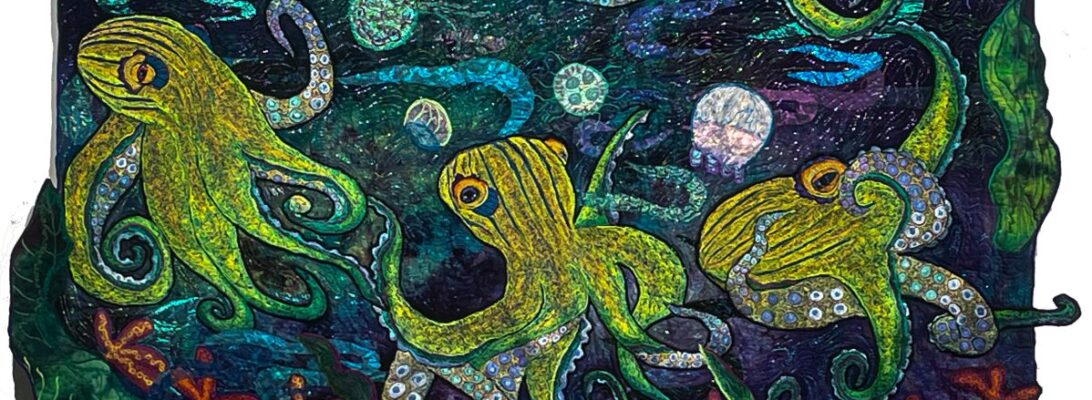
We’re ready to roll with the 3rd pin up on Octopus 5. I believe we’ll call it, Rock, Paper, Shark.
Octopuses have put me in the land of the garnet stitch. It creates. textire and pattern, all within it’self.
Garnet stitch is one of the great non-programmed stitches. it’s simply moving your hands free motion in circles. Check out the Variable Garnet Stitch for more information about the stitch.
Garnet stitch has another very useful feature. You can always see the background behind it. Sometimes that is to be avoided. I pick my embroidery background to match the overall background carefully, so only the stitching stands out.
But sometimes I want the embroidery background to shine through.
This was one of those times. The background for this piece is darker and moodier than the other pieces in the series. I needed something to lighten it up. So I used a very odd cream and green background. I love it. I have a green and cream light octopus in a dark sea.
We are on to the pin up stage for octopus 4. That’s always the moment of truth. You know if it’s going to work at that point.
Because I’ve made small metallic fish and 2 nurse sharks, I have my components to fill the space and set a path. I’ll tweek it some, but the design is pretty much there.
There’s a lot of stitching left, and I need to do my water layer. But I’m confident I’m going to like this piece.
Just to show you where I am in the octopuses garden, here’s the pieces so far.
One more at least to go. Does it look like a show yet?
I never used to think about how a quilt would be viewed. Was it pretty? Did it move? Did it tell a story? Did it change people to see it? I never thought about how the size of the space around it affects what the viewer sees.
Now I’m keenly aware of the space a quilt will hang in. I don’t have any control over that when I sell a quilt. It goes where the owner wishes. It becomes part of their house and their lives.
But small work is viewed differently, just by definition. Small work is made to be examined. You come up close to see it. Every detail matters and is exposed.
Unfortunately, most small work isn’t really that visible at a distance. It’s made to be intimate. Your relationship with it is within its small space. It fills a tiny space with an explosion of color and detail.
Larger works have a harder task. Done well, they will pull you from across the room. The movement and the color should sweep you in. But once you’re up close, the detail should amaze you.
When I first started using rubbed fabric in pieces, they were all experiments. I worked very small, partially to learn and partially to see how they would be received. I was limited by the size of the rubbing plates. The largest were under a square foot.
I’ve worked hard to find alternatives since then. I’ve used ceiling tiles and texturized surfaces. I’ve learned to make my own rubbing plates from modeling paste using stencils. So my options have expanded not only in size but in possibilities.
With these octopus quilts, I’m using the rubbings as objects themselves, rather than backdrops. Mostly, I did seashells and jellyfish.
I love the rubbings I’ve done for this. But they need something to pump them up to be seen across the room.
I usually use straight stitch #40 poly thread to match and shade the rubbings. That’s exquisite on a small piece. It’s almost invisible at a distance. So how do we pump it up?
I chose to stitch my jellyfish in white. I rarely use white. It’s too bossy. But for this piece, white thread pumps the jellyfish up.
I chose to outline with a very small zigzag. It’s a subtle difference. But it does define the line.
For the seashells, I did not outline. Their shapes were visible enough.
The downside of this much stitching is that I have some distortion. We can fix that. Where’s my iron?
I try really hard not to rate my pieces as I make them. I find that my opinions of things change over time, largely in reaction to people’s reactions. If I suspend my judgment of work, I find I learn more from it. Suspending judgment allows me to flesh out ideas and move on. Finish the quilt. Next quilt, please. The learning is the goal. The quilt is almost a byproduct.
But sometimes I do a piece that knocks my socks off and throws me across the room. It’s not an everyday thing. When that happens, I find myself asking some of the same questions that I ask when I do something I hate. What happened here? Why is this piece wonderful? Or awful? What?
Was it the color palette? Technique? Is it about my background? The image itself?
A fabulous piece makes you think, “Can I do this again? How did this happen?”
I love this piece so much. So I’m going to try not to reproduce it, but to focus on its successful elements.
Part of what I love here is the quiet palette. I normally go for eye-sore colors. This was restrained. Luckily, the last batch I dyed had a piece, not exactly in the same palette, but in the same tone.
The fish can be the same threads. And I think it needs to be.
I had trouble with the fish. I wanted a fresh image, not the same, but in the same colorations. So I started several fish, only to find them wrong. I love these. But in terms of direction and size, they’re just not right.
I went through my collection of drawings. My embroidery process uses a pattern drawn on Totally Stable that goes into the back of the piece as a pattern and a stabilizer. So each drawing is consumed by the embroidery itself.
Not to worry. For the last 3 years, I’ve saved a tracing of my drawings for later. It’s turned into a jumping-off point for other pieces, and I consider that collection a treasure. I found a fish that had to be at least 10 years old, which I don’t believe I ever used.
This will be reversed when I’m done. I’m half way through the embroidery.
Originally I used a tree rubbing plate both for the trees themselves and for the reflection in the pond.
And I want to explore the rubbed oil paint trees. This piece of fabric evokes a stream rather than a pond.
Now that I’ve analyzed my elements, we’ll see where it goes. It’s at that awkward spot where everything looks wrong. But that’s the exact moment to suspend judgment and push through.
It may take all those elements and work well. It may not. There’s a mystery here I don’t understand. But I think that part of it is that a piece is not the sum of its parts. Instead, perhaps it’s a whole being itself. Maybe it can’t be reworked with the same success.
Push on. Finish the quilt. Next quilt, please. The learning is the goal.
Most quilters think in terms of one surface. You make a top. You quilt a top. It works for the traditional quilt.
It’s never worked for me. If you’re creating a natural world, one layer seems, well, flat. Layers change tones across a piece, build texture, create shading, and add elements that are present but not solid. They can be made from fabric layers, thread layers, and sheer layers.
I also have a layer of image embroidery which is a separate thing.
Hand dye is always my starting layer. Even now when it’s become a pain in the ass to dye, I still don’t want anyone’s fabric for my art but my own. It’s unique one piece to another and if you let it, it will tell you what to do. Who doesn’t need a leg up?
This last month I’ve added another possibility. I can have an oil paint stick rubbing layer that adds substance as well as texture.
Because I can make the rubbing plates I need. I’ve used rubbings for all kinds of things, but mostly, the commercia; plates are best for texture. Oil paint stick rubbing is not exactly transparent, but it does show the background through.
On this piece I wanted trees, water, and reflected trees. I wanted the actual trees to be more present, so I stitched them straight stitch with brown, black and blue.
The reflected trees and the water texture I simply let be. It feels, mirkier, wetter and more like water surface.
I have a beginning layer of sheer shapes for water under my fish.
After I’ve stitched down my fish, the second layer of sheers places them in the water.
A stippled thread layer of Madeiera Metallic colorizes the air portion and makes it shimmer.
A stipple layer of Sliver thread makes the water splash and shine.
Finally a layer of leaves defines the surface of the water.
My goal was to create three worlds, the pond, the surface and the air. I think I’ve got it.
Layers add texture, density and complexity to what I do.
I spent last week working on three cranes. I was fairly pleased with myself, when someone asked, “Are these cranes having sex?
I hadn’t seen it. I still kind of don’t. I looked up a picture of cranes in love, and it didn’t quite look that quiet. But I have my head in my hands trying to figure out what I do next.
I was inspired by a Japanese textile design in a Dover Pictorial Archive book. I’m pretty sure they didn’t see it as cranes in love. It was my own rendering of it, changed in the way we change everything we draw ourselves.
Usually I let people tell me anything about my art. If it comes from them, it’s theirs. I don’t mess with that. I meant what I meant. I’m not responsible for their response.
But this hits me in a place that makes me feel very vulnerable. Sex is about bodies and bodies are about vulnerability. Art is about visual vulnerability. I’m not really secure about body image. I work in animal imagery since I can’t bear to work in human flesh. I have a delicate detent with my body, somewhat riddled by the failures of old age and memories of high school.
It’s a response to really old tapes. I wasn’t just fat. I was born deformed. Admittedly, it was a small genetic oops. But my mother could build a tragedy out a broken nail.
IF you are harmed enough, people can frame you as being inhuman. If you are harmed deeply enough, you may even think that’s true. If other people think it’s true, they can do anything to you because you aren’t a human being. That was my whole childhood. It seems to be going around globally right now.
I’m not taking this anywhere except in my own life. And I don’t want anyone to explain situations where it is somehow ok. Or tell me to get over it. I don’t believe we get to dehumanize people.
The bottom line is that I’m terrified of naked vulnerability. My animals are me in some way. I’ve come to see my self through Don’s eyes and his vision is kinder than my memories. I usually let that stand. I’m not sure I can be a crane in love on a quilt.
I took the time to reoutline the birds. It usually makes things clearer. Maybe this time that’s not such a good idea.
So what do I do with a quilt with cranes possibly delecto inflagrante? Do I finish it? Put a bunch of cat tails around them? Do I stuff it in a drawer until I feel more brave? I tend to not just throw work out, even if I don’t like it. I could put a lower price on it, and it either sells or it doesn’t. That assumes I can bear to finish it. There’s a dark corner in the closet, perfect for storage.
So what do you think? Would you finish it? Show it? Put a fig leaf on it? What?
This blog is taken from a blog from several years back. Somehow, the pictures got removed, so I’m revising it and putting it up where it’s available. Of all the things I do as an art quilter, I’m very proud that I’m not confined by binding. This lets me make any shape quilt I wish, in any color binding I want.
I started out as a traditional quilter. And for years, I bound all my quilts with bias tape. But as my work became more organic, it felt terribly strange to put my work in a square box. None of my work fits in rectangles. It grows organically. It should be allowed to grow off the edge.
The corded buttonhole is a standard technique from couture sewing, translated from there to the quilt world. It gives us a way to finish both quilts and art clothing in a new way that’s literally out of the box. Instead of the square edges and gentle curves that are the limit of bias binding, we have the freedom to follow any shape. That means that the edge of our pieces is not defined by straight lines, but by their internal design. It also means a quilt can have an external shape that fills a wall in a much more exciting way. giving the negative space around the quilt impact. And because our binding is thread, we have the full range of polyester thread colors for our palette.
I prefer to do this on my Bernina because of the specific feet and the stitch quality. You can use a regular utility foot and a couching foot off another kind of machine.
We’ll be using two basic feet for our binding.
What largely counts is the thread escape on the bottom of the buttonhole foot.
The #1 foot has a top groove we can use to couch down the cord. It’s your standard zigzag pressure foot.
The #3 foot has a thread escape groove on the bottom for the zigzag stitching to pass through. The #3 foot is the older style buttonhole foot (without the electronic eye)that has exactly the right thread escape to accommodate the buttonhole binding.
No matter where I put the couching thread, it lands on the floor while I’m stitching. If you have floors like mine, a yarn bowl will help keep your crochet cotton clean. The thread will spool evenly as you’re couching.
You’ll need
#3 Crochet cotton
A quilt/ or quilted object backed, quilted and ready to bind
Polyester #30-40 weight embroidery thread the color of your choice
A#3 foot and a #1 foot, or a regular presser foot and a couching foot
A zigzag sewing machine
A rotary cutter and mat
A yarn bowl
Binding
We’ll bind our piece with a corded binding that’s basically a corded buttonhole all around the edge.
Preparing your quilt:
Stitch around the edge either with monofilament nylon or with a neutral embroidery thread so that all the layers are together
Your piece doesn’t have to be rectangular or square. It can be any shape at all. To keep sharp 45-degree corners or points, you need to clip the tips off them.
Using your rotary cutter, cleanly cut away all the extra bat and backing fabric, exactly the shape you want your quilt to be. You want all the edges to be clean. You will lose around a quarter inch in the binding.
Thread your machine top and bottom with a polyester embroidery thread of your choice. You can use rayon or metallic thread, but the breakage tends to make things so much more difficult. I prefer Madiera Polyneon and Isacord.
Attaching the cord:
Set your machine on a zigzag stitch, with the needle position one position over from full left. Your stitch length should be set at almost the widest width.
Position your quilt so the stitch falls just over the right-hand edge of your quilt. Thread the crochet cotton through the top of the foot.
Start your stitching somewhere in the lower edge, not on a corner or direct curve.
Zigzag your cording all around the edge.
When you come to the end, drop your feed dogs and make several stitches to anchor the cord.
Clip your threads and cord.
Tip: If you have a quilt that is ruffling at the edge just a bit, you can pull the cord and gather in the ruffle. This will not solve severe distortion problems, but it will fix minor ones. You need to pull the cord before you change directions or turn a corner.
Corners, curves and points:
These all take a bit of finesse. Your standard buttonhole stitch isn’t set up to cover them. But you can get good coverage on them by rocking your stitch over them. As you’re stitching, you can pull back just a bit from the front to make sure your stitch line covers everything. Curves may also need that assistance. For corners and particularly for points, stitch up to them and turn the piece at slightly different angles as you go round the edge. You can put the needle down within the point and pivot and stitch several times until you have coverage.
Covering the cord:
Your second pass should cover your cord with smooth zigzag stitching. Flip your piece over and start on a straight section.
You’ll find certain areas may not have been included in the stitching. This will give you a chance to address that.
Set your sewing machine for the widest stitch it will give, and the densest stitch length it can handle. Put your needle position to the far left.
Use your #3 foot, with the double channel thread escape.
Position your quilt so that the stitch to the right ends over the edge of your quilt
Start at a lower edge, not on a corner or a curve.
Stitch around the edge of your quilt.
When you come to the beginning, move your needle position to the far left, set it onto a straight stitch, and stitch in place to anchor the stitching.
Sometimes I get enough coverage on the second pass, but that’s rare. Usually, it takes a third time around. Turn the piece over. If you still have wisps sticking up through the binding, trim them as best you can, and go around another time. I’ve been known to do four passes to get a smooth, solid cord. Turn your piece over each time to get better coverage.
Your color choice defines the edge of the quilt. If you match the center of your quilt, it will have no visual border. The piece appears to drift off the edge. If you contrast it strongly, it stops right at the edge. If you pick a color that softly blends in with the piece, the edge is visual, but softer, blending the edges into the wall. There is no right or wrong. Just the result you want for that piece.
Tips:
A clean-cut edge to your piece is always easier to cover with stitching. Use your rotary cutter and make a nice, solid cut line. Trim curves with sharp scissors.
Use a new topstitching #90 needle for the best stitch and for less thread breakage.
Apply Sewers Aid to the thread to help with thread breakage.
Organic quilts don’t have to be stuck in a box. A corded buttonhole binding lets your quilt go over the edge.