Going Straight: Stretching into Different Stipple Patterns

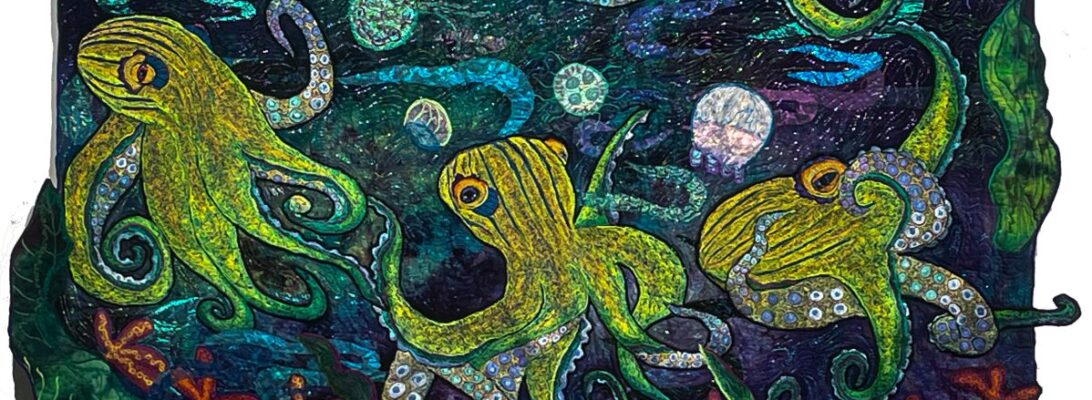
I’ve been working on the octopuses for around five months. There are seven in all, five finished. I’m pleased to say they make a good start for a show.

But I don’t want quilts that look like the same pieces, only in different colors.

What defines a work? Certainly subject matter. Certainly color. But textures also make pieces stand from with each other.

I’ve leaned heavily into oranges and blues on this collection, but I think there’s a good range of colors. The background is always the color of your sky, the mood of the piece, and its definition

The octopus’s garnet stitch texture connects the grouping.

Something more subtle separates them.

The stipple treatment establishes the movement of the water, but it also visually separates the pieces from each other.

Confession. Left to my own, I have three stipples I use. I really felt I needed to stretch a bit here, particularly because I want the quilts in this series to stand up as separate works.

Version 1.0.0

Leah Day’s book, 365 Free Motion Quilting Designs has become a go-to reference for me. I don’t feel a need to copy her designs, but it’s full of a lot of stimulating ideas. It’s one of the few books I store right by my machine. It’s a worthy resource. I turned to it for some different stipple ideas.

I almost never do straight lines in my work. I’m not very good at them. But I love the bubbles and stripes here. It’s almost like wallpaper for the quilt.

Here are details of the other quilts, showing the different stipples.

Leah’s book is a lovely springboard into other possibilities. It’s available on Amazon

So I went straight on one of them and survived. Maybe I can do straight lines.

The Big Black Line: More than Just an Outline

Every image has to be attached to a quilt at some point. There’s more than one way to accomplish that. But the one I use most is a solid black line of polyester zigzag embroidery.

That sounds dull, doesn’t it?

The black poly outline does more than you would suppose. It creates a crisp outline.

I’ve tried using other colors. Bright, light, neon colors. Nothing gives the same punch as black.

It’s not true of flowers. I can use a bright color outline on a flower that pops it perfectly.

The outline defines the edge visually. If you want it to show up across the room, you’d better make it bold. The outline is the finish line.

I’m just finishing outline octopus 4. One nurse shark is outlined. One is not.

But it does two more things. It makes the image puff just a little. I like the 3-D effect.

And it holds images down solidly. These embroideries wave around the edges like the flag on a windy day. A light line of stitching does not hold them down well enough.

I did not need to cut either the sharks or the octopuses, to get them to lie flat for this quilt. All of it was done with a heavy black outline. The thread traps the edges and mashes it into place.

I used to use black metallic thread to outline metallic images. But since that has to be done with metallic thread in the top, it’s an all-day sucker. Takes forever. Endless breakage. The polyester thread doesn’t have the same shine. But I only have so much hair I can pull out in one afternoon of sewing.

Doing the Twist: Designing Ways

I’m always astonished at how much an image can change with positioning. One of the advantages of component quilting is that it can be moved endlessly to get the placement right. I went to embroidering large images some while back. But I’ve learned several other things component quilting allows me to do, and I use it constantly now.

Changing Processes

Three changes in my process made this work: component quilting, pin-ups, and daily process photos. I work with components rather than images stitched into the work. I do multiple pin-ups for placement, and daily process photos that let me track the changes.

These are all relatively new for me. But it wasn’t something I planned. I just happened to find these processes helpful, and now do them regularly just in my studio work.

Component Batch Quilting

Batching a number of elements at once allows freedom later on in the project. Instead of just doing the larger images, almost all of the embroidery is on a separate sandwich, ready to cut out and use.

  • I’m free to change my mind about each element. If I embroider a moth in the piece, that’s where it stays. Right or wrong, it’s not going anywhere. You live with your choice. If the moth is separate, I can move it indefinitely.
  • I can make images from the same color choices that are in the same range but unique.
  • I can always use whatever is left over. There are never enough fish, frogs, bugs or birds.

So now, almost all my embroideries are made as components that can be used at will. For more information on batch quilting, check out Streamline Quilting with Component Techniques.

Pin-Ups

The first pin-up is where I design my quilt. Once I put the quilt top on a sandwich, I put my main images in, see where they might fit, to rearrange things.

But the first pin-up is only a beginning. In this case, I did my pin up, added my elementals, and pinned it back up with those included. My original intent was to have the octopus learing over the top kind of like Cthulu. But it was flat.

So I gave it a twist. To make something move, put it on the angle. I angled the octopus, to put him into motion. Then I angled the other elements to echo that motion.

Picture This. by Molly Bang, is the best book about composition. It’s about how people process imagery. First, she illustrates Red Riding Hood with rectangles and triangles. And she made it work.

But she explains how we see things, what meaning we take from images.

If you are an artist, run out and buy this book. Then buy another 5 copies, because you’ll want to give it to every artist you know.

She has some very useful observations. Horizontal lines are stable. Vertical lines are stable. Angled lines look like they’re falling. If they’re falling, they’re in motion.

I angled the octopus to echo the left jellyfish.

Then I angled the nurse sharks to echo the octopus.

Daily photography

Having daily process shots gives me so much information about what is and isn’t working in a piece.

Including a black and white picture to evaluate values.

I’m always surprised at how much a little twist can do.

Finished, Except that Nothing Really Ends

I have a very hard time when things finish. I’m an INFP for those who know Myers-Briggs. I’m happier with things left open, possibilities, choices, options. That moment when something is finished is joyous, but it’s also an end, a loss, as well as a win.

This could be an excuse for the large pile of unbacked and unbound quilts sitting by my machine.

.I have a friend I just heard is dying. One of those good and bad things about getting older is that we sometimes have thirty-year-old friendships. It’s like the world shuts a window that was a bright and different view.

I don’t know how to say goodbye to a friend from that long ago. He brought me wonderful art books helped me write and publish my first fiction writing, and took me to my first country dance. Wonderful gifts. I sent chocolate Haagen-Dazs, soup, and M&Ms. We bring whatever bits we have.

I hate watching things end. Even in art.

There’s an energy to art that might be its largest purpose. There is a connection between you and your art that wizzes around the room, even in the duller processes. I do believe art is alive. It has an energy of its own, and it communicates what should happen next. It is not your child. It’s a partner in co-creation. While you are making it, it’s remaking you.

There is a finish line, a moment where the last stitch is stitched. The energy stops swirling. There is an end. It’s wonderful, but something is lost.

But at that separation, something else happens. The connection between the art and the artist is cut like an umbilical cord. But art finds its own place. In someone else’s world or heart, it goes on to do other things for other folk. Art soothes people, riles them, teaches them, inspires them, but most of all, it changes them. If art is really good, it lives past you. Nothing really ends. It moves into the next space. Other challenges. Other purposes.

I’ve peppered this post with photos of the quilt I’m currently finishing. We’re stippling today. Almost done. It’s a good thing I have another quilt waiting in the wings.

Tax Sale

We got hit with an unexpected and awful tax bill. So all my quilts are on sale.

New, old, large, tiny quilts all available at the best prices.

I don’t ever want to ask for money. Instead, I offer you my very best work at my very best price. If you’ve wanted a quilt of mine, this is the time. I’m also open to offers.

Thanks!

https://www.etsy.com/shop/ellenanneeddy

Making Rocky Roads: Rocks Out of Cheesecloth

texturized pebbles

Once I find something that works, I tend to stick to it. A creature of habit, like anyone else. What pushes me out of the box? Mistakes! Misorder! An inability to find what I need! Basically, it takes a catastrophe. Fortunately, it doesn’t have to be a big catastrophe for it to do the job.

I really love using rocks in my work. They weigh a piece. They can form a visual line. They add a dark shadow or highlights depending on your color choices that frames the piece. They identify the bottom of a piece.

972 Shelter from the Storm unstitched rocks

I’ve used hand-dye for years for rocks. It already has that mottled texture and color. I used to soft edge the appliquĂ© so the edges weren’t as obvious, but I’ve come to like the shading I can do with black thread. Inner shading works better with a straight stitch. Outside edge works best with a thin zigzag top, and a heavier shaded bottom.

texturized rocks

I sat down and started cutting rocks for the Octopus surround and realized, I didn’t have enough rock fabric. I dye greys and browns specifically for rocks, But there is almost never enough. And greys and browns are regular backing colors I use all the time. But if you’re working on three quilts at once, that’s a lot of rocks.

They also need to be differing colors. Rocks are never all the same. That’s part of their charm. They need to fit well enough to be identified as rocks, but they need a separate individuality to work.

Earlier this year, I ordered a box of cheesecloth. I use dyed cheesecloth for leaves, flowers, and other translucent things. I bought a box of cheesecloth at Joann’s every year or so. That cheesecloth was a uniform open weave,

Now that Joann’s is gone, I found that cheesecloth is graded in sizes by the number of threads per inch. Makes sense. It’s how we class thread and fabric.

I overestimated and ended up with a much tighter weave of cheesecloth. At first, I thought it wasn’t a problem. Then I realized it was much less transparent and much more like regular cotton.

I’d dyed a batch that sat on my table for a long time. It lacked the same transparent grid of the lighter-weight cheesecloth, and didn’t do the texture of leaves as well.

When I went to clear the table, there it was, in about a dozen browns and greys.

So if I use cheesecloth for rocks, what changes? I have to choose a background that will show through. The weave will show through as a grid of sorts, but that can be pulled in different directions and stretched.

Normally, I stitch my rocks on black felt, because it gives me an edge that fits with the stitching. If it’s all backed in felt, it should work.

Interestingly enough, what changes is how the stitching looks. Straight stitching sinks into the texture of the cheesecloth and is less visible. But the cheesecloth makes it more textured.

I’m not sold on cheesecloth for rocks, but I think it works here. I can always stitch heavier.

One More Time: We Need Another Fish

Fall Waters the original quilt

Late last year I did a fish quilt that I thought was really successful. As an experiment, I took some of the same elements to see if I could make something that matched it in energy and beauty. Not copying. Just trying for the same feel. It failed. It laughed in my face.

This is not a new thing. I have piles like an archaeologist’s dig of pieces that didn’t work, tucked into the corner or another. And I raid those piles regularly, looking for the next thing.

Here is my failed experiment. I found it tucked in one of those piles. Could it work a different way?

first fish for fish rising

I blame the fish. He’s a nice fish. A little clueless. But not compelling.

New catfish

So we/re trying again. Same background. New fish. Something with more drama going on.

At that point, I abandoned the idea of using the same components. This quilt needs its its own water and world. I put in sun motes across the surface. I decided against small embroidered fish because I already had some wonderful ones rubbed into the fabric in gold.

Fish Rising, with a different fish

Once I added the new fish, I felt more assured. Full disclosure, I cut off the white tail ends since they made it look like Pac-Man. Much improved.

We’re not done yet. Lots of layers of stitching and sheers left to go. But it doesn’t feel like a loser anymore. My experiment was very useful. You really can’t step into the same piece of art twice.

Octopus Family Planning Two: The Pin Up Girls

You can blame this on three stinky days when I couldn’t get to the studio due to bad weather and hinky cars. I do not do well in captivity.

Usually, when I’m working on a piece, there’s a moment when I sit with 3-4 backgrounds, deciding which will work best. What I’ve found is that the background tells the story. The image is the who. But the background is the where, what, and when, Here’s a blog that talks about it. Telling the Story: The Background Changes Everything.

So I pin up backgrounds and move images from one to the other until I have the background that either shows up best or explains things better.

With three pieces in a display, that’s overwhelming. My arms aren’t that strong. So I’m going to use Photoshop and the art boards to interview my fabric choices. I don’t need to see the actual placement. I need to see how they go with each other. The octopuses are my pin-up girls and this is a virtual pin-up.

What am I looking for? What do I need my backgrounds to do?

  • They need to be 45″ tall
  • They need to match in intensity
  • They do not need to be blue
  • They need to flow into each other
  • They need to show off each octopus well
  • In the end, just like Highlander and Sudoku, there can be only one chosen for each octopus. There is no way of reproducing hand-dye.

I need to say this was not seamless. Photoshop seems to change every ten minutes, and I was not up to the latest artboard information. But it’s given me a chart to help me decide what works best.

I chose my fabric so I’m looking at 1 yard pieces, 36″x 45″. The edges will be irregular, so they don’t need to be exact.

My third octopus is not completely done and is only partially cut out. I don’t think that will make a big difference.

Here are some of my best choices.

This is a reasonable amount of pin-up. Once I’m back in the studio, I can put up the best choices and turn them in different ways. Strangely enough, the orange went with everything. I’ll put them up on the board and fussy-place them to settle it.

Would I have done this if Don hadn’t called a winter day off? Maybe not. The cats and dogs are way out of the way. That may have involved screaming at the computer. It was not simple. At one point Photoshop locked up and we had to give it the purge. No, I’m not kidding.

But it did give me a way to sort my tops all in one piece.

Why am I fussing? I’m planning on a layer of rubbed sea shells and pebbles on the bottom of each. I’ll get one crack for each to get it right. Testing out my options just seems smart.

Planning a Surround: Family Planning for Octopuses

I’ve been noodling around the idea of a series planned as a surround. I’ve done many series over the years, but this is different.

I suppose you could plan a series. But I’ve never seen it happen. You do one quilt with a subject that is either so fun or compulsive that you do another five more. That’s an organic process that I enjoy. But it doesn’t lend itself to consistency.

These birds just happened. I love the shape of them, the bills and that crazy pink coloration. So I’ve made a number of roseated spoonbills.

We’re talking something different here. A surround has to be planned so that each piece flows into the other one. I can do that somewhat with the drawings. They need to flow across the different quilts into eachother. I can do that somewhat with background images. Rocks and seashells can make a pathway. I can also do that with small fish. I’m thinking of clownfish and something small and gold in color. That is the plan.

The coloration should be easy. The hand-dye needs to be all of the same intensity, and we’ll keep the octopuses bright. They should fitin with each other well.

The first octopus is embroidered and ready to place in background elements.

The second octopus is almost embroidered. I need to outline the suckers.

He’s already had a large change. Originally, I had one sucker tentacle closer to the head. It worked in the drawing but not in execution. So I cut it out, and moved it. I think it works better.

shell rubbings from another project

The next steps will be tricky. I plan to rub seashells into the fabric on the bottoms of all of these. They’ll need to fit into eachother. I’m not sure if I can display them all on one photo wall. But they need to dance across four pieces altogether. The last time I did something this large, I hung it off the back porch of my apartment building and walked down the alley to where I could see it as a whole. That was three homes ago. We’ll need to figure it out.

I’ll keep you posted as I work on this. I think it’s going to be a wild ride.