
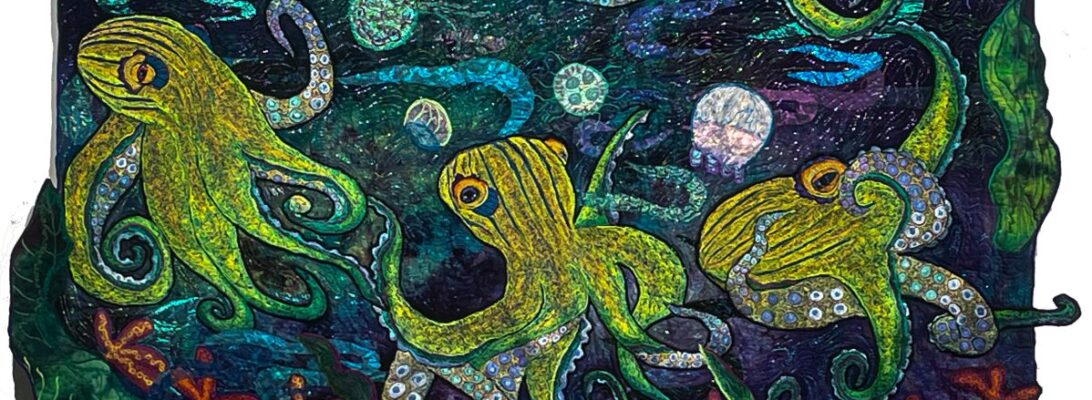

If you are making wild places you need weeds. And I’m always in search of a better way.
In my search for more rubbing plates, I’ve discovered I can make my own from stencils. Read Modeling past: All it needs is peperment flavor for more information. I did some experiments on the wave stitching earlier. Check out Making Waves: Stitching Waves into Water
What oil paint stick rubbing offers is something less defined by stitching. It offers the coloration and shape of the rubbing, but with a soft blur.By itself, it’s translucent. With stitchery, it’s more defined.
Meadows are wild. That blur reminds us that the meadow is its own quiet chaos.
I found wonderful stencils for weeds and made rubbing plates for them


I wanted browned dried weeds by the pond for this piece.


There are several concerns in working with stitched rubbings.
- A rubbed background gives a glow around the weeds. Stitching provides definition. You need to decide if you want just the glow, or the definition as well.
- It’s easier to stitch the whole background and add figures afterwards. It’s harder to stitch around the figures than to stitch the whole area first before applying the image. I stitched all across the weeds, knowing they’d be covered in places by the images.

I wanted a thicker line for the waves so I stitched them from the top with #40 weight embroidery thread, then stitched with #8 weight metallic from the back,
That was less successful. I think it was worth it this time. But it’s hard to stitch exactly into the line you stitched from the top.
Here’s the final pin-up for the piece.

Rubbings add a lot to a piece. But it’s tricky integrating the stitching into the surface. On this piece,I think we’re there.