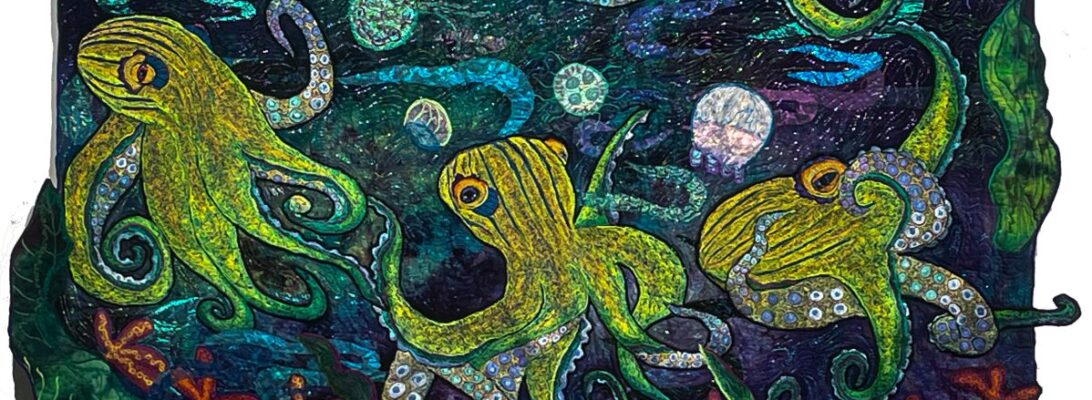
I didn’t have any shows this year. Which is ok. Every artist has ideas they aren’t quite sure how to approach. Instead, I spent a lot of time trying out ideas I wanted t do my quilts. That takes time and effort. It messes with production significantly. So I’m glad to have spent my studio time this last year in this way.
I learned how to make waterfalls.
There and Bacl Agaom
I learned how to make a reflection of my subject in water.
In the shell
I worked on seashells and tenacles.
B;lue Herons
I experimented with extreme borders.
I learned to make my own rubbing plates from stencils.
Three Cranes
I learned to incorporate those plates into my work.
I worked in desert landscapes.
I finally worked out the cat head fountain.
It’s been a good year for learning. If you’ve followed my blog, you know, because each week I show you what I’m working out, working on, and working through.
Here’s to 2025:
Major quilts
Small work
Unfinished work
I couldn’t do this without your support. Not necessarily monetarily, but spiritually, personally, and energetically. No art is in a vacuum. I suspect that I would do art if it were just me arranging deck chairs on the Titanic, but your company on this journey has made it much more worthwhile.
Last week I showed you my experiment recreating the elements of a piece I thought was particularly effective. At that point, it was speculative. You can read that at Again? Really. Yes. Really I’ve spent a week on it and here are my results.
I divided the parts into elements. Here are the elements I was working with.
The focal image
Hand dyed background
Oil paint stitck layer
Sheers layer’
Small elements
Background stipple.
What do these elements do?
The Focal Image is the answer to who. Ir creates the subject and focus of the piece.
The dyed background is the answer to where and when. It creates the light in the piece. It also defines the environment.
An oil paint rubbed layer is the texture of a piece. I don’t use it everywhere, but it gives a somewhat translucent surface without sharp edges. You can see the background, but it has shifted in color and appearance.
Sheers make another translucent shift across the surface. It transforms the background color and creates movement. Sheers have defined edges, but don’t have a visible thread edge.
Small elements can be used to establish a visual path. Flowers, rocks, leaves, bugs, birds and frogs can all point a direction through the piece.
Stippling changes the coloration of the surface. It creates dimension and defines light and dark.
I think I’ve failed on this piece. It’s not bad. It just isn’t as good. Why?
I’m reasonably sure of my background and my oil paint rubbing layer. The sheers can be dinked with.
I didn’t get to the small elements because I’m just not content with my drawing. These fish will add movement, but I don’t think they’ll help enough.
Oooops. Sometimes I don’t know until I get the piece embroidered. I drew other fish for this. This was the best of them, but it’s just not dramatic enough. I need a drama queen fish.
Here are the two drawings I rejected. I’ll save them for another piece another day.
I could push through. All the elements are there. But the experiment failed. I took similar elements, and they did not create the same energy.
I could blame it on the weaker drawing. That would be fair. But I suspect that the energy of the piece itself is different, and probably can’t be reproduced.
Will I throw it out? Heaven’s no! I can always use an extra fish. This one just doesn’t belong here.
So, as a rest, I’m back to octopuses. The fish piece is on the wall, aging like fine wine. It will find its time.
Fallow time seems to be an important part of the process as well. Repeating the same elements doesn’t always create the same energy. The parts just aren’t the sum of the whole.
I try really hard not to rate my pieces as I make them. I find that my opinions of things change over time, largely in reaction to people’s reactions. If I suspend my judgment of work, I find I learn more from it. Suspending judgment allows me to flesh out ideas and move on. Finish the quilt. Next quilt, please. The learning is the goal. The quilt is almost a byproduct.
But sometimes I do a piece that knocks my socks off and throws me across the room. It’s not an everyday thing. When that happens, I find myself asking some of the same questions that I ask when I do something I hate. What happened here? Why is this piece wonderful? Or awful? What?
Was it the color palette? Technique? Is it about my background? The image itself?
A fabulous piece makes you think, “Can I do this again? How did this happen?”
I love this piece so much. So I’m going to try not to reproduce it, but to focus on its successful elements.
Part of what I love here is the quiet palette. I normally go for eye-sore colors. This was restrained. Luckily, the last batch I dyed had a piece, not exactly in the same palette, but in the same tone.
The fish can be the same threads. And I think it needs to be.
I had trouble with the fish. I wanted a fresh image, not the same, but in the same colorations. So I started several fish, only to find them wrong. I love these. But in terms of direction and size, they’re just not right.
I went through my collection of drawings. My embroidery process uses a pattern drawn on Totally Stable that goes into the back of the piece as a pattern and a stabilizer. So each drawing is consumed by the embroidery itself.
Not to worry. For the last 3 years, I’ve saved a tracing of my drawings for later. It’s turned into a jumping-off point for other pieces, and I consider that collection a treasure. I found a fish that had to be at least 10 years old, which I don’t believe I ever used.
This will be reversed when I’m done. I’m half way through the embroidery.
Originally I used a tree rubbing plate both for the trees themselves and for the reflection in the pond.
And I want to explore the rubbed oil paint trees. This piece of fabric evokes a stream rather than a pond.
Now that I’ve analyzed my elements, we’ll see where it goes. It’s at that awkward spot where everything looks wrong. But that’s the exact moment to suspend judgment and push through.
It may take all those elements and work well. It may not. There’s a mystery here I don’t understand. But I think that part of it is that a piece is not the sum of its parts. Instead, perhaps it’s a whole being itself. Maybe it can’t be reworked with the same success.
Push on. Finish the quilt. Next quilt, please. The learning is the goal.
What oil paint stick rubbing offers is something less defined by stitching. It offers the coloration and shape of the rubbing, but with a soft blur.By itself, it’s translucent. With stitchery, it’s more defined.
Meadows are wild. That blur reminds us that the meadow is its own quiet chaos.
I found wonderful stencils for weeds and made rubbing plates for them
I wanted browned dried weeds by the pond for this piece.
There are several concerns in working with stitched rubbings.
A rubbed background gives a glow around the weeds. Stitching provides definition. You need to decide if you want just the glow, or the definition as well.
It’s easier to stitch the whole background and add figures afterwards. It’s harder to stitch around the figures than to stitch the whole area first before applying the image. I stitched all across the weeds, knowing they’d be covered in places by the images.
I wanted a thicker line for the waves so I stitched them from the top with #40 weight embroidery thread, then stitched with #8 weight metallic from the back,
That was less successful. I think it was worth it this time. But it’s hard to stitch exactly into the line you stitched from the top.
Here’s the final pin-up for the piece.
Rubbings add a lot to a piece. But it’s tricky integrating the stitching into the surface. On this piece,I think we’re there.
I’ve been working on this piece for a while. And then I’ve needed to let it sit.
Partially, I was waiting for weed stencils I could turn into rubbing plates. They came from Temu. and took forever. But I’m pleased with them. I want more, higher up on the right side.
Now we come to the tricky part. We have a blank space on the left hand side. You don’t have fish or frogs in surf. Maybe butterflies by the shore. I think rocks would be understated and wrong. What will I use to fill in?
Usually I know my options pretty well. I work a lot with grasslands and swamps, rivers, and ponds. Ocean shores, not so much. I’m not sure what is on the beach except for horseflies. Somehow, that’s not what I wanted.
Google didn’t help either. I looked up coastal insects and got lots of information about pest control. I was hoping for pretty pest control subjects. They did mention some pretty moths.
This is a moment I’m glad I’m a bibiloholic. I have in a series of books, Florida’s Fabulous insects. I have a terrible urge to use a lunar moth I already embroidered. IT worked pretty well. Moving moths could set the path for the eye through the quilt. When I looked it up, luna moths are down there.
So I drew out a series of luna moths. It’s more than this piece needs, but there is no such thing as a luna moth I won’t eventually use.
Design is a process. Solve one part of the puzzle, move to another part. Waiting is also part of the process. I find pieces grow into themselves rather than follow a design I had in mind.
I’ve spent a lot of time working with making rubbing plates. Here’s one of the reasons. There are ways to make waves out of sheers and lame, or stitchery, but I want that feeling of white foam and spray.
It’s pretty. But it lacks definition. I can approach this with thread and/or sheer applique. It’s also a test case for my cranes.
This is what I’m aiming for. I’d rather not make my mistakes here. I’m waiting on some beach grass stencils to finish off this top. But I’m still unclear how I want to treat my water.
The two pieces give me the opportunity to try different ideas and compair them. For Making Waves 1 I treated the white bits as different from the darker blues. I stitched it with 40 weight madiera metallic supertwist first. That was miserable. Sometimes Supertwist will work with a 90 topstitching needle and a lot of Sewer’s Aid. This wasn’t that time. I got about three stitches before breakage. That’s past my tolerance.
So I went to plan b
So instead. I stitched the white waves from the top with poly 40 weight. The stitching from the top marks the back Then I traced the stitching with #8 weight candlight, rainbow.
I like this a lot. I went back in after that and stitched the rest with matching poly 40#.
Making Waves 2 is my second possibility.I stitched the waves withpoly 40#. More subtle but I like it too.
I also tried two different approaches to my sheer overlays. For Making Waves 1
I used white and purple cheesecloth. I found it too clunky.
Making Waves 1 sheers with cheesecloth
I like this treatment better. Metallic lace and white organza just blends in better.
Making Waves 2 sheerswith fish d1
So to recap. I like the thick threaded Candelight on the waves, 40 weight polyester on the darker sea, and metallic lace and organza on the waves. What do you think? What would you choose?
Most quilters think in terms of one surface. You make a top. You quilt a top. It works for the traditional quilt.
It’s never worked for me. If you’re creating a natural world, one layer seems, well, flat. Layers change tones across a piece, build texture, create shading, and add elements that are present but not solid. They can be made from fabric layers, thread layers, and sheer layers.
I also have a layer of image embroidery which is a separate thing.
Hand dye is always my starting layer. Even now when it’s become a pain in the ass to dye, I still don’t want anyone’s fabric for my art but my own. It’s unique one piece to another and if you let it, it will tell you what to do. Who doesn’t need a leg up?
This last month I’ve added another possibility. I can have an oil paint stick rubbing layer that adds substance as well as texture.
Because I can make the rubbing plates I need. I’ve used rubbings for all kinds of things, but mostly, the commercia; plates are best for texture. Oil paint stick rubbing is not exactly transparent, but it does show the background through.
On this piece I wanted trees, water, and reflected trees. I wanted the actual trees to be more present, so I stitched them straight stitch with brown, black and blue.
The reflected trees and the water texture I simply let be. It feels, mirkier, wetter and more like water surface.
I have a beginning layer of sheer shapes for water under my fish.
After I’ve stitched down my fish, the second layer of sheers places them in the water.
A stippled thread layer of Madeiera Metallic colorizes the air portion and makes it shimmer.
A stipple layer of Sliver thread makes the water splash and shine.
Finally a layer of leaves defines the surface of the water.
My goal was to create three worlds, the pond, the surface and the air. I think I’ve got it.
Layers add texture, density and complexity to what I do.
I’ve been prepping for a show proposal for weeks now. While I was working through my machine woes, I couldn’t back and bind the larger quilts. Now that I have a functional 930, I could accomplish that.
Two years ago, I started this heron piece. I don’t know what I was thinking. It’s a heron drawing I found in my files. It was lovely. So I embroidered it and fit it into a quilt.
But it’s large. The word large is inadequate. It’s roughly 59″ x 59″ It’s larger than I’m tall.
Embroidering it wasn’t’ the problem. But after you add a back and a layer of felt, you have a lump. A very large lump.
So it sat the corner. And I became afraid of it. I made a myth of it. It was too large. It wouldn’t fit through the machine. My arms aren’t as strong as they used to be.
I had a friend ask if I could make it work if I cut it up in some way. That shook me loose. It wasn’t a bad quilt, or even a failed quilt. It was just too big. And I was being a coward.
After that I went hunting my big girl panties.
All of those things are true. It’s too large, it did not fit prettily into the machine. I had to jam it under the machine head. And my arms may be less strong, but my will..? Never doubt my will. No one can tell me no but me.
There’s no can’t like won’t, Sometimes we build myths about our work. “It’s so good.” “It’s no good.” “It will never lie flat” Almost all of that is irrelevant. I won’t know i it’s good for some while after I finish it. I need to stop the negativity and just step into the task. It was backed, quilted and bound in 3 days.
Here’s the details on Great Blue
Here are the other quilts I’ve set up for my proposal. I think the heron’s really necessary. Big girl panties and all. Wish me luck.
Willow MarchEgretBlue FishOctopi ReelBsvkyard ConversationWaterfallBlue PondSnake in the GrassIn the ShellBig FishWaterfall
I finished three quilts this week. That felt great but I always have a kind of wobbly moment when a project is done. With the machine troubles, I wasn’t able to back or bind things easily, so it waited. I had 6 quilts backed up, ready to bind. I have three done, three left to bind.
After you finish, you look around the studio and try to figure out what’s next. In this case, a whole lot more binding. It’s not encouraging.
In Myers-Briggs speech, I’m an INFP. The P stands for perceptive. The N for intuitive. What that means is that I don’t like finishing.
When I start a piece of art, it’s truly a part of me. It comes out and is connected to each day in the studio.
But as it grows, it develops a life of it’s own. There are things that quilt will demand. Some of which aren’t what you normally do. So you separate slowly, as the work finishes.
When it’s finished, it’s itself. It has it’s own destiny. It will do what it’s supposed to do. And I desperately need another piece to fill the void.
I suppose it’s separation anxiety.
I’m very anxious when I finish work. I don’t know what to do with myself until I start something new. The process itself is how I live and breathe. One quilt flows into another. One piece suggests something else that has to be tried.
Lucky me, I have three more quilts to back and bind. It’s not my favorite part. By the time I’ve finished that, I’m done. And part of me longs to be off with another piece, figuring out its background and thread colors.
But there is something wonderful that happens when a top becomes a quilt.
It feels finished. It feels complete. It’s ready to be shown and shared. It’s a finished chapter.
It leaves a hole.
I’ve been riding a I need to take my new work, this new wind and use it to safe a place for my work. Besides, it makes me crazy not to show it off. It has a life of it’s own. That life shouldn’t be just the closet.
So I’ll grind through bindings, and flip through books until the next thing grabs me by the neck and must be made.
The embroidery makes me happiest. After all, it’s color therapy in thread.
I’ve randomly added pics of the finished quilts. They are up and for sale on Etsy
This article has good information about the Myers-Briggs personality types. It’s a helpful way at looking at how others view their worlds.