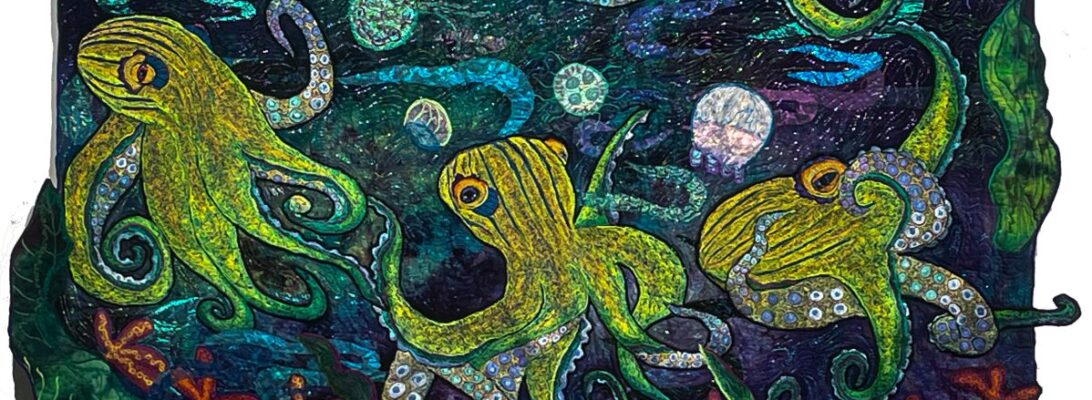
Step-by-Step Guide to Using Color Theory for Thread Art

Outline, dark base, shader, and the beginning of the blue range

The nice thing about color theory is that it works across all kinds of media. What changes isn’t the color theory, but the way the media is applied.

Color theory for thread is different only in the fact that you really don’t mix colors. Instead, you lie them next to each other, and your eye mixes them.

These nurse sharks are part of my octopus garden. I don’t have their octopus stitched yet, but they were compelling. I love the spiky shapes. They will have orange-yellow stripes. I’m not quite there yet. Right now, I want them round and shaded, with a clear indication of which side is up. I need smooth color for that.

Smooth color creates a color range.

The formula for it is

  • A dark base color
  • A dark complementary color as a shader
  • A range of colors in the base family
  • A bright color as a shocker
  • A lighter or brighter shade of the base color to finish.
  • If the subject is too large, I can zone the areas of the image and repeat the formula in a set of lighter or darker shades.
  • I usually work light to dark. The last color will be the most prevalent, so keep that in mind. Sometimes with fish or frog bellies, I color the dark to middle section, add the lightest color on the other edge, and work in my darker colors, so the tummies aren’t so blatant.
Green as a shocker

I chose green as my shocker color. Usually, I would have used either the blue or purple complement, but orange is so strident. I will use yellow for the stripes, but I think I’ll brown them out so they don’t scream at me.

It takes a fair amount of courage to add the shocker. The shader layer makes visual sense. The shocker layer screams at you. There’s a terrible urge to rip it out immediately. But it quiets down once you put the next layer of the base color. And the color is smooth without being bland. The shocker is an electric spark in a range of smooth, quiet color.

It’s time consuming, but I love the base colors. Between the shocker and the shader, the color has a splash of excitement, but creates a flow color base.

What will they look like with yellow-orange stripes? I expect they’ll be quite jazzed up. I’ll show you next week.

A Series of Lessons

Over the last couple of months, I’ve been working on a series of fish in the waters. This is an important symbol for me. It explores surviving strange waters, rising out of the depths, swimming with the current, and swimming against the current. It’s about flowing water and changes. It really checks all my boxes. It also serves as a connection with my father, whose religion was bass fishing. Since going fishing made better people than going to church, I respect it deeply, even if I won’t eat fish. I live in water.

So I noodle at the fish-in-the-water image often. If you’ve been following the blog, you know I made one quilt I loved, and I wanted to see whether I could recreate the energy. Not the fish or the river, but the energy of the piece.

Epic fail. I made a very nice other piece with similar hand dye, a fish I drew 5 times before I was pleased, and similar oil paint stick rubbing for the forest in the background. I hated the first fish I embroidered. I stitched a more active catfish, that was better.

Then I took a break and went to find the studio floor. Again. Everything flutters to the floor except the things that go clunk.

There it was, the best background for the embroidered fish I rejected. The fabric made a vortex, so I did too, out of stitching a swirl of sheers.

I didn’t learn anything technical from the exercise. But I did confirm what I already knew. It does me no good to recreate something. Another piece will need different components and approaches. I didn’t need to be making arbitrary rules for myself. I needed to listen to each piece to give it what it needs. If I thought I was in control, that was delusional.

Maybe this is a right-brain, left-brain thing. I’ve been struggling to organize both in the house and the studio. That’s a very left side of the brain thing to do. It’s foreign thinking, but it’s less grim than Swedish Death Cleaning. You know what? No one ever did teach me this. Certainly not my mother.But that shouldn’t stop me. If you don’t know how, you can learn.

So cleaning does turn into art. Eventually.

As Don says, “I’m a man. I can change. If I have to. I guess.”

I can too. If I have to, I guess.

Of course, I hung the quilt up and noticed that the wonderful spiral stitching in the center is unnoticeable 3 feet away. Small flowers and thick thread to the rescue. Of course, the pond has floating flowers.

The change isn’t a technique or a new technology, really. The change is learning to listen better.

Angling for Fish: The Short and Long of It

Last week has been spent in fish production. I can’t really put in the octopuses until I have the fish to create the path around them.

Usually, fish have scales, and the scales divide the space..You progress from scale to scale, picking lighter colors as you get to the underbelly. You fill in the scales darker on top and progressing through lighter colors around the belly. It’s pretty. It gives depth.

What if you don’t divide the space? You can stitch row after row of color next to each other. It looks stripy. There’s a place for that, but it’s not very natural.

It doesn’t work for clown fish.They blend from one color through another without separation.

So how do you fill in a larger space? One way is the short and long stitch.

You need to understand that none of this is a stitch on your machine. It’s all zigzag stitching. The change is the angle in which your fabric goes through the machine.

The long and short stitch is done from side to side. The difference that it spreads from both sides and fills in unevenly, shading the area softly and without stripes. The top and bottom of the image has a solid line to outline.

That kind of shading allows us to put in darker contrast colors to shade that blend right in. These fish are shaded with a dark and then a lighter purple. Since the colors are mostly covered with orange thread, your eye blends them into a shaded solid orange.

All of this is for the octopus’s garden. This is my second pin-up. I think it needs one pillar rock and some water, but it’s ready to back, and stitch.

For more information about the long short stitch, check out The Long and Short of It Blending Stitches with the Long Stitch

Woman Proposes, Art Laughs

A while back I decided to see if I could recreate the energy from a piece I was particularly pleased with. If you’ve been following the blog, I’ve documented it as I’ve worked.

I wouldn’t call it a success. I went through three separate fish, not happy with any of them. I embroidered the best of them and still felt bland.

So I passed on the bass and did a catfish, which I’m not displeased with. The bass went back into the pile.

I can plan all I want. There’s a serendipity to art that is inescapable. While I was scraping out the studio, I found a piece of fabric I’d totally forgotten about.

All of a sudden, my wallflower fish had gone dramatic. I built him a whirlpool/vortex.

My fish fooled me again. I spent some time embroidering some nice metallic minnows that shyly blended right into the background.

They are pretty, but they have no punch.

So I’m trying these brighter gold minnows. I’m still not sure. They’re embroidered from poly, and they might stand out too much. I may need to do some from metallic gold.

I’m in charge. Right.

One More Time: We Need Another Fish

Fall Waters the original quilt

Late last year I did a fish quilt that I thought was really successful. As an experiment, I took some of the same elements to see if I could make something that matched it in energy and beauty. Not copying. Just trying for the same feel. It failed. It laughed in my face.

This is not a new thing. I have piles like an archaeologist’s dig of pieces that didn’t work, tucked into the corner or another. And I raid those piles regularly, looking for the next thing.

Here is my failed experiment. I found it tucked in one of those piles. Could it work a different way?

first fish for fish rising

I blame the fish. He’s a nice fish. A little clueless. But not compelling.

New catfish

So we/re trying again. Same background. New fish. Something with more drama going on.

At that point, I abandoned the idea of using the same components. This quilt needs its its own water and world. I put in sun motes across the surface. I decided against small embroidered fish because I already had some wonderful ones rubbed into the fabric in gold.

Fish Rising, with a different fish

Once I added the new fish, I felt more assured. Full disclosure, I cut off the white tail ends since they made it look like Pac-Man. Much improved.

We’re not done yet. Lots of layers of stitching and sheers left to go. But it doesn’t feel like a loser anymore. My experiment was very useful. You really can’t step into the same piece of art twice.

Building An Ocean Floor: Seashells and Pebbles

I’ve been working for some time on my octopuses, and I’ve begun to build up backgrounds. I’m working on three of them simultaneously. It’s complicated. But if I work one piece at a time, changes in construction creep in. It’s almost unconscious. I may have worked the water a different way, or the rocks are different, and won’t fit in. This way, I’ll have three pieces that flow into eachother seamlessly.

This week I worked on seashells and jellyfish. I’ve been collecting stencils ( there are no commercial seashell rubbing plates I know of) to make rubbing plates. I used foam board for a base, and modeling paste to make rubbing plates of the stencils. You’ll find full instructions for this in Modeling Paste: All it Needs Is Peppermint Flavor

I used this rock backsplash I got from Lowes to make the pebbles.

This is one of the backgrounds I chose for the octopuses. I’m still not sure about Octopus 1. I’m tending towards the green-blue background. I wanted seashells and pebbles on the sea floor, and jellyfish floating above. I found I couldn’t place them correctly all at once. I put in the shells, then the jellyfish and finally the pebbles.

It’s a work in process. I’m waiting for them to dry to get the next photos and then we’ll add what’s needed. I think today will be cloudy with a chance of fish drawings.

2025: A Year of Experimentation

I didn’t have any shows this year. Which is ok. Every artist has ideas they aren’t quite sure how to approach. Instead, I spent a lot of time trying out ideas I wanted t do my quilts. That takes time and effort. It messes with production significantly. So I’m glad to have spent my studio time this last year in this way.

I learned how to make waterfalls.

I learned how to make a reflection of my subject in water.

I worked on seashells and tenacles.

I experimented with extreme borders.

I learned to make my own rubbing plates from stencils.

I learned to incorporate those plates into my work.

I worked in desert landscapes.

I finally worked out the cat head fountain.

It’s been a good year for learning. If you’ve followed my blog, you know, because each week I show you what I’m working out, working on, and working through.

Here’s to 2025:

Major quilts

Small work

Unfinished work

I couldn’t do this without your support. Not necessarily monetarily, but spiritually, personally, and energetically. No art is in a vacuum. I suspect that I would do art if it were just me arranging deck chairs on the Titanic, but your company on this journey has made it much more worthwhile.

Thank you!

Again? Really? Yes. Really.

I try really hard not to rate my pieces as I make them. I find that my opinions of things change over time, largely in reaction to people’s reactions. If I suspend my judgment of work, I find I learn more from it. Suspending judgment allows me to flesh out ideas and move on. Finish the quilt. Next quilt, please. The learning is the goal. The quilt is almost a byproduct.

But sometimes I do a piece that knocks my socks off and throws me across the room. It’s not an everyday thing. When that happens, I find myself asking some of the same questions that I ask when I do something I hate. What happened here? Why is this piece wonderful? Or awful? What?

Was it the color palette? Technique? Is it about my background? The image itself?

A fabulous piece makes you think, “Can I do this again? How did this happen?”

I love this piece so much. So I’m going to try not to reproduce it, but to focus on its successful elements.

Part of what I love here is the quiet palette. I normally go for eye-sore colors. This was restrained. Luckily, the last batch I dyed had a piece, not exactly in the same palette, but in the same tone.

The fish can be the same threads. And I think it needs to be.

I had trouble with the fish. I wanted a fresh image, not the same, but in the same colorations. So I started several fish, only to find them wrong. I love these. But in terms of direction and size, they’re just not right.

I went through my collection of drawings. My embroidery process uses a pattern drawn on Totally Stable that goes into the back of the piece as a pattern and a stabilizer. So each drawing is consumed by the embroidery itself.

Not to worry. For the last 3 years, I’ve saved a tracing of my drawings for later. It’s turned into a jumping-off point for other pieces, and I consider that collection a treasure. I found a fish that had to be at least 10 years old, which I don’t believe I ever used.

This will be reversed when I’m done. I’m half way through the embroidery.

Originally I used a tree rubbing plate both for the trees themselves and for the reflection in the pond.

And I want to explore the rubbed oil paint trees. This piece of fabric evokes a stream rather than a pond.

Now that I’ve analyzed my elements, we’ll see where it goes. It’s at that awkward spot where everything looks wrong. But that’s the exact moment to suspend judgment and push through.

It may take all those elements and work well. It may not. There’s a mystery here I don’t understand. But I think that part of it is that a piece is not the sum of its parts. Instead, perhaps it’s a whole being itself. Maybe it can’t be reworked with the same success.

Push on. Finish the quilt. Next quilt, please. The learning is the goal.

A Great Frame up: Centering a Design with a Frame

One of the things that’s hard about a circular image is that it doesn’t move very easily. As a design. Circles lie like a lump unless you put them in a row or on a path.

I love this octopus in a shell, but it was static. There are several ways to create motion in a piece. Creating a visual path with rocks or shells would have worked. But I wanted something showier.

The best piece of fabric I had was a half-yard of blue hand-dye. But the shell didn’t fill it up. I could cut it to fit the shell. But a square wouldn’t work

So I decided to make a frame. But a rectangle was no better. There’s nothing square about an octopus. They flow with the ocean tide. They exude curves.

So if I wasn’t going to put the octopus in a rectangle or a square of some kind.

I needed to apply a different aesthetic. When you need design help, go look at great art. They knew what they were doing.

I’m a huge fan of Art Nouveau.

“Art Nouveau is …known for its flowing, organic shapes, curved lines, and reliance on natural motifs like flowers and plants. The movement aimed to unify all artistic disciplines, creating a holistic design experience.” Wikipedia

Art Nouveau has always made my heart beat faster. Natural organic forms that flow in movement, are based on the oriental concept of the visual path and movement make perfect sense to me.

I hadn’t seen an Art Nouveau octopus before. Japanese art is full of them. But tentacles would make a marvelous frame.

One thing about octopuses is that you don’t always see all of them. They hide, they move, they twist in the water. They don’t stay in one place while you take their picture. So I made three tentacles of another octopus, encircling the one in the shell.

Besides, the tentacles interact with the rest of the water and the jellyfish.

This is all pinned up and ready to stitch. I hope none of it splashes into the studio.

Not every frame is a box. A frame centers your design, accentuates it, and interacts with it. It is there to put the subject in the center of attention. Who says you have to be square?