


What is that weird fabric in your sash?
For years now, I’ve kept a stash of sheers and lace. It’s essential for my work. It’s one of the reasons I’m really mourning the loss of Joann’s. I use several techniques to create elementals in my work.

What’s an elemental?
An elemental is something see-through or transparent in a piece: water, air, sunlight, fire, and mist are elements you can see. They usually don’t have a hard edge. Layers of sheers make a translucent element that creates that effect. It shifts the background either in color or texture.

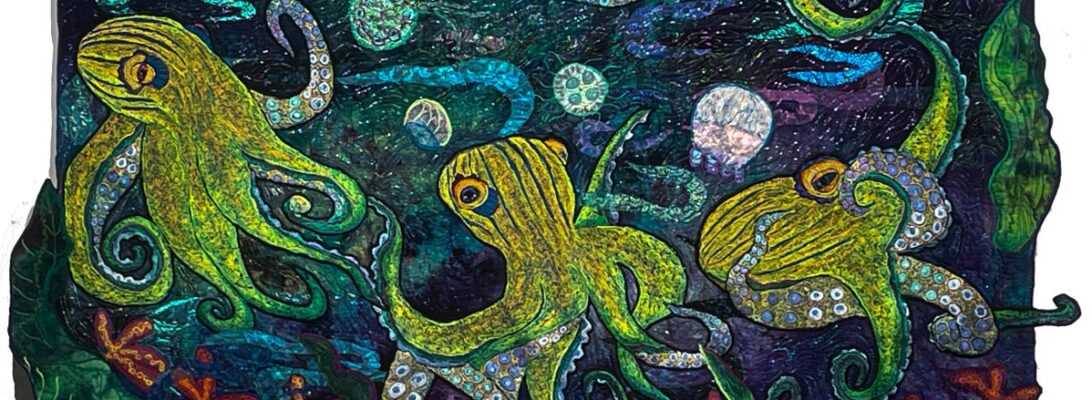
Lately I’ve been using oil paint stick rubbing as well. It’s a very different process, but it serves the same purpose. The background shines through, but the rubbing gives a soft edge of paint, defining the details.
I’ve been using both to stretch my ability to show something that’s essentially ephemeral. I can overstitch them if I want them more defined.
How do you build in layers?
My first layer is always hand-dye cotton. It has its own story in the dyeing. Light source hand-dye gives the best background with the story already written in. But where I want to build something not solid, I turn to layers.

The paint stick layers almost have to go first. That’s somewhat scary for a large piece because there’s no way to remove them. You need to get it right at the first pass or you need another background. Choose your rubbing plate, and anchor it to the table. Use spray glue to anchor your fabric. Remove the edge film on your oil paint stick and rub away. Let it dry for several days and iron it to make it permanent. I could do the waves just in stitchery. But the oil paint stick rubbing pops it off the surface.
In contrast, you can plan sheers and rearrange them indefinitely. I use Steam-a-Seam 2 as my fusible. It has two pieces of release paper and a glue layer in the center. It pats onto my fabric. I cut my shapes and then peel off the release paper. I can place and replace them anywhere until I iron them down.
What does that buy me?
Elements that still allow me to see the background but shift color and texture. I have water, waves and weeds, all of which are very visible without overwhelming or hiding the background.


Elementals are a big part of my work. So much of nature is in layers, peeking out from each other.
For your information, if you’ve been enjoying this blog and finding it through Facebook, I may not be able to supply a link on Facebook anymore. Their rules have changed. Please subscribe to the blog and/or join my Patreon page so you won’t miss a post. Both are free. I post the blog every Sunday, and post 3 times a week on Patreon: Show Off Saturday, Technical Tuesday, and Art Attack Thursday. I’ll continue to post in Facebook, but I may not be able to supply links to those other pages. See you there.


