
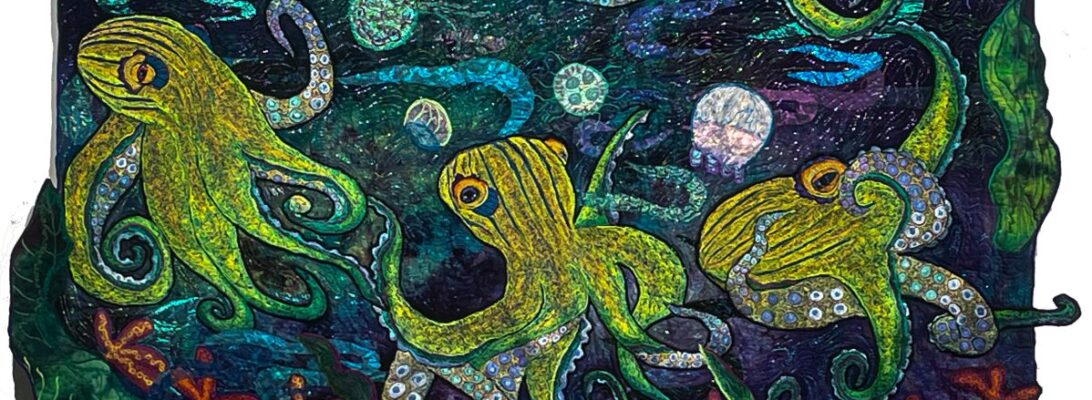

I’ve been a long time follower of the visual path. Our eye travels through a piece of art and makes its own journey. We can build that visual path with our objects and their placement.
A good visual path
- should welcome you into that world,
- should give you a good tour, covering the surface of the piece.
- should graciously show you the way out.
- should breathe.
But part of that pathway is perception. How does the structure of the design direct us to travel on that path? Where do we start?
There are some other good questions as well. What makes an entry point? How do we travel? Are we released from the piece at some point? Or does it try to make us stay focused within the piece?
I’ve begun to think about how we enter a piece when we see it. Where does the eye start? Does it make a difference? Being a good dyslexic, I always thought it didn’t, but I’m thinking I was wrong.
As Westerners, we read left to right. So do we enter a project visually from the left and travel over to the right hand side? And what does that do within the language of the piece? What does that positioning tell us?
Handedness is pretty hardwired, but some of it is cultural. We can see an image either from either left or right like flipping a slide. But how do we normally process that?
What matters is what we see first. Where does it direct us to look?
If it faces directly in front of us, that sort of stops the motion right there. We are where we are.
If the subject is facing us, headed left, we see it as the main object.
If the piece is standing facing from left to right, we see it as a main object, but we also see what it is focused on.
The entry point is either a spot that focus us for being open, or for grabbing our attention.
For our purposes, the red arrow is the entry point and the yellow arrows point out the path.


The entry point here is the from the view of our subjects. Everything carries them along in their quest. The movement is all left to right.


The bird is our entry point. We see what she sees. She’s focused on a pond beneath here.The rocks circle the pond, defining it, but also drawing our eye around it.


Our entry point leads us straight to the mocking bird facing left. . Her glance takes us around the piece following the lizards.
This is just a theory so far. I’m curious what you think about it. How does the facing of the subject change the story of the piece. What is the structural language? What are we saying?


So this is drawn with the eyes facing left. When it’s embroidered, it will be flipped horizontally and it will face to the right. We’ll be in a position to see the world as the fish does.
I’m not sure about this yet. It’s a theory. I’m curious to see what you think as well.
For more information about visual paths, check out It’s the Little Things Building a Visual Path
In these examples I’d say the largest thing catches my eye and indeed, if it is a thing looking a certain direction, then my eye tends to wander that direction too. Thinking back to viewing more traditional quilts, the eye is often directed dead center (and again where the largest design element often is). Then where to go? I was told a long time ago that most people tend to look at the top left corner closely after the initial overall viewing so quilt that area last when you are thoroughly warmed up and making few if any mistakes. I think I tend to do a back and forth viewing, moving from the left top corner right, then down across to the left, then down and back to the right etc., then do another overall viewing. Don’t know if any of this helps.
It does. Thank you!